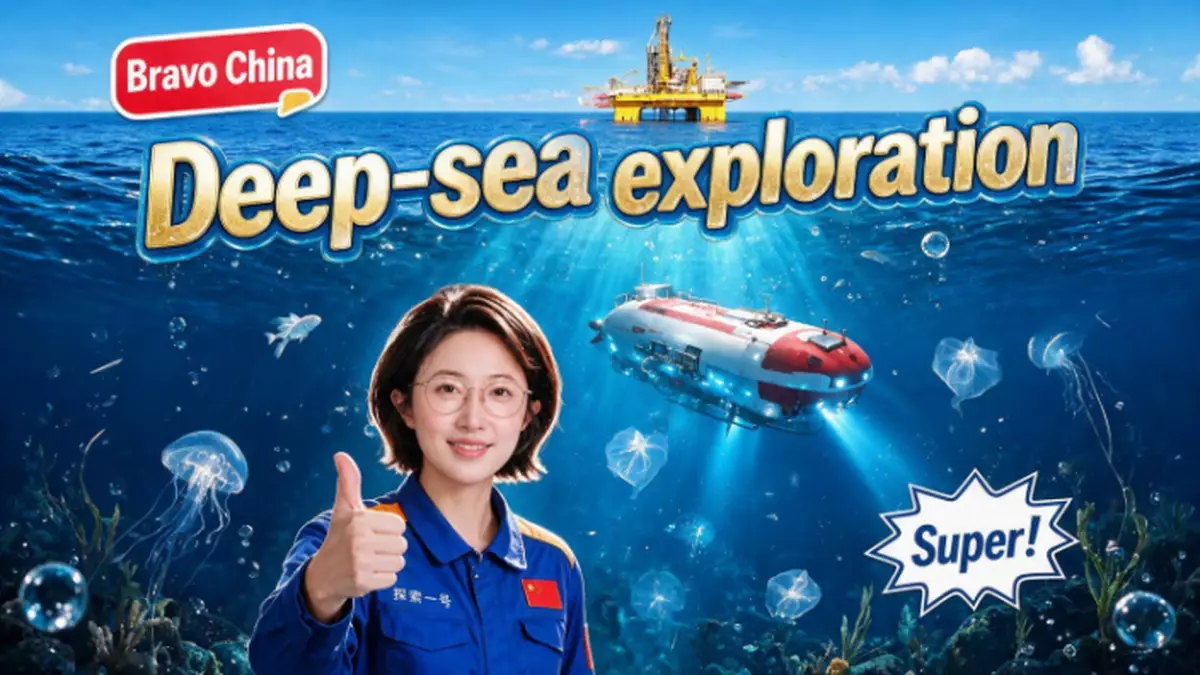
71% of Earth's surface is ocean, yet we have explored less than 5% of it. At ten thousand meters down, a manned deep-sea submersible must withstand pressure equal to 2,000 adult African elephants standing on one person's back.
Starting with the ‘Jiaolong’, China has independently developed manned deep-sea submersibles. In 2020, the ‘Fendouzhe’ successfully dove to nearly 11,000 meters —the deepest trench on Earth—equivalent to 23 ICC towers stacked up.
Chinese scientists have made many dives, bringing back samples of combustible ice, minerals, and hadal fauna—all vital to China's energy and resource security. Combustible ice, a natural gas hydrate formed under deep-sea pressure, offers vast reserves and a new option for future clean energy. In 2017, China set a world record in the South China Sea: 60 consecutive days of gas production from combustible ice. Young scientist Mengran Du found the deepest animal ecosystems on Earth and was named one of Nature’s 10 in 2025.
China is now building the world's first deep-sea space station. Once completed in 2030, scientists can stay long-term at a depth of 2,000 meters, conducting systematic research to support future combustible ice extraction in a more environmentally friendly way.
From outer space to the deep sea, China blazes a trail for sustainable development and charts a course for humanity's future.
Amid turbulent waves of the vast Yellow River, China has earmarked a mega project beneath its muddy riverbed to divert clear Yangtze River water from the south to Beijing and other northern cities, which lack water resources. This is the Crossing-Yellow River Project, the critical passage of the South-to-North Water Diversion Project.
In China, nearly half of its population and many of its industrial bases sit in the north, yet about 80% of the country's water resources lie in the south. Two decades ago, Beijing was one of the world's most water-starved megacities; its groundwater was all but pumped dry.
So the country decided to channel clean water from the south to the north. Before reaching Beijing, that water must cross the Yellow River. How to prevent the muddy river from contaminating the clear water?
Engineers drove a tunnel beneath the 4-kilometer-wide riverbed. Tunnel boring machines excavated while grouting stabilized the ground to prevent collapse, and a pioneering double-lining structure - an outer layer to resist the pressure of the riverbed, an inner layer to contain the diverted water, and a drainage layer between them to carry away seepage. The entire tunnel took over eight years to complete.
Today, two-thirds of Beijing's drinking water comes from this diverted supply. In 13 years, the whole Project has delivered water equivalent to 6,400 West Lakes, benefiting nearly 200 million people.
With one steady, clean artery, China safeguards resource security, and protects the well-being of millions of households.