Beijing is exploring smarter approaches for urban governance in its pioneer E-Twon by leveraging AI, robotics, and big data to support city management and serve residents.
The Beijing Economic-Technological Development Area, better known as Beijing E-Town, is a digital intelligence hub for cloud computing, big data, and AI innovation. As part of the city's push for smarter urban governance, E-Town is extending high-tech services into the fine details of daily life.
Security patrol officer Yan Yunxiang is tasked with regularly checking how streets in E-Town are used by vehicles and bikes to ensure smooth and safe traffic. His workload has been eased by a new colleague: a smart inspector that operates 24/7.
Being able to handle tasks ranging from daily patrol to emergency response, the inspector can alarm human officers when any irregularity and misbehaver is detected and provide timely support to patrol officers nearby.
"The help lies in its convenience and efficiency. With the inspector patrolling the street, we receive reminders on our app the moment it detects any problem," Yan said.
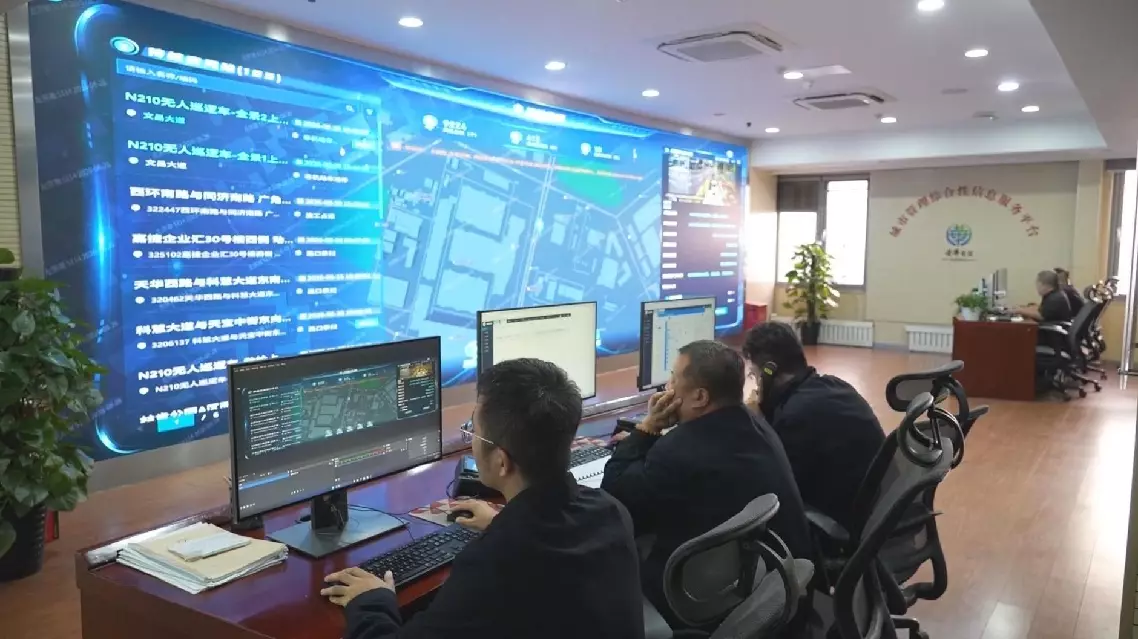
Twenty AI-powered unmanned patrol vehicles have been deployed in the area so far. Using information gathered across E-Town, a behind-the-scenes large-model platform can warn officers of ongoing or potential risks, enabling more comprehensive and scheduled dispatching.
"In our daily work, we pay attention to whether any new risks have emerged on the platform. If a new risk does emerge, we will make a judgment," said Sun Fei, an officer at the Citizen Complaint Handling Center in E-Town's Ronghua Subdistrict.
With round-the-clock monitoring and centralized management, it stays alert at all times, safeguarding the streets with high-tech-powered precision and speed.
"The platform is technological and intelligent. It captures risk points on the street through algorithms based on large models and big data," said Liu Xiang, an officer at the Office of Urban Management in Ronghua Subdistrict.
Beyond pavement management, E-Town is also bringing robots into eldercare.
At a local public eldercare facility in Ronghua Subdistrict, managers have designed a crossover of a community center, a tech showroom, and a nursing home, bringing fun and convenience to a neighborhood where more than a quarter of residents are over 60.
Zhuang Lei, an 80-year-old resident, said he visits the facility at least twice a week, not only for meals but also for AI health checks.
"After inputting personal information and scanning facial recognition, the results are generated automatically," he said.
In addition to cooking and healthcare, robots have been deployed across the building for more services to benefit the elderly which also helps robot designers upgrade their products as well.
"After providing services at the facility, we collect opinions and suggestions from the elderly and feed them back to robot manufacturers," said Zhang Li, director of the Office of Livelihood Security in Ronghua Subdistrict.
AI patrols, service robots make urban governance in Beijing's E-Town smarter