Skip to Content Facebook Feature Image

Trilliant Health Releases Its 2026 Trends Shaping the Health Economy Report

Business

Trilliant Health Releases Its 2026 Trends Shaping the Health Economy Report
Business

Business

Trilliant Health Releases Its 2026 Trends Shaping the Health Economy Report

2026-10-06 18:03 Last Updated At:18:10

BRENTWOOD, Tenn.--(BUSINESS WIRE)--Oct 6, 2026--

Trilliant Health, the healthcare industry’s leading analytics firm, today released its 2026 Trends Shaping the Health Economy Report, which examines how individually rational decisions across the health economy compound into collective failure.

This press release features multimedia. View the full release here: https://www.businesswire.com/news/home/20261006830657/en/

“The U.S. health economy is a textbook tragedy of the commons,” said Trilliant Health’s Chief Research Officer Allison Oakes, Ph.D. “Every stakeholder is incentivized to maximize its own revenue, and the predictable result is a healthcare system that delivers disproportionately little health for what it costs.”

The report examines this pattern across six trends, supported by hundreds of data stories drawn from Trilliant Health’s proprietary claims database, price transparency data and Provider Directory, alongside government and industry sources:

The U.S. healthcare “system” does not function as a system. The U.S. has never resolved three foundational questions: what is healthcare, who is entitled to it and who is obligated to pay? The lack of shared purpose impacts how care is financed, delivered and evaluated.

Population unwellness is a collective failure that the “system” is not designed to address. Poor diet, physical inactivity and social isolation are producing an increasingly unwell population, yet healthcare incentives remain focused on treating illness after it develops rather than preventing it.

The disconnect between demand and supply is a market failure. Utilization has remained relatively flat even as disease burden has increased, reflecting supply that is both constrained and misaligned with the needs of an increasingly unhealthy population.

Value is not incentivized; therefore, it is not measured or managed. The healthcare system generates enormous quantities of activity without a coherent framework for determining whether that activity produces any measurable health benefit.

Misaligned incentives manifest in systemic fraud, waste and abuse. Every policy built to constrain American healthcare – site-of-service reimbursement differences, medical loss ratios, certificate of need laws, traditional fee-for-service reimbursement – has produced a workaround that is individually rational and collectively destructive.

Stakeholders fail to understand the health economy is a negative-sum game at their peril. The financial model of the U.S. healthcare system has long rested on a simple premise: more procedures, more patients, more revenue. New medications and shifts in settings of care are challenging this long-held belief.

“American consumers seek value for money in almost every economic transaction, including healthcare, but health economy stakeholders are not delivering it,” said Hal Andrews, Chief Executive Officer of Trilliant Health. “Nature abhors a vacuum, and Federal and state government officials have concluded that price controls are the only way to control healthcare prices. Unless health economy stakeholders begin to act in the interest of the commons, they should expect to be increasingly constrained by outside forces.”

Read the report: https://www.trillianthealth.com/market-research/reports/2026-health-economy-trends

About Trilliant Health

Trilliant Health’s analytics platform provides a comprehensive view of healthcare supply, demand and yield across local markets. Recognizing that every American is affected by the health economy, its mission is to redefine evidence-based strategy while optimizing return on invested capital.
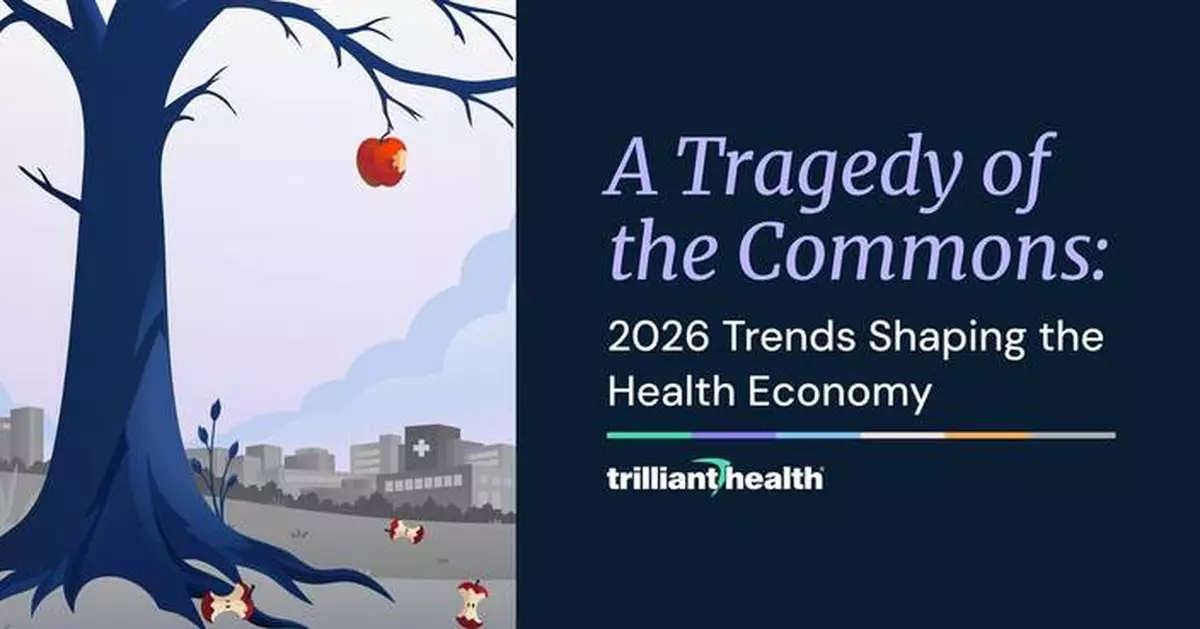
Trilliant Health's 2026 Trends Shaping the Health Economy Report finds the health economy is a textbook tragedy of the commons.

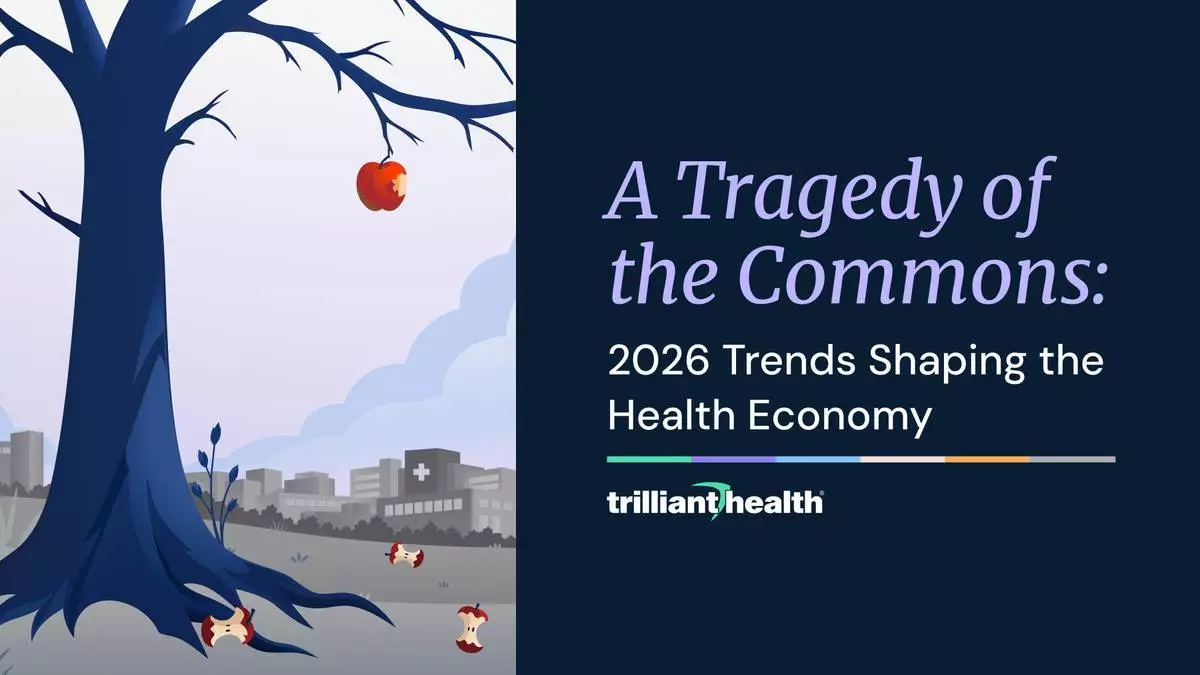
Trilliant Health's 2026 Trends Shaping the Health Economy Report finds the health economy is a textbook tragedy of the commons.
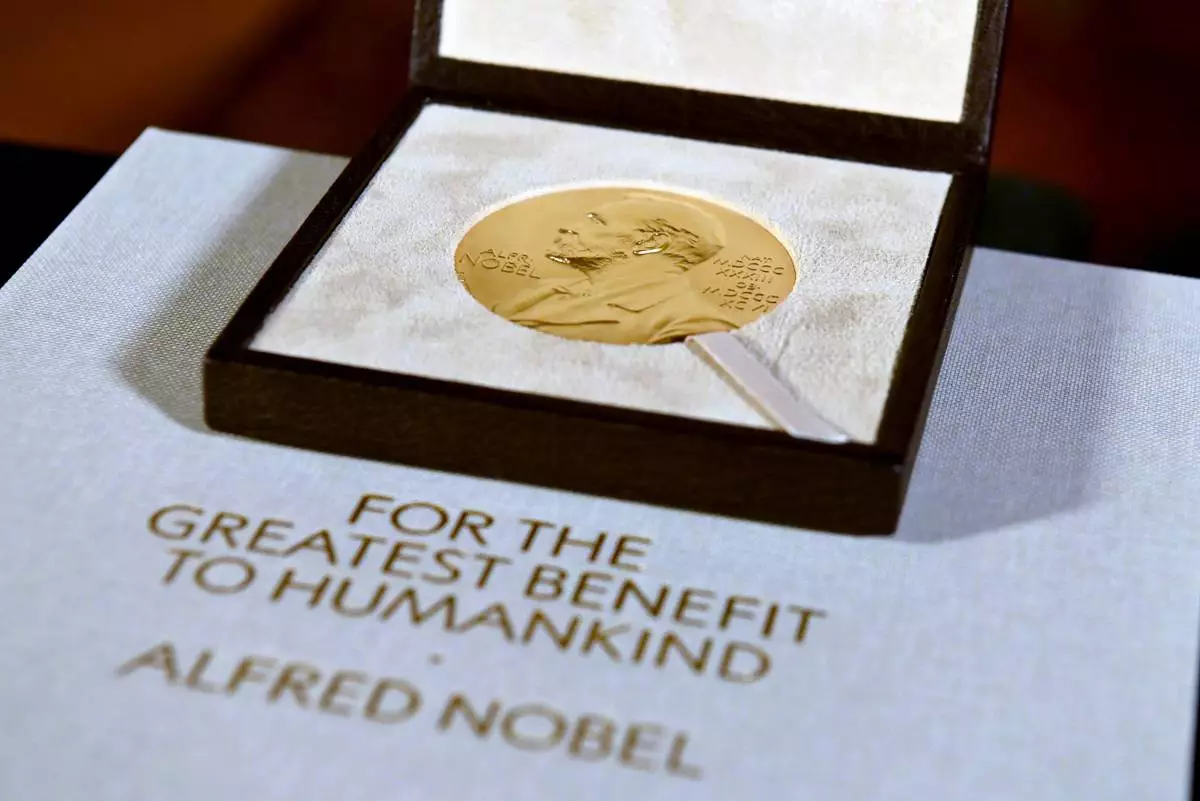
STOCKHOLM (AP) — Francis Halzen won the Nobel Prize in physics on Tuesday for his contributions to the IceCube Neutrino Observatory and his discovery of high-energy neutrinos of astrophysical origin.

“Francis Halzen has led an international team of researchers and engineers who have provided us with a fantastic instrument. His tenacity and scientific vision has paved the way for a new kind of astronomy,” Mark Pearce, chair of the Nobel Committee for Physics, said in a news release.

Halzen spoke to the committee by phone from Italy on Tuesday.

“It was a great surprise and I obviously didn’t expect it,” he said.

Born in Belgium, the 82-year-old scientist is affiliated with the University of Wisconsin–Madison in the U.S. Efforts by The Associated Press to reach him were not immediately successful.

The IceCube Neutrino Observatory is a research facility located at the South Pole in Antarctica, according to its website, and the University of Wisconsin–Madison is its lead institution.

Halzen’s research into capturing neutrinos at the South Pole dates back to the 1980s.

The Royal Swedish Academy of Sciences announced the award in Stockholm.

The prize money this year is 12 million Swedish kronor (about $1.2 million), whether for an individual, a small group of laureates or an organization.

Last year, three scientists won the Nobel Prize in physics for research on the strange behavior of subatomic particles called quantum tunneling that enabled the ultra-sensitive measurements achieved by MRI machines and laid the groundwork for better cellphones and faster computers.

The announcements of this year's prizes began Monday with the Nobel Prize in medicine being awarded to three scientists whose work led to a tool that uses light to help unravel how the brain works.

This week's awards continue Wednesday with the chemistry prize and literature on Thursday. After Friday’s peace prize is awarded, the Nobel Memorial Prize in Economic Sciences will be announced on Monday.

The prize money this year is 12 million Swedish kronor (about $1.2 million), whether for an individual, a small group of laureates or an organization.

Dazio reported from Berlin.

AP Nobel Prizes: https://apnews.com/hub/nobel-prizes

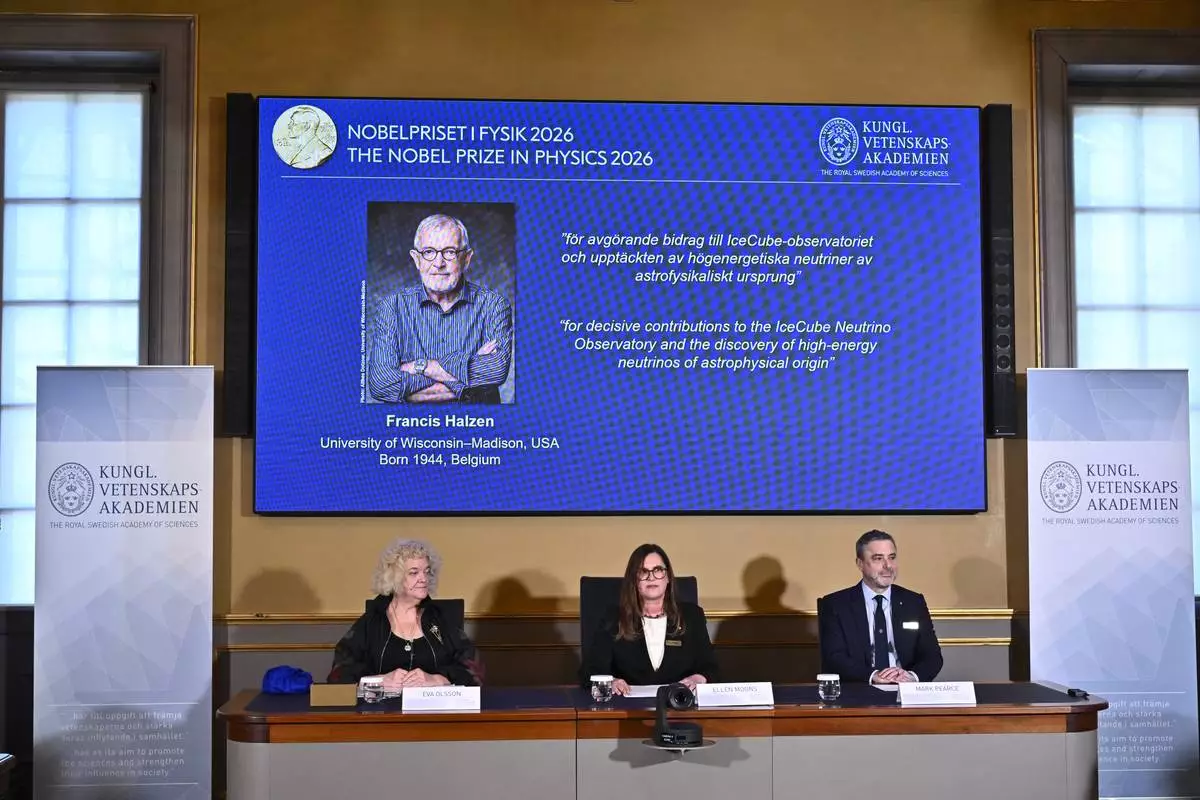
A portrait of Francis Halzen is shown on the screen as Eva Olsson, Ellen Moons, and Mark Pearce announce as the recipient of the 2026 Nobel Prize in Physics during a press conference at the Royal Swedish Academy of Sciences, Stockholm, Sweden, Oct. 6, 2026. (Christine Olsson/TT News Agency via AP)

A portrait of Francis Halzen is shown on the screen as Eva Olsson, Ellen Moons, and Mark Pearce announce as the recipient of the 2026 Nobel Prize in Physics during a press conference at the Royal Swedish Academy of Sciences, Stockholm, Sweden, Oct. 6, 2026. (Christine Olsson/TT News Agency via AP)

FILE - A Nobel diploma and medal are displayed, Dec. 8, 2020, during a ceremony in New York. (Angela Weiss/Pool Photo via AP, File)

FILE - A Nobel diploma and medal are displayed, Dec. 8, 2020, during a ceremony in New York. (Angela Weiss/Pool Photo via AP, File)

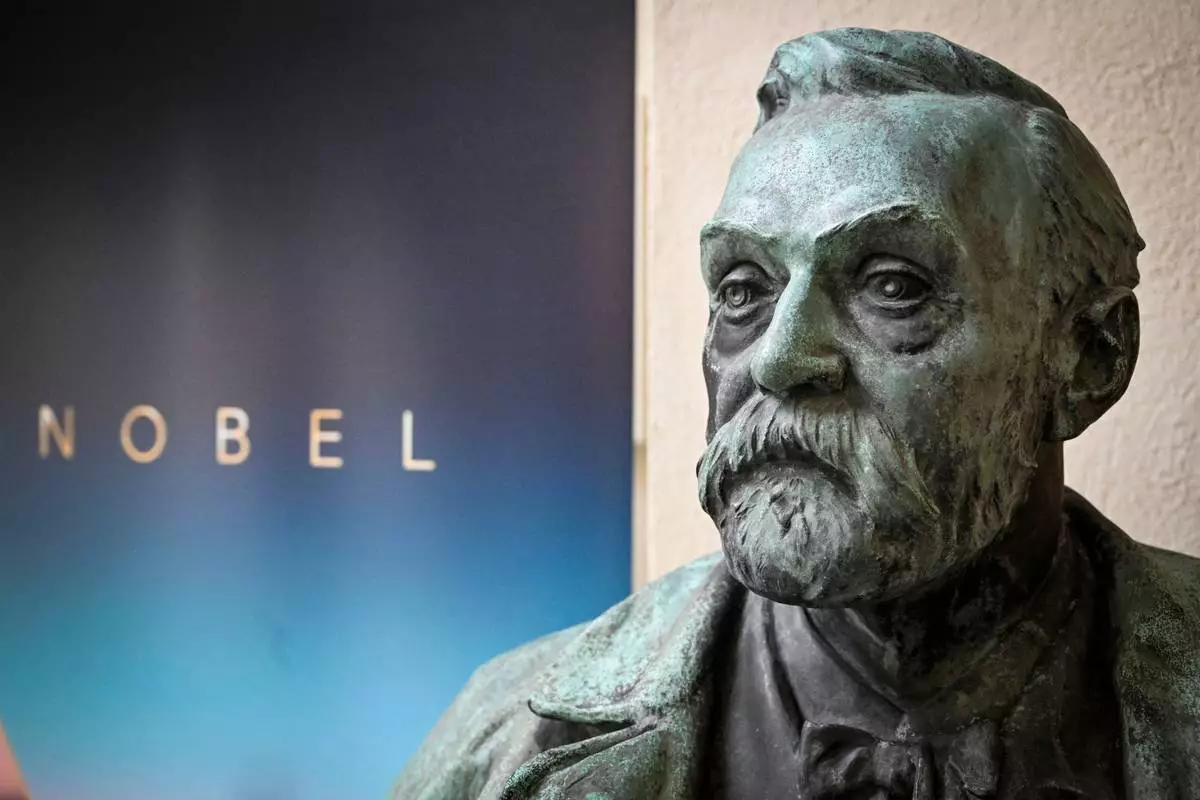
FILE - A bust of Alfred Nobel on display following a press conference to announce the Nobel Committee for Physiology or Medicine at the Karolinska Institute in Stockholm, Sweden, on Oct. 3, 2022. (Henrik Montgomery/TT News Agency via AP, File)

FILE - A bust of Alfred Nobel on display following a press conference to announce the Nobel Committee for Physiology or Medicine at the Karolinska Institute in Stockholm, Sweden, on Oct. 3, 2022. (Henrik Montgomery/TT News Agency via AP, File)

Recommended Articles