A Chinese envoy on Monday delivered a strong rebuttal during the general debate of the 81st session of the United Nations General Assembly's Third Committee in response to the groundless accusations made by a handful of countries, urging them to stop spreading lies about China and using human rights issues for political manipulation. Sun Lei, China's deputy permanent representative to the United Nations, stressed that China strongly condemns and is firmly opposed to the malicious smears of China's human rights situation by Japan and a few other Western countries.
"The representatives of the United Kingdom, Australia, Japan, Ireland, the Czech Republic and Lithuania made groundless accusations against and maliciously slandered China's human rights situation in their remarks. China strongly deplores and opposes this. The above-mentioned countries consider themselves superior to others and often assume the posture of self-proclaimed 'preachers' on human rights, yet they have serious human rights problems of their own. They are in no position to lecture others on human rights, still less to make irresponsible remarks about China," he said.
Sun stressed that China has continued to ensure and enhance the people's wellbeing in the course of development, eliminating absolute poverty nationwide. Close to 100 million poor rural residents were lifted from poverty, and the country has more than 400 million people in the middle-income bracket.
"By contrast, poverty in the United Kingdom has continued to worsen in recent years, with more than 14 million people living below the poverty line, half of them in 'extreme poverty.' In Japan, the relative poverty rate of households stands at 15 percent, and child poverty has become an increasingly serious problem. China is deeply concerned about the human rights situations in Japan," he said.
In addition, China has continued to develop whole-process people's democracy and ensure that the people run the country, with public support for and satisfaction with the Chinese government exceeding 90 percent for years, Sun said.
The Law on Safeguarding National Security in the Hong Kong Special Administrative Region (SAR) marked a historic turning point for Hong Kong, bringing it from chaos to governance and from stability to prosperity, while improving and developing its democratic system. It has been supported by people from all walks of life in Hong Kong, according to the Chinese envoy.
By contrast, polls show that about 75 percent of the public in the United Kingdom are worried about the future of democracy. In Australia and the Czech Republic, the public's trust in the government has hit new lows, and young people's confidence in the democratic system has declined markedly, Sun said.
Meanwhile, Sun highlighted that all ethnic groups in China are equal members of the big family of the Chinese nation and are closely united like the seeds of a pomegranate. The political, economic, cultural, and religious rights and other rights of people of all ethnic groups in the Xinjiang Uygur Autonomous Region and Xizang Autonomous Region are effectively protected. The enactment and implementation of the Ethnic Unity and Progress Promotion Law is aimed at promoting the common prosperity and development among all ethnic groups.
By contrast, Japan has failed to fulfill its commitments to eliminate racial discrimination and does not treat the Ainu people and Ryukyu people as equal ethnic groups, putting their survival and development in jeopardy. In the United Kingdom, Australia, and Ireland, colonialism has caused enduring harm to this day, and these countries now face serious social problems such as racism and ethnic divisions, Sun said.
Sun also said that amid global turbulence and headwinds facing multilateralism, China has contributed to the international human rights cause through its own development. It has also taken concrete efforts to promote dialogue and cooperation and to make global human rights governance more just and equitable.
"By contrast, the United Kingdom, Australia, Japan, the Czech Republic, Lithuania and others are fond of preaching morality, yet they remain indifferent to the unjust treatment suffered by the people of Palestine, Iran, Cuba and other countries. They have repeatedly used human rights as a pretext to interfere in other countries' internal affairs and impose unilateral coercive measures, infringing on the interests of developing countries and playing a highly disgraceful role," he said.
Sun said the global trend towards multipolarity and greater democracy in international relations is irreversible. Solidarity, cooperation and progress remain the aspiration of people around the world. China will stay committed to a path towards better human rights that follows the trend of the times and fits its national realities. China is ready to engage in constructive dialogue on human rights with all sides, oppose the politicization of human rights issues, and make unremitting efforts for the noble goal of ensuring that all people enjoy human rights.
"China urges the handful of countries to stop fabricating and spreading lies about China and stop engaging in political manipulation under the pretext of human rights, otherwise they will only end up shooting themselves in the foot," he said.
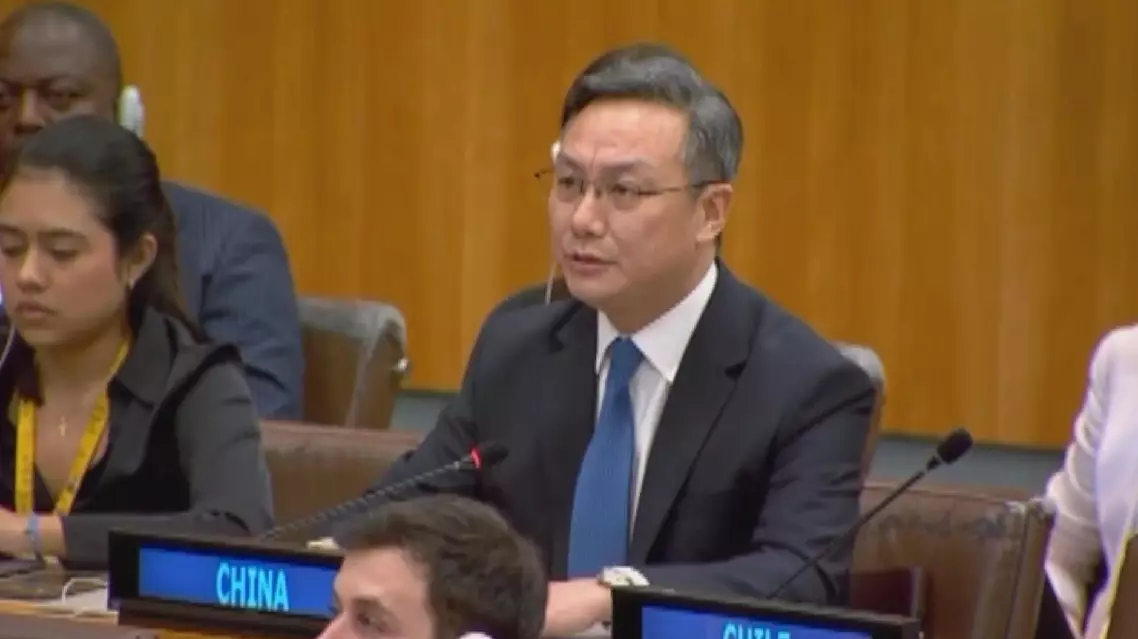
Chinese envoy refutes groundless accusations on China's human rights at UN general debate