HONG KONG, Oct. 7, 2026 /PRNewswire/ -- Whether navigating outer space or tackling challenges closer to home, technology is revolutionizing our ability to explore. In the seventh season premiere of Tech for Good, CNN anchor and correspondent Kristie Lu Stout meets the young researchers and innovators leading a new era of discovery and developing technology that pushes beyond the limits of human reach. From lunar exploration to environmental monitoring, this episode spotlights creative, adaptable and resourceful engineering that expands opportunities to venture and discover.
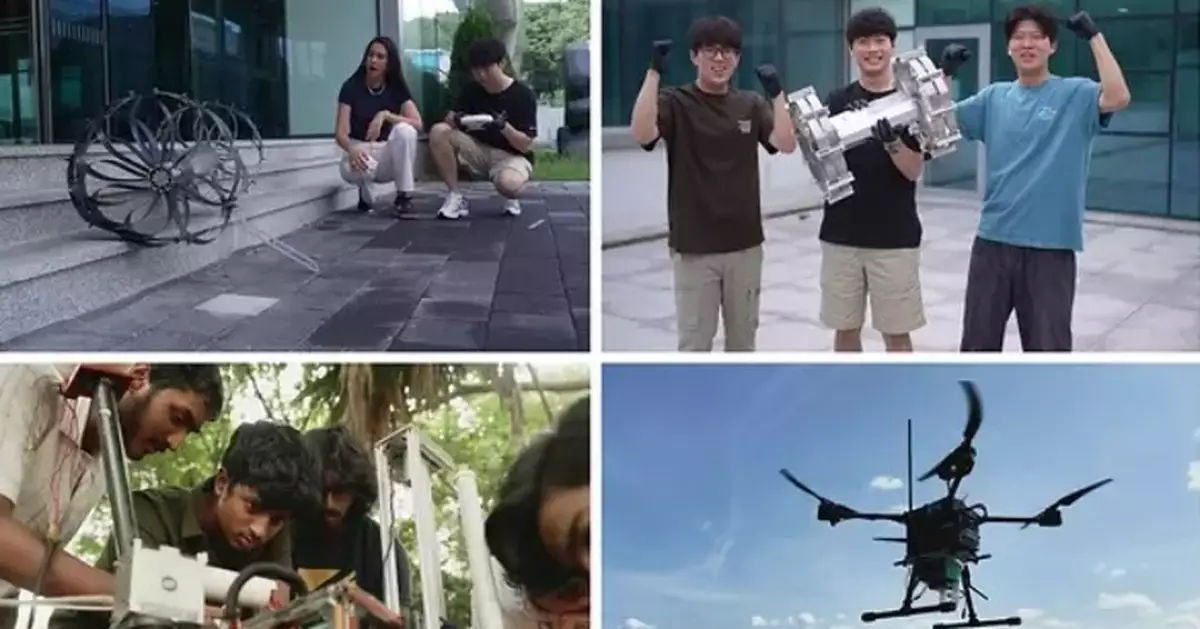
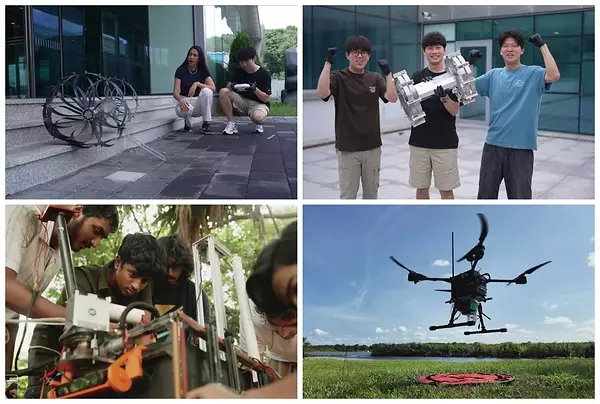
CNN first visits students at the Korea Advanced Institute of Science and Technology (KAIST), to meet a team of engineers developing origami-inspired lunar rover wheels. The intricate spiral wheels are made from thin metal strips, and are designed to change shape, absorb shock, and navigate rough terrain. PhD candidate Seong-binLee and his team have spent three years refining it, with the hope of it one day exploring lunar lava tubes and caves. Master's student YiseubYun is working on integrating artificial intelligence and reinforcement learning to turn their design into an intelligent rover, as the team works towards South Korea's planned lunar mission. In another aerospace project at KAIST, PhD candidate Sung-jin Lee is developing a satellite-mounted gripper designed to capture space debris, which the team says is due to be tested in space in 2027.
CNN then heads to Florida, where students from Embry-Riddle Aeronautical University are trying to tackle a vast environmental challenge at Lake Okeechobee, Florida's largest lake. Warm water and nutrient-rich runoff contributes to toxic blue-green algae blooms that threaten people, wildlife and coastal economies. PhD student Kaylor Taylor and a collaborative team of engineers, drone pilots and environmental scientists are using drones fitted with specially designed devices to take air and water samples, as well as cameras to map algal blooms from the sky. Their system results in faster and richer data collection beyond traditional sampling, helping scientists understand how blooms develop, move, and predict what might happen next.
In Chennai, CNN visits Team Anveshak and 'Jade' at the Indian Institute of Technology Madras. Developed by project lead Soham Warde and a team of 60 students, 'Jade' is a Mars rover prototype developed to navigate rough terrains, drill for soil samples, and carry out tasks with a robotic arm. Beyond its capabilities, the USD$6000 rover reflects 'jugaad', an Indian concept that means to make ambitious things possible using what's on hand. The team has won several competitions run by the Indian Space Research Organization, but the next stop is an international rover competition in Florida for a chance to demonstrate India's homegrown approach on a global stage.
Finally, in Tech for Good's 'Where Are They Now?' segment, CNN revisits Myoungseok Kim, originally spotlighted for his nanoscale DNA folding at Seoul National University in 2023. Now at the University of California Berkeley, his latest discovery in the DNA origami field may serve as biosensors for detecting diseases, including cancer.
Tech for Good trailers: https://bit.ly/4xY1hL7
Tech for Good images: https://bit.ly/4jtQBQD
Tech for Good microsite: https://cnn.it/3PB5DSq
Airtimes for 30-minute special:
Saturday, 10th October at 7:30pm HKT
Sunday, 11th October at 11:00am and 3:30pm HKT
Monday, 12th October at 5:30am HKT-Ends-
** This press release is distributed by PR Newswire through automated distribution system, for which the client assumes full responsibility. **
CNN's Tech for Good spotlights the next generation pushing the limits of exploration