Hundreds of commercial space companies have gathered in Türkiye for the 77th International Astronautical Congress (IAC), where Chinese firms are expanding into the global market, combining exports with knowledge transfer for their partners.
The five-day IAC, the world's largest annual space gathering, is being held in the Mediterranean resort city of Antalya, drawing space leaders, researchers and industry representatives from across the globe under the theme "The World Needs More Space."
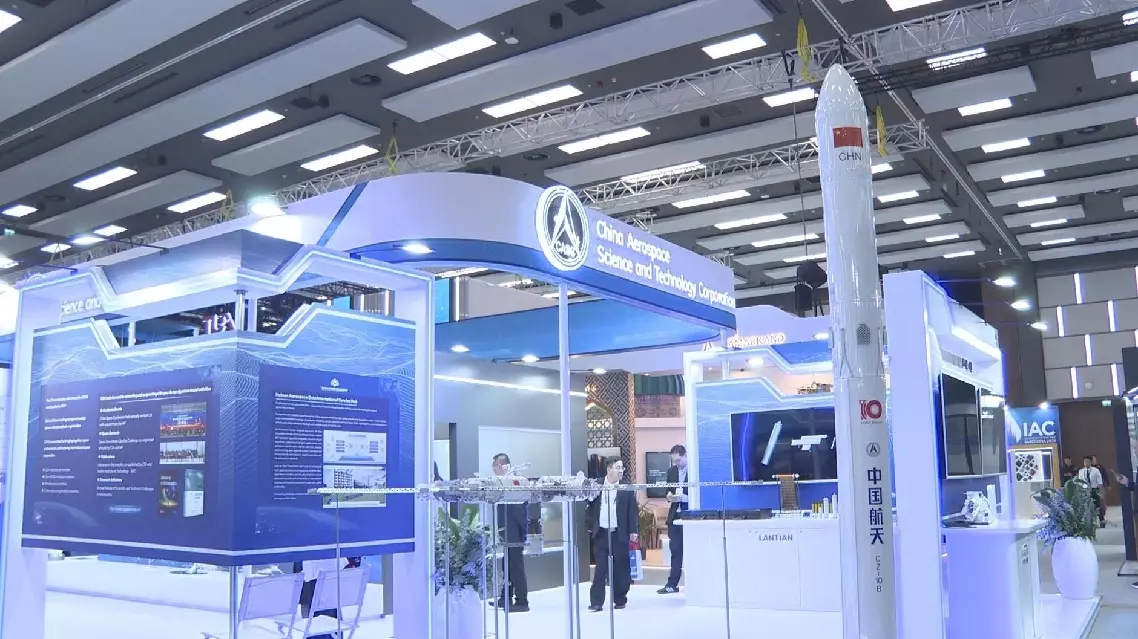
The event features sessions on the industry's key priorities, from lunar exploration and satellite systems to artificial intelligence, space security and international cooperation. Chinese exhibitors are showcasing capabilities across that spectrum -- from rockets and satellites to data services -- as they pursue new partners and markets.
A growing number of Chinese space firms are offering launch services, satellite components and one-stop solutions as they look to tap into markets across the world together with international partners. The congress has also become a prime venue for exchanges and cooperation. One Chinese commercial space company has signed a new agreement on AI satellites with its Omani partner -- a deal that both sides say goes beyond the hardware.
"We are also announcing the launch of upcoming two new satellites with 0.5 [meter] resolution, further advancing our capability within the space industry in Oman and in the region, especially when it comes to knowledge transfer, [which] is really essential for our capacity building," said Yahya Al-Mohamed, Solutions Manager of Oman Lens.
"While we are working with Oman, not only do we design and build satellites, but we also help train their local talent, the idea is not to directly export satellites, but we also want to help the local scientists grow, that is the idea: we grow people, grow the talent, grow the ability locally, so this will be part of their ecosystem," said Liu Yandong, CEO of STAR.VISION, a Hong Kong-based company that builds AI-powered satellites.
As more countries and satellite operators race to deploy constellations of their own, demand is climbing for the data processing and ground station services needed to keep them running.
"We [have] already established around 10 global ground stations overseas. We want to leverage these capabilities and network to introduce the solutions, services and products of our partners in China's aerospace industry," said Li Chenhui, director of the International Business Department of Beijing-based commercial satellite company Emposat.
Alongside ground services, manufacturers are also under growing pressure to build payload systems that integrate the distinct roles satellites serve today, from remote sensing and communication to navigation.
"Because we design from the chip level to the device level, and subsystem and satellite levels, with four levels of research and development we are able to to cut down the cost and increase the performance dramatically," said Chen Jinlin, CEO of Final Frontier.
Beyond satellites, firms at the congress are also promoting commercial spacecraft designed for microgravity research, a field expected to generate strong demand in the years ahead.
"We will have the maiden flight of our Lihong-2 suborbital recoverable spacecraft early next year. It's for a space medicine research mission, so we do have a lot of Middle Eastern potential clients. We are talking with them and hopefully there will be some good news," said Yang Sihan, head of International Business at China's commercial rocket company CAS Space.
China is home to more than 600 commercial space enterprises across the supply chain and as the deals and conversations in Antalya show, they are increasingly looking to reshape the global space economy together with international partners.
Chinese commercial space firms court global partners at international space congress