WASHINGTON (AP) — The Department of Homeland Security on Wednesday proposed a $70,000 fee for international students seeking to work in the United States, the latest effort from the Trump administration to crack down on foreign enrollment.
A proposed rule would require schools to pay the fee for every student who participates in the optional practice training program, known as OPT, which allows students to work in jobs related to their major during or after their time in school. Students are generally eligible for one year of work post-graduation, though certain science, technology, engineering and math majors are eligible for an additional two years.
Schools would be required to pay the $70,000 for each new student's initial application to the program, and a $30,000 fee for each renewal.
American colleges and universities heavily recruit students from overseas as a source of tuition revenue. Tech companies and other industries also hire many international students for technical roles.
The OPT program allows international students to gain hands-on experience and fill labor shortages in high-demand STEM fields, said Fanta Aw, CEO of NAFSA, an association that represents international education.
“Driving away the talents, perspectives, and aspirations of international students will only hurt American innovation, economic growth, workforce development, and global leadership,” Aw said in a written statement.
In a statement, DHS described the fee as a response to fraud and abuse of the visa program, which it called a “pipeline for cheap foreign labor.”
The public has 60 days to comment on the proposal before DHS can finalize it and put it into effect. The proposal also could face legal challenges from higher education groups or business associations that could delay it.
The proposed rule is part of its wider efforts to crack down on immigration and reshape higher education. Last year, the Republican administration began suddenly terminating the legal status of thousands of international students, detaining and deporting many of them.
This summer, the administration finalized a rule that sought to prevent international students from staying in the U.S. for more than four years without approval from the federal government. The move drew swift backlash from higher education leaders who said it would increase the burden on schools and noted that many programs are longer than four years by design. A federal court prevented the rule from taking effect in September.
Doug Rand, a former senior adviser at U.S. Citizenship and Immigration Services during the Biden administration, predicted that the fee would be struck down in the courts, as was a $100,000 fee for the H-1B work visas that many tech companies and universities rely on to fill openings for skilled jobs.
The Trump administration is now trying a different way to raise the fee for the visas to more than $100,000.
Rand said fees are not the answer.
“When we educate international students at our universities, and they want to work and apply their talents here after graduating, of course we should embrace them -- not use an exorbitant fee as a pretext to send them packing,” Rand said in an email.
Sarah Spreitzer, vice president at the American Council on Education, which represents college and university presidents, said international enrollment has suffered.
Last fall, the number of new students entering the United States for the first time fell by 17%, the sharpest decrease since the COVID-19 pandemic. Overall numbers for this fall are not yet available, but Spreitzer said some individual colleges are reporting drops of 30% to 40%.
She said the new Trump plan will not help.
“We know that OPT is one of the reasons that international students choose to study in the United States because they’re able to have that post-graduation work experience,” she added.
A similar program that allowed international students to participate in internships and practicums also has faced scrutiny from the Trump administration. New guidance from U.S. Immigration and Customs Enforcement that the program, Curricular Practical Training, should only be authorized when the work experience is a degree requirement led to a lawsuit Monday.
Education groups, including the Association of American Universities and NAFSA, said that in the past that program was allowed if it was “directly related to the student’s major area of study.” The groups also said ICE was threatening college university officials with criminal prosecution if they did not comply.
“We know the administration has been trying to hinder legal employment-based immigration through numerous means,” said Steven Brown, a Houston-based immigration lawyer. “I think this is the next level of attack, and I think it’s a design to kill the program without killing the program. I don’t see too many schools wanting to pay $70,000 for a student to get OPT."
Hollingsworth reported from Mission, Kan.
The Associated Press’ education coverage receives financial support from multiple private foundations. AP is solely responsible for all content. Find AP’s standards for working with philanthropies, a list of supporters and funded coverage areas at AP.org.

FILE - A Morehouse College student lines up before the school commencement, May 19, 2024, in Atlanta. (AP Photo/Brynn Anderson, File)
CAIRO (AP) — Three people were killed in attacks on two airports in Saudi Arabia, the Saudi General Authority for Civil Aviation said Wednesday.
The Saudi authorities did not blame any party for the attacks at Abha and Riyadh’s King Khalid international airports, but Iran-backed Houthi rebels in Yemen claimed earlier said they carried out attacks against the two airports.
The attack on Abha airport killed Moroccan and Algerian residents and wounded 28 others people, while the attack on King Khalid airport killed a Sudanese national and wounded eight other people, officials said.
Earlier Wednesday, Iran-backed Houthi rebels in Yemen claimed new attacks on both airports and military facilities in neighboring Saudi Arabia as the kingdom is pulled deeper into the latest front in the Iran war, which also threatens a crucial shipping alternative to the Strait of Hormuz.
As the Saudi capital is targeted again, new cage-like fences have been erected this week around fuel tanks and other equipment of the Saudi state-run Aramco oil company near the Riyadh airport. The kingdom, the world’s top oil exporter, has seen oil and military assets targeted in recent days.
The Houthis’ military spokesperson, Brig. Gen. Yahya Saree, said on social media that the rebels launched ballistic missiles and drones against King Khalid International Airport in Riyadh. The spokesperson for the Saudi-led coalition fighting the Houthis, Maj. Gen. Turki al-Malki, said they intercepted a ballistic missile north of Riyadh. Flights were briefly disrupted, according to Flightradar24.
Now Saudi Arabia and allied Yemeni forces have launched a major ground and air offensive aimed at retaking territory that the rebels seized a month ago along Yemen’s western Red Sea coast and on the Bab el-Mandeb Strait.
Those positions gave the Houthis better surveillance as they pursue a blockade of Saudi-linked shipping. On Monday, officials said forces of the Saudi-led coalition recaptured several key areas around the strait, through which about 12% of global trade transits.
“The Houthis believe that they can maximize Saudi economic costs and compel Saudi Arabia to surrender to Houthi demands by striking civilian infrastructure, such as oil facilities and airports,” the Institute for the Study of War, a Washington-based think tank, wrote in an analysis.
The Houthi spokesperson said they also targeted Abha airport in Saudi Arabia, a frequent target of rebel drones and missiles. The rebels also claimed to hit an air base in the city of Khamis Mushait and two military bases in Najran and Asir. All are in the southwest, near the Yemeni border.
Inside Yemen, fighting has centered in and around the crucial town of Dhubab, some 54 kilometers (33.5 miles) south of the port city of Mokha that the rebels seized last month, according to both the Houthis and Yemen's internationally recognized government.
Two Houthi officials said Wednesday that the rebels had regained control of key areas of Yemen’s southwestern coast, including Dhubab and the nearby village of Al-Jadid, as well as the Bab el-Mandeb strait, after intensified fighting with Saudi-backed coalition forces.
A government official denied the claims, which The Associated Press could not independently verify.
The Houthis also claimed that Saudi forces had targeted “civilian assets” over the past 24 hours in Yemen’s capital, Sanaa, as well as Taiz, Jawf and other active fronts, including Saada and Marib.
Houthi military spokesman Brig. Gen. Yahya Saree said, without providing evidence, that fighter jets used in the attacks had taken off from Khamis Mushait and Taif in Saudi Arabia, while missiles had been launched from Najran and Jizan. The rebels have repeatedly claimed attacks on those Saudi cities in recent weeks.
Al-Malki has vowed “full operational support” to Yemeni government forces until the Houthis are “eliminated.” The coalition has said 100 fighter jets were providing support. Another aim is to liberate Sanaa, Yemen’s rebel-controlled capital.
Houthi leader Abdul Malik al-Houthi criticized Saudi Arabia over support for Yemen’s government forces in the latest escalation with the Houthis, which has shattered a truce reached four years ago.
Rebels are ready to support Palestinians in every way they can in case of “any new round of escalation” with Israel, al-Houthi said in a speech Wednesday expressing solidarity with Gaza on the third anniversary of Hamas’ Oct. 7, 2023, attack on Israel.
The offensive began after the rebels seized Turbah town on a main road linking the provincial capital of Taiz, Yemen’s third-largest city, with Aden, the seat of the internationally recognized government. Officials have said U.S. support has included intelligence sharing, target identification and planning.
The escalation has revived Yemen’s civil war after a four-year ceasefire. Almost 1,000 people have been killed in the latest fighting, with over 200,000 displaced, according to the United Nations. Cholera and malnutrition cases are increasing, access to trauma care is more difficult and some hospitals have shortages of surgical and other supplies, the World Health Organization said this week.
The Houthis also said they launched a missile strike early Wednesday against Aden. Explosions were heard by an AP journalist around 2 a.m.
The rebels hit a military camp close to the city's airport with ballistic missiles, Saree said. Security authorities in Aden said the Houthis targeted the airport with two missiles, with no casualties. The airport is close to the seat of government.
One missile hit close to the runway just before the scheduled landing of a flight from Cairo, the Human Rights Ministry said. Flight 603, operated by Yemen’s flagship airline, landed safely in Aden at 3:30 a.m., according to the flight tracking platform FlightAware.
The ministry said the missile hit as other passengers were waiting to board their flight to the Saudi coastal city of Jeddah.
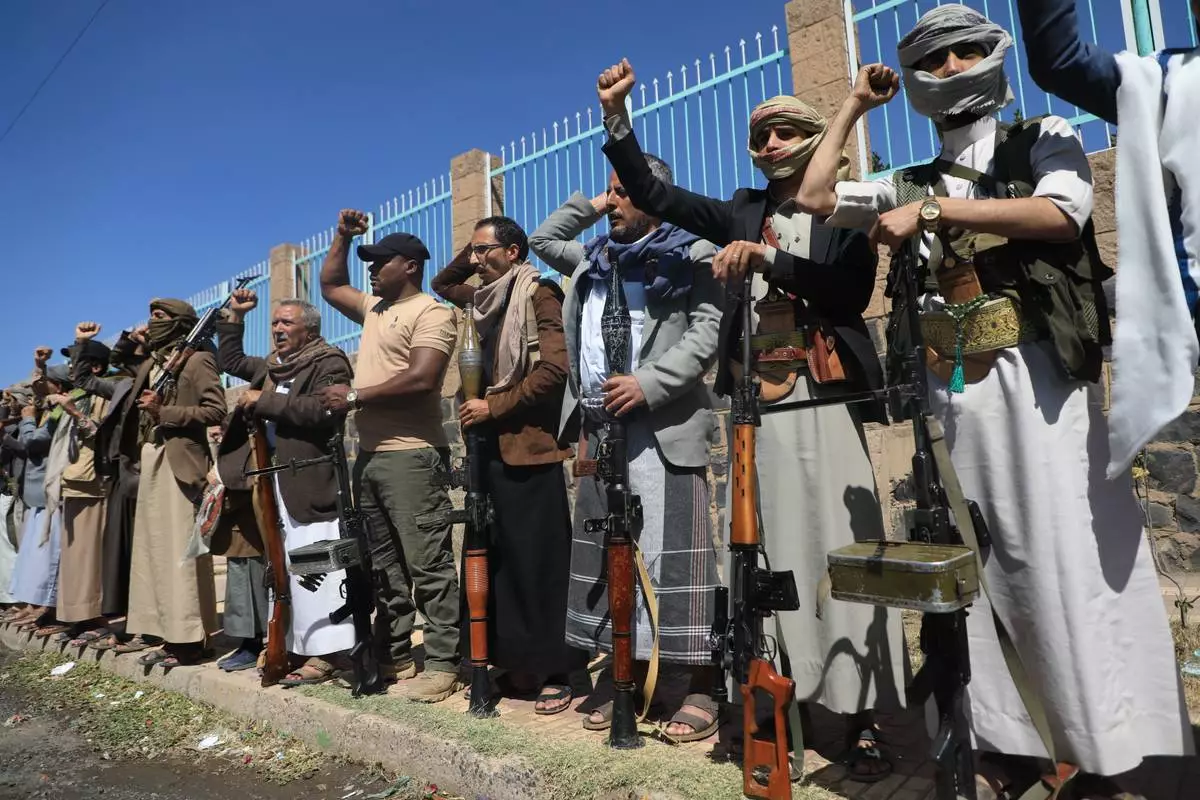
Houthi supporters chant slogans during an armed tribal rally in Sanaa, Yemen, Wednesday, Oct. 7, 2026. (AP Photo/Osamah Abdulrahman)
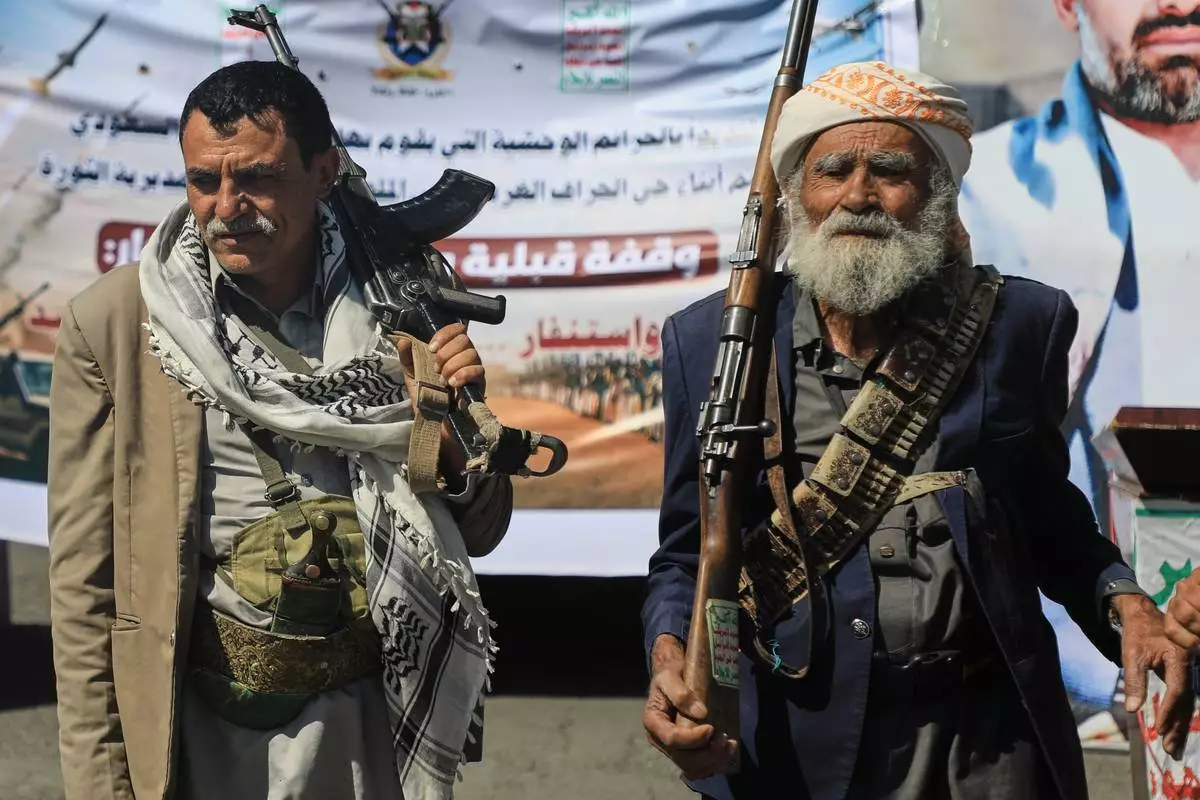
Houthi supporters attend an armed tribal rally in Sanaa, Yemen, Wednesday, Oct. 7, 2026. (AP Photo/Osamah Abdulrahman)
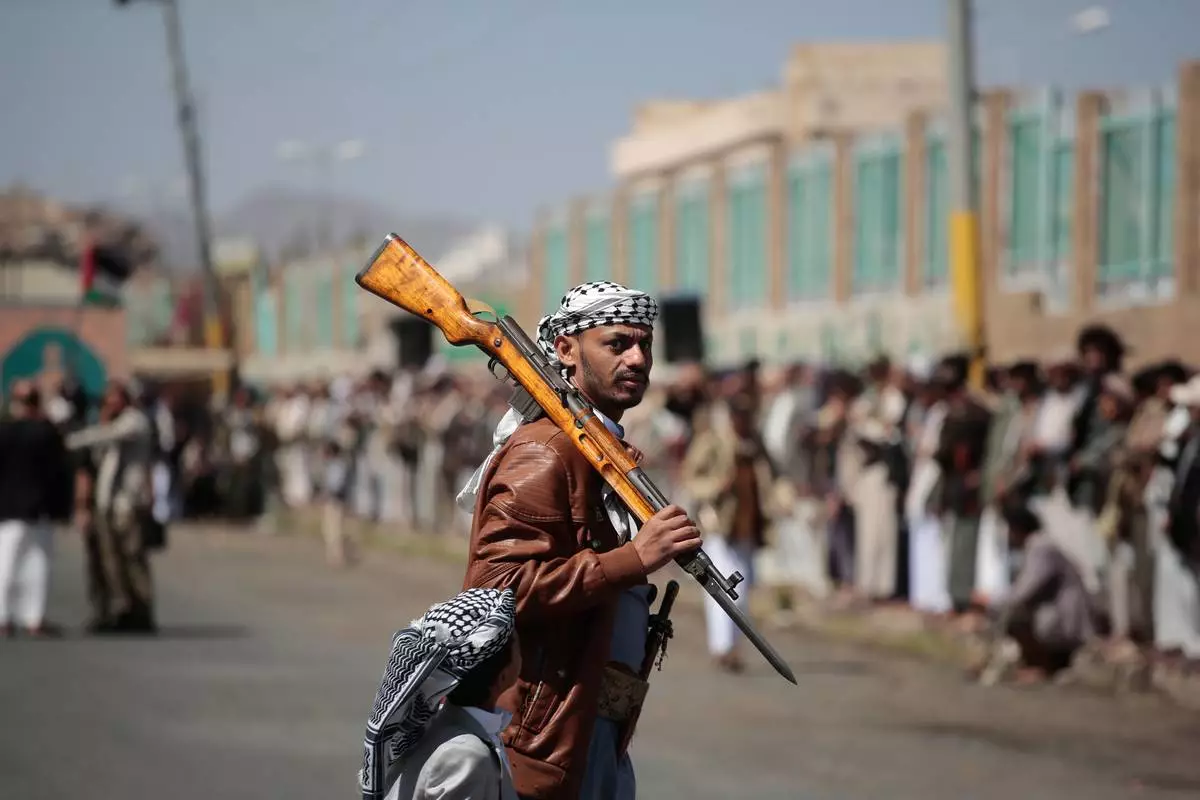
A Houthi supporter carries a rifle while attending an armed tribal rally in Sanaa, Yemen, Wednesday, Oct. 7, 2026. (AP Photo/Osamah Abdulrahman)
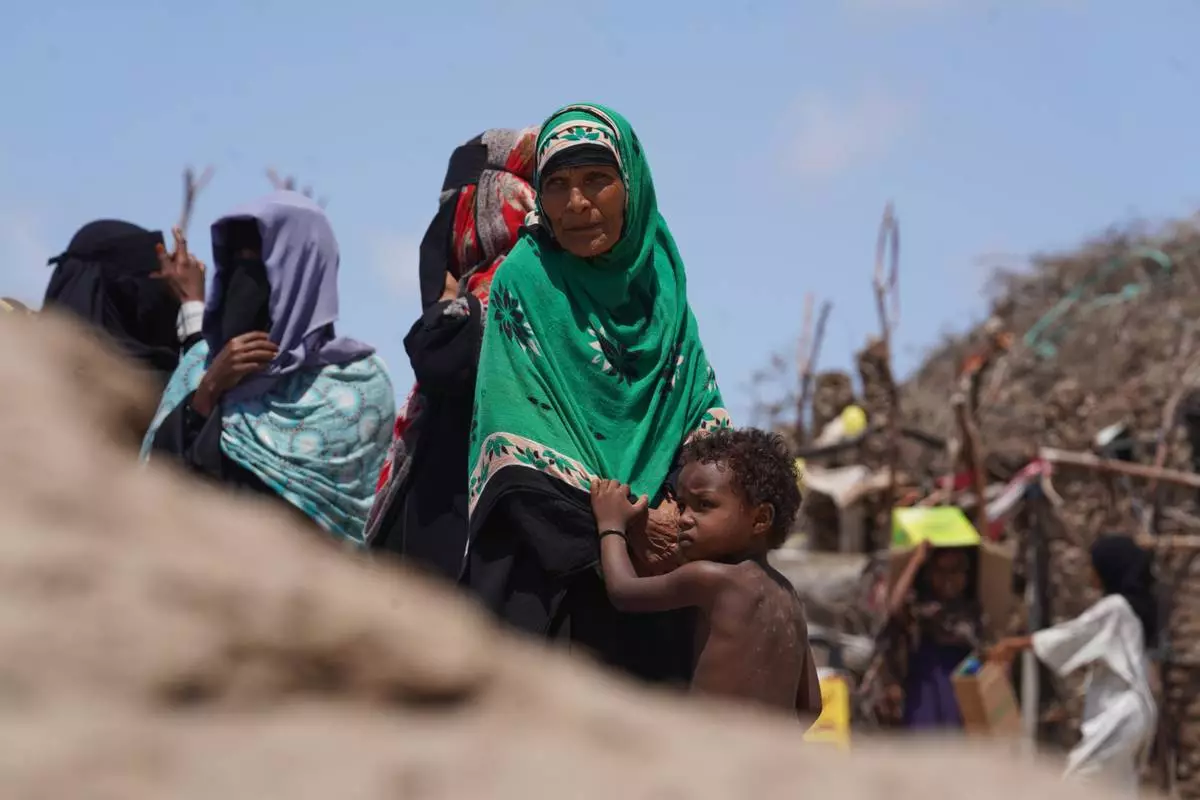
Displaced Yemeni women wait to receive aid supplies at the Al-Salam camp in Dar Saad district, Aden, Yemen, Tuesday, Oct. 6, 2026. (AP Photo/Abdulnasser Alseddik)
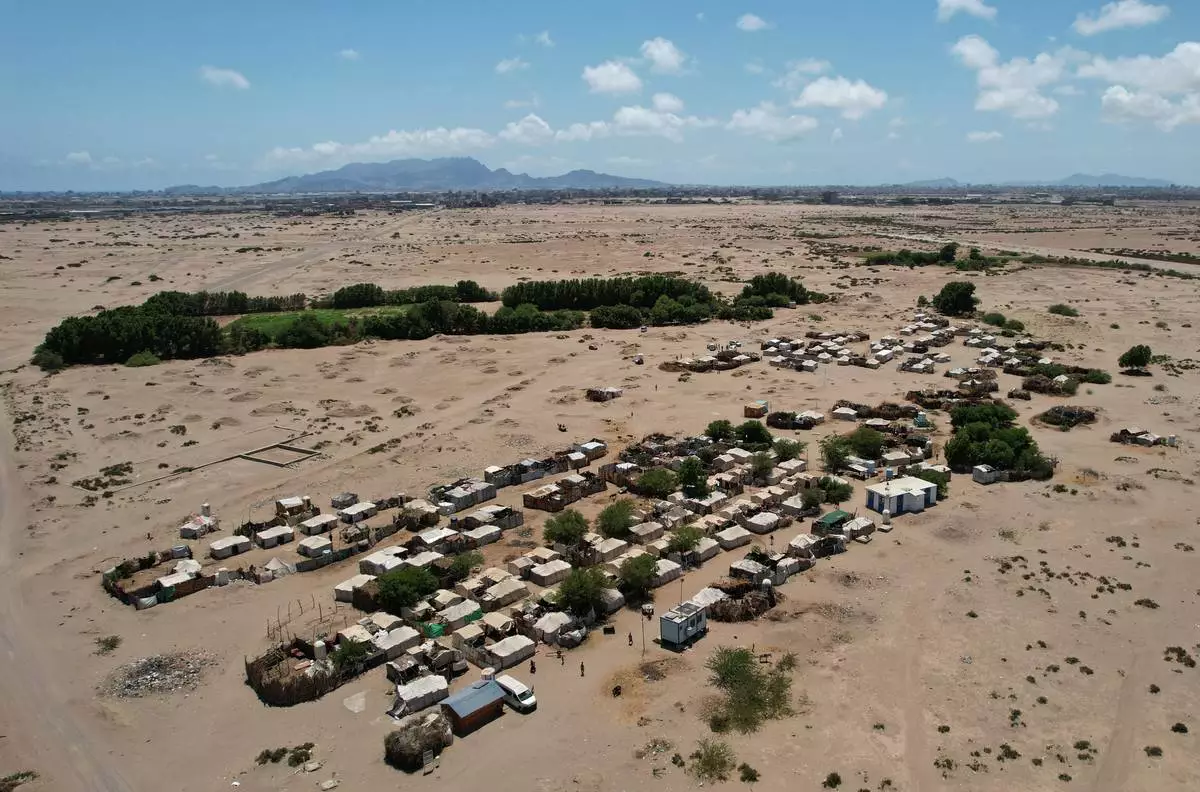
An aerial view shows the Al-Salam camp, which shelters displaced Yemenis, in Dar Saad district, Aden, Yemen, Tuesday, Oct. 6, 2026. (AP Photo/Abdulnasser Alseddik)
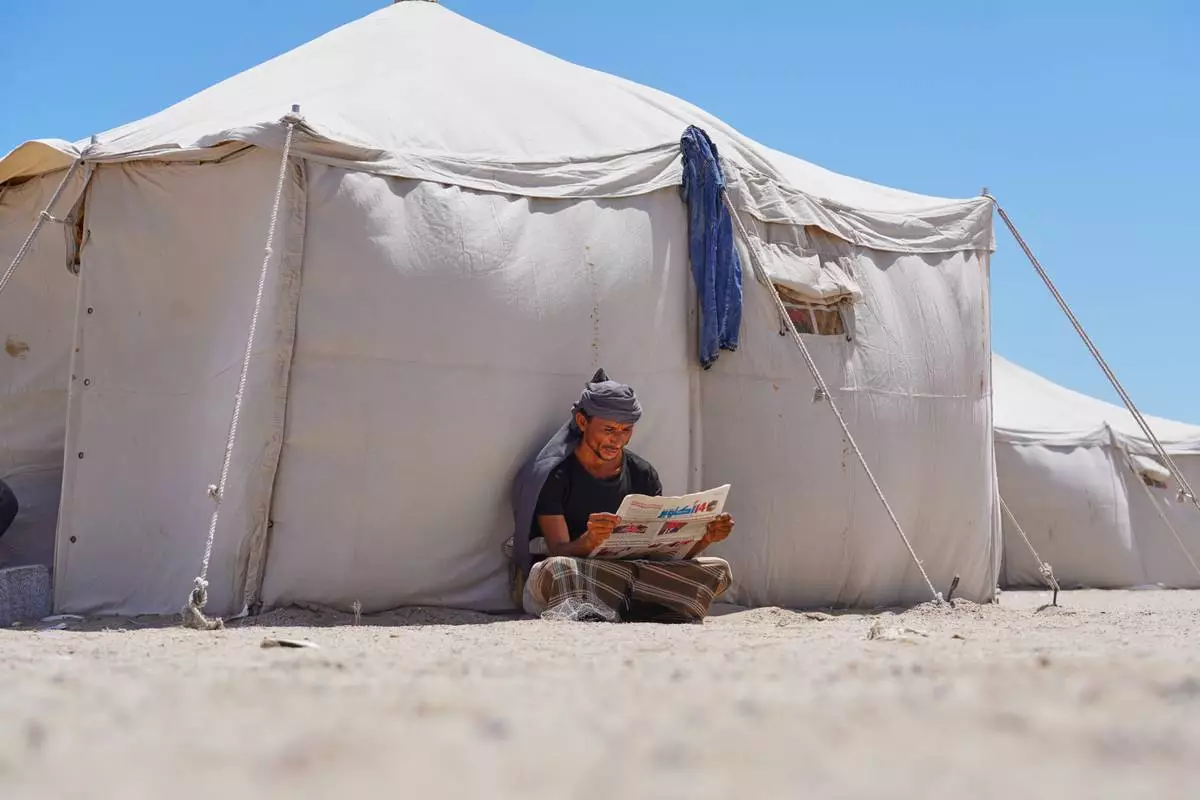
A displaced Yemeni reads a newspaper at the Al-Firdaws camp in Ras Imran on the western outskirts of Aden, Yemen, Monday, Oct. 5, 2026. (AP Photo/Abdulnasser Alseddik)