China plans to carry out the Tianwen-3 mission around 2028 to bring back samples from Mars, as Chinese space scientists eye new frontier in deep space exploration.
This year marks the 70th anniversary of the founding of China's space industry. Over the past seven decades, the country has achieved a series of major breakthroughs in deep space exploration, reaching the Moon and Mars, and beyond.
China formally established its lunar exploration "Project Chang'e" in 2004. Sun Zezhou, an expert on deep space exploration of China Academy of Space Technology, started his deep space career since then.
On Oct. 24, 2007, China launched Chang'e-1, its first lunar probe, making China the fifth country to develop and launch a lunar probe on its own.
"Our first mission of stepping out of Earth and heading to the Moon has gone pretty well. I think it gives us vital confidence for being able to go even farther into the future," said Sun in an interview with the China Media Group (CMG).
In 2008, the Chang'e-3 mission entered the engineering development phase. As a key step in the lunar exploration program's three-stage strategy of "orbiting, landing, and returning," more than 80 percent of the Chang'e-3 mission consisted of new products and new technologies. "At the beginning, we were also quite anxious when we encountered problems. We always had issues on various experiments. When the phone rang, we would feel nervous, thinking it was probably another experiment that didn't turn out as expected. We progressed and kept on testing key technologies on the ground. The more problems we encountered, the fewer errors we would face in the future. That is the rule," said Sun.
On Dec. 14, 2013, Chang'e-3 landed on the moon, marking the first time that China had sent a spacecraft to soft land on the surface of an extraterrestrial body.
Since then, the Chang'e-4 probe, launched on Dec. 8, 2018, made the first-ever soft landing on the far side of the moon. The Chang'e-5 probe and Chang'e-6 probe took samples from the lunar surface.
Alongside lunar efforts, Chinese scientists have also turned their attention to Mars.
China's Tianwen-1 mission, consisting of an orbiter, a lander and a rover, was launched in July 2020. The probe entered Mars' orbit in February 2021, and the Mars rover Zhurong landed on Mars in May 2021. It has fulfilled three scientific objectives -- orbiting Mars for comprehensive observation, landing on Martian soil and sending a rover to roam the landing site -- in one mission.
China will launch the Tianwen-3 Mars sample-return mission around 2028, with the primary scientific goal of searching for signs of life.
The retrieval of samples from Mars will represent another milestone in China's deep space exploration, as no such retrieval has ever been accomplished.
"Among all eight planets in the solar system, Mars is the most similar celestial body to Earth. If we compare Earth as a young adult in its prime, Mars is more like an elder in its twilight years. As for the exploration of Mars, to put it most simply and directly, we want to understand the evolutionary process of our close neighbor and what insights it can offer us," Sun said.
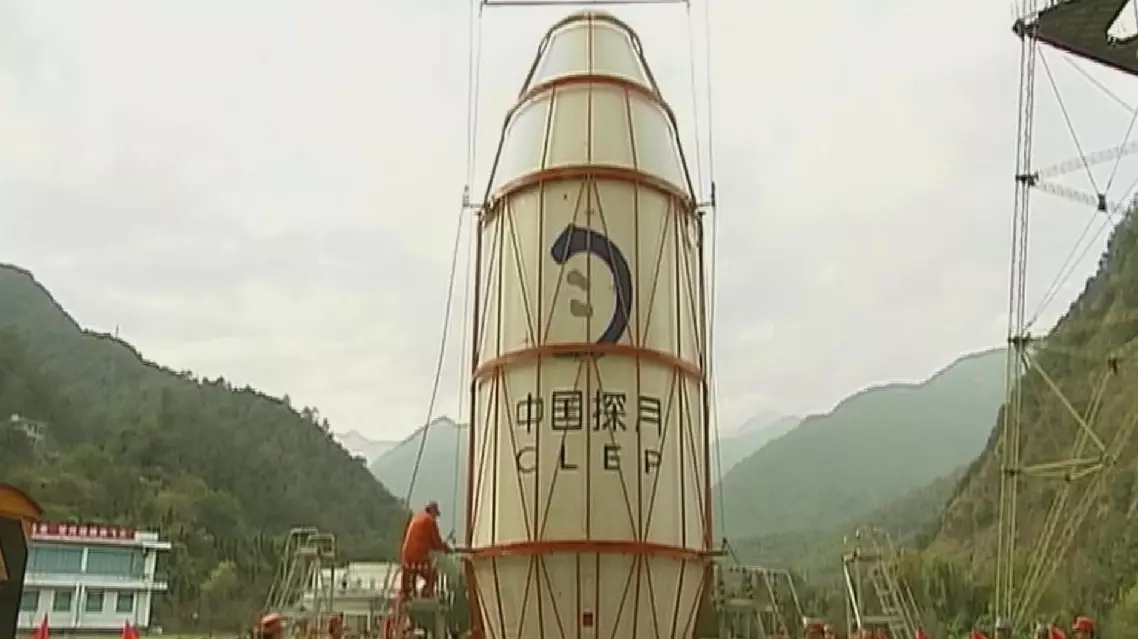
China aims to launch Mars sample-return mission around 2028