NEW YORK--(BUSINESS WIRE)--Oct 8, 2026--
This press release features multimedia. View the full release here: https://www.businesswire.com/news/home/20261008286438/en/
This year’s winners demonstrate the expanding role of Banking AI — retaining millions in deposits, creating thousands of hours of workforce capacity, resolving customer needs around the clock, and equipping employees with real-time knowledge to fuel personalization and cross-selling. Together, these banks and credit unions are proof that with Banking AI, community and regional institutions can compete with megabanks and fintechs without sacrificing the relationships and experience that have always differentiated them.
“As AI moves from automating routine tasks to completing complex operating procedures, these institutions are leading the way,” said Dan Michaeli, co-founder and CEO of Glia. “By methodically building and scaling Banking AI into their operations, they’ve positioned themselves ahead of the industry — directly benefiting their employees, local communities and account holders. We are proud to partner with them and celebrate their incredible momentum.”
Glia’s 2026 Catalyst Awards winners include:
Together, this year’s Catalyst Award winners demonstrate the transformative power of AI built specifically for community banks and credit unions. By leveraging AI designed specifically for their needs, these institutions are creating experiences and operational efficiencies that rival the nation’s largest banks — all while protecting and prioritizing the relationships and customer-centricity that defines community banking.
“Out of the more than 700 financial institutions we work with, these four stood out for their ability to drive significant results and achieve AI maturity that impacts both their employees and account holders,” said Paul Sheets, chief customer officer at Glia. “Glia’s mission is to empower community and regional institutions to thrive against megabanks and fintechs. These award winners prove that when local financial institutions put Banking AI to work, they don't just compete — they win.”
Additional information on the 2026 Catalyst Awards is available at glia.com/catalyst-awards.
About Glia
Glia is the #1 Banking AI platform, empowering community and regional financial institutions to create efficiencies, accelerate loan growth, drive deposits, and deliver experiences that win against megabanks and fintechs. Glia’s Banking AI combines intelligence, knowledge, and action into a single agentic framework, activating an AI workforce of specialized agents that draw from banking data, interaction history, and integrated systems of record. Banking-trained AI agents automate workflows across voice and digital—from front office to back office—resulting in decreased operational costs and the Universal Banker model. Trusted by 700+ banks and credit unions for its ironclad security and reliability, Glia provides the foundational trust institutions need to safely scale AI. It’s why Glia customers quickly and confidently put Banking AI to work with measurable results from day one. Learn more at glia.com.

Glia, the #1 Banking AI platform, today announced the winners of its 2026 Catalyst Awards, which honor the most forward-thinking institutions using Banking AI to create measurable impact across growth, operational efficiency and customer experience.
BEIRUT (AP) — Palestinian factions are discussing postponing legislative elections that had been planned for November, officials said Thursday.
A top official with the Hamas-allied Islamic Jihad group said the factions had reached an agreement to delay the vote, which is facing huge logistical issues in Israeli-annexed east Jerusalem and war-ravaged Gaza, as well as the long history of internal feuding among the Palestinians.
A spokesperson for Fatah, the party of Palestinian President Mahmoud Abbas, stopped short of confirming that a final decision had been reached. But he said the election timing will be part of a “dialogue and national consensus” among the factions and that the potential postponement will be discussed by the executive committee of the Palestine Liberation Organization.
Abbas has set Nov. 28 as the date of parliamentary elections in Gaza and the occupied West Bank. If the elections proceeded on schedule, they would be the first polls in 20 years.
Islamic Jihad deputy secretary-general Mohammed al-Hindi said in a statement to The Associated Press that after meeting in Cairo, the factions “have reached understandings regarding the resumption of Palestinian national dialogue and agreed to postpone the upcoming Palestinian elections.”
He said that the Fatah delegation will return to Ramallah to finalize consultations.
Fatah spokesperson Abdel Fattah Dolah said the party wants elections to take place but is engaged in dialogue with the other factions on their timing, in light of calls for their postponement and “the difficult circumstances on the ground facing our people in the Gaza Strip and the West Bank." He described the discussions in Cairo as “very positive.”
Countries that back the internationally recognized Palestinian Authority have pushed for elections as part of broader reforms. In the past, Palestinian leaders have postponed elections at the eleventh hour, citing challenges including campaigning and voting in east Jerusalem. The logistics of voting in the Gaza Strip are even more complicated.
Failing to hold the elections could strain the Palestinian Authority’s relations with donor countries that help fund it.
Key logistical issues for holding the vote in Gaza and east Jerusalem remain unresolved, and leading factions have not registered electoral slates, with the deadline for candidates less than a week away.
Basem Naim, a member of Hamas’ political bureau, said the scheduled elections had been premature.
“Election is part of a democratic process, and it has to be built on a solid Palestinian-Palestinian dialogue to see how can we proceed forward in this conflict, and how to manage our internal disputes, and to offer, or how to present the Palestinians to the world with a united leadership, with a united vision,” he said.
Naim said Hamas would support postponing the election if it would allow for such a dialogue to take place.
Without elections, the Palestinian Authority has gradually lost popularity in Gaza and the West Bank, where many Palestinians see it as ineffective, corrupt and acting as a subcontractor for Israel's decades-long occupation.
Hamas won a majority of seats in the 132-member Palestinian Legislative Council the last time elections were held in 2006. Israel and Western countries then boycotted its government, fueling months of unrest that led to the Hamas takeover of Gaza the following year. Abbas dissolved the parliament in 2018 and postponed the most recent scheduled elections in 2021.
Not all factions are on board with delaying November's vote. Helmi Al-Araj, a political bureau member with the Democratic Front for the Liberation of Palestine, a small faction within the PLO, said that requiring consensus should not be used as an excuse to postpone elections that could “end rule by decree and by one individual.”
“Postponing the elections would cost the Palestinian Authority what remains of its credibility with its people and with the international community,” Al-Araj said.
Ahead of November's scheduled election, an unlikely alliance — which appeared to take aim at 90-year-old Abbas — had emerged between Hamas, Islamic Jihad and a bloc led by Mohammed Dahlan, a former Fatah security chief who was exiled in 2010 after a bitter falling-out with Abbas and had previously been driven from Gaza by Hamas. Dahlan has since cultivated close ties with the United Arab Emirates, which has relations with Israel and was the driving force behind the 2020 Abraham Accords.
He serves as an adviser to the UAE's ruler and maintains extensive contacts with U.S. and Israeli officials, making him an unlikely ally for Hamas and Islamic Jihad, which have fought Israel for decades.
There have been multiple attempts over the years to bring Hamas and Islamic Jihad into the Fatah-led PLO, the highest body representing the Palestinian cause internationally, but all have foundered.
A main sticking point has been the PLO’s recognition of Israel. While Hamas officials have said they are willing to accept a Palestinian state in Gaza, the West Bank and east Jerusalem — territories Israel seized in the 1967 Mideast war — they have stopped short of recognizing Israel, while Islamic Jihad takes a harder line.
Both are considered terrorist groups by the U.S. and other Western countries, which have voiced support for Palestinian democracy over the years while rejecting any government that includes Hamas.
——
Metz reported from Jerusalem.
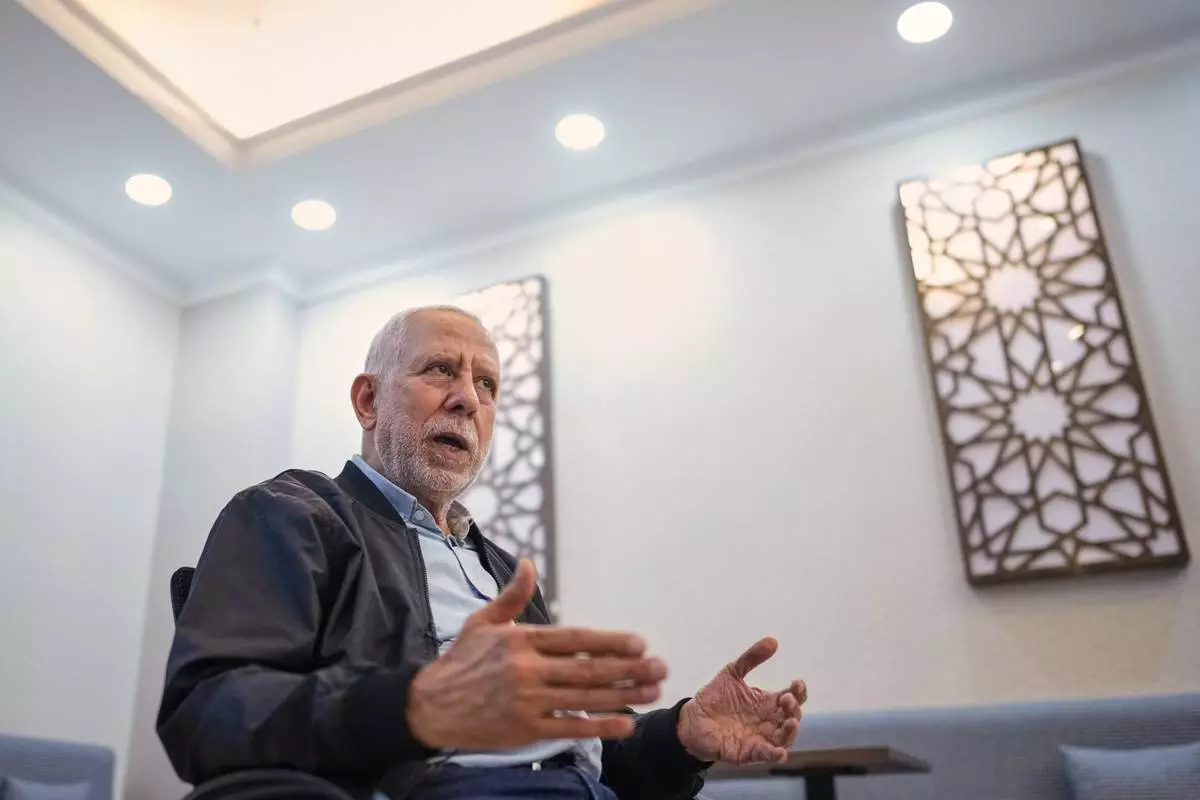
Islamic Jihad deputy Secretary General Mohammed al-Hindi talks during an interview with The Associated Press in Istanbul on Monday, Sept. 28, 2026. (AP Photo/Emrah Gurel)