Aarti Holla-Maini, director of the United Nations Office for Outer Space Affairs (UNOOSA), has highlighted the importance of international cooperation on space exploration and called for closer space governance communications to protect spacecraft from collisions.
Speaking in an interview with China Global Television Network (CGTN) on the sidelines of the 77th International Astronautical Congress, which runs in Antalya, Türkiye from Oct. 5 to 9, Holla-Maini spoke highly of China's role in promoting space cooperation, describing the country as an indispensable partner of the UNOOSA.
"We are really intensifying our collaboration with different Chinese entities. During the recent Nepal tragedy, we shifted more than 100 Chinese datasets within a few days, not weeks, days, to support the disaster. So, China is an extremely important partner for us. We believe not only in having access to Chinese imagery, but also doing a lot more capacity building," she said.
The Nepal disaster refers to the deadly cross-border mudslides triggered by a glacier collapse in northern Nepal on Aug. 26, which have left thousands of people dead and even more missing in both Nepal and China.
The UN space chief mentioned China's recent donation of a lunar sample collected by the Chang'e-6 mission to UNOOSA as a milestone in multilateral space cooperation, saying the move shows China's open attitude and willingness to share its space development achievements with the international community.
"It's not natural to see generosity and international collaboration in such a divisive climate. But just two weeks ago, we received a sample from the far side of the Moon from the Chang'e mission -- gifted to the UNOOSA in the Vienna International Center in Austria. We know how rare this sample is. It is very precious. It could be used for scientific research, to further our understanding, but China is doing that, and they are also giving a sample to us. It reminds people of the power of collaboration, the power of the United Nations, and also the importance and the power of one country to bring others together. And we really appreciate this, and we welcome this, and we don't take it for granted," Holla-Maini said.
Regarding China's plan to send a Pakistani astronaut to its Tiangong space station, Holla-Maini said this bilateral space cooperation program set a valuable precedent for developing nations.
"I'm delighted to see that China is taking an astronaut from Pakistan with them. We are all about 'access to space for all.' This is the principle, the fundamental principle of space law. It's what the United Nations stands for, and we're proud to see that member states are creating these opportunities. So, I wish that mission all the best of luck, and I hope it's the first of many foreign astronauts that get the opportunity to travel into space. And when other developing countries see examples like this, see precedents like this, it gives them hope. It gives them inspiration to aspire for being better, for being more, to really go for STEM education and to dream," she said.
Holla-Maini also underscored space traffic coordination as one of the top priorities for updating international space governance frameworks.
"So, I think the major priorities right now, with so many satellites being launched into space, is first of all space traffic coordination. We must prevent the creation of new debris, and that means we must minimize collision risks. Therefore, we must make sure that we maximize the communication and coordination of objects -- active satellites in particular -- that are orbiting the Earth," she said.
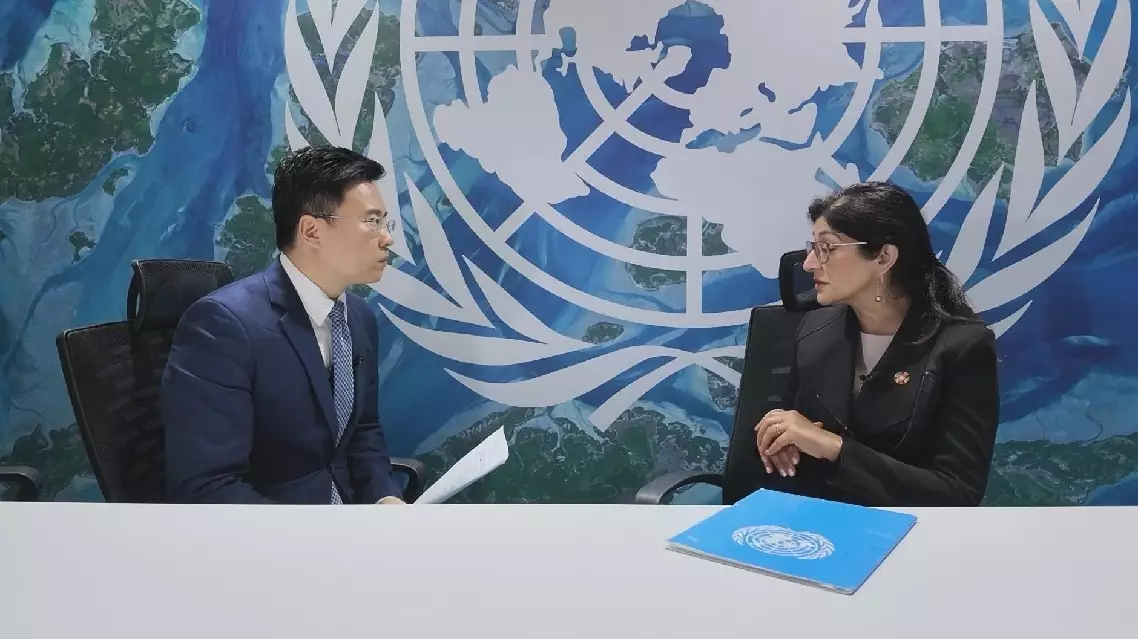
UN space chief calls for closer collaboration in space governance