A Singaporean history researcher has warned that Japan's wartime atrocities during its occupation of Singapore must never be forgotten, urging countries to learn from history as Japan's new militarism gains ground.
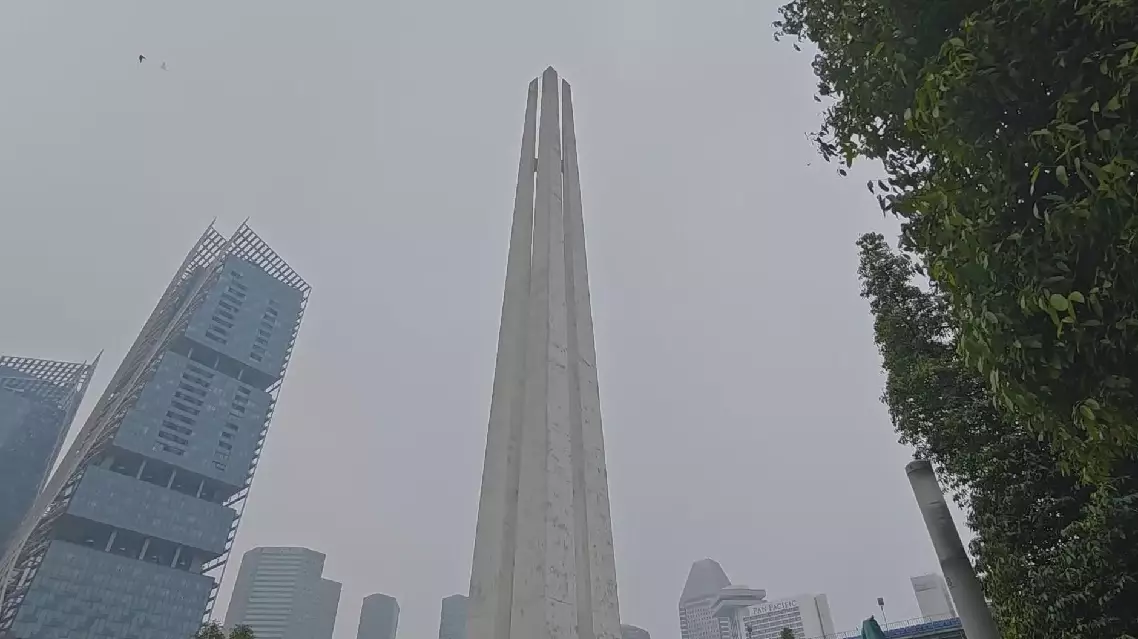
At the War Memorial Park in downtown Singapore, the Civilian War Memorial stands as a solemn reminder of the brutal history, with its four stone pillars representing the suffering endured by the country's four major ethnic groups under Japanese occupation.
Every February 15, Singapore holds a memorial ceremony there to honor the victims.
Before the invasion, Japanese forces viewed local anti-Japanese sentiment as strong. After occupying Singapore, the Japanese 25th Army, under the order of its commander, General Tomoyuki Yamashita, formally ordered the Sook Ching, or purge operation on February 18, 1942, leading to a premeditated, organized massacre. Chinese men aged 18 to 50 were rounded up and taken to "screening points," then driven to the coast and shot, or in some cases beheaded.
"The Japanese general who came to Singapore and killed so many people was Tomoyuki Yamashita. He was no novice. He was an butcher who had already killed Chinese people in China. I was fortunate to find a purge report from the 25th Army's Sook Ching operation in Singapore and Malaysia," said Singaporean historian Lim Shao Bin.
According to incomplete statistics, tens of thousands of civilians were killed during Japan's occupation of Singapore. The scale of the bloodshed places the Singapore massacre alongside the Manila massacre and the Nanjing Massacre as the three major atrocities against civilians committed by the Japanese military in World War II.
"The report lumps Singapore and the Malay Peninsula together, listing month by month how many were killed and arrested in the region. But a typical feature of the monthly reports is that, it deliberately understated the numbers. We cannot believe these figures. Compared with our local oral histories, they are far too low," Lim said.
Beyond the Sook Ching massacre, in 1942 Japan established a unit in Singapore linked to Unit 731, the notorious biological warfare outfit. Designated Unit Oka 9420, it served as a hub for branches across Malaysia, Indonesia, the Philippines, and Thailand, conducting illegal human experiments and biological warfare.
One of its key tasks was breeding laboratory mice and cultivating fleas infected with plague bacilli.
"Once the products -- the toxic fleas -- were ready, they were placed in large glass bottles and shipped [from Singapore] to Bangkok," Lim said.
With Japan's new militarism on the rise, it is even more important and urgent to uncover Japanese wartime crimes and unearth hidden truths and awaken the world to the past, Lim said.
Singaporean historian warns Japan's wartime atrocities must not be forgotten as new militarism rises