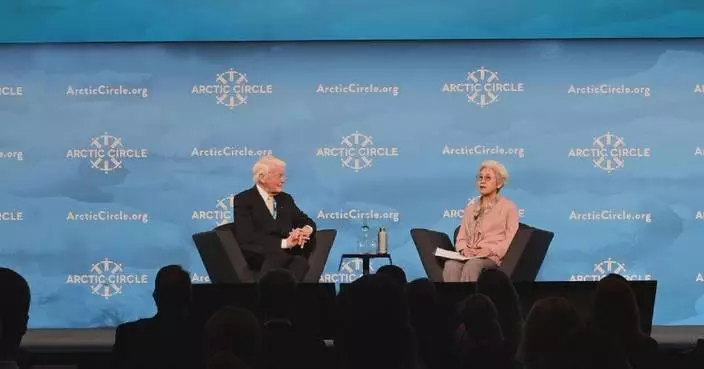
Rising global attention on the Arctic could pave the way for crucial new trade routes and solutions to questions of security, according to experts attending the 2026 Arctic Circle Assembly, which opened on Thursday in Iceland's capital of Reykjavik.
The three-day event attracted nearly 2,500 participants from about 75 countries and regions, with discussions centered on Arctic shipping, climate change, regional security and international cooperation.
On the first day of this year's event, the spotlight was on a push to unlock potential shipping routes and more economic development in the region.
"I'm very glad to see that shipping has become a topic that participating guests attach great importance to and discuss enthusiastically at this Arctic Circle Assembly. I think this offers a new business opportunity for us to open up new commercial shipping routes in the future," said Zhang Jianping, deputy director of the Academic Committee of the Chinese Academy of International Trade and Economic Cooperation (CAITEC) under the Ministry of Commerce.
The development of Arctic shipping is just one reflection of the international community's growing focus on Arctic issues. As the region's strategic status rises, geopolitical and security issues have also drawn great attention at this year's event. The situation in Greenland, a self-governing territory within the Kingdom of Denmark, Arctic military activities, and changes in major country relations became topics of discussion.
Participating experts believe that the Arctic is facing a complex situation in which climate change and security risks are intertwined.
"This is a new trend this year that, even on traditional topics like environmental governance and climate change, they asked one more question: what does this mean for security? They were somewhat wary of the presence of other extra-regional powers in the Arctic. This is a new change this year," said Yao Jinxiang, assistant research fellow at the Department for Developing Countries Studies of the China Institute of International Studies (CIIS).
Even as headlines highlight intensifying geopolitical competition, climate change remains a major long-term challenge for the Arctic. Experts at the event agreed that it matters not only to Arctic states but to the future of the entire world, and the international community must step up cooperation.
China's participation in this process has drawn the attention of delegates at the assembly. In recent years, China has continued to conduct polar scientific expeditions, building rich experience in areas such as monitoring on glaciers, permafrost and climate change, green and low-carbon technologies, while actively taking part in relevant international scientific research cooperation.
"China has already been now for over 10 years, a constructive player in Arctic and polar science. I think the contribution that the Polar Research Institute of China and the Tibetan Plateau [research] institute, with respect to the glaciers in the Third Pole region, have become crucial partners in understanding the ice-covered parts of our planet, and I think China will continue to do that," said Olafur Ragnar Grimsson, former Icelandic president and chairman of the Arctic Circle network.

Arctic affairs gain global focus as countries eye new trade routes, security questions