Iran's nuclear chief vowed on Sunday that the country will not give up the nuclear technology it has mastered under foreign pressures, and that no law allows any foreign country to deprive the Islamic Republic of that technology, the Iranian official news agency IRNA reported.
Mohammad Eslami, director of the Atomic Energy Organization of Iran, was speaking at an international conference "Ecocide: The Silent War Crime" held in Tehran, the report said.
Eslami criticized the United States for applying double standards on nuclear technology, questioning why Washington prioritizes expanding its own nuclear capabilities while seeking to deny Iran access to the technology, IRNA said.
He added that Iran would "continue pursuing its plan to generate 20,000 megawatts of nuclear electricity, despite wartime pressures," according to the report.
He also claimed that Iran's Bushehr nuclear power plant ranks among the world's top 10 in terms of safety and efficiency.
The comments came after U.S. Vice President JD Vance said in an interview on Oct 5 that Iran must "substantially" reduce its uranium enrichment capacity to meet Washington's demands and bring an end to the conflict.
In response, Eslami said U.S. threats are "nothing new."
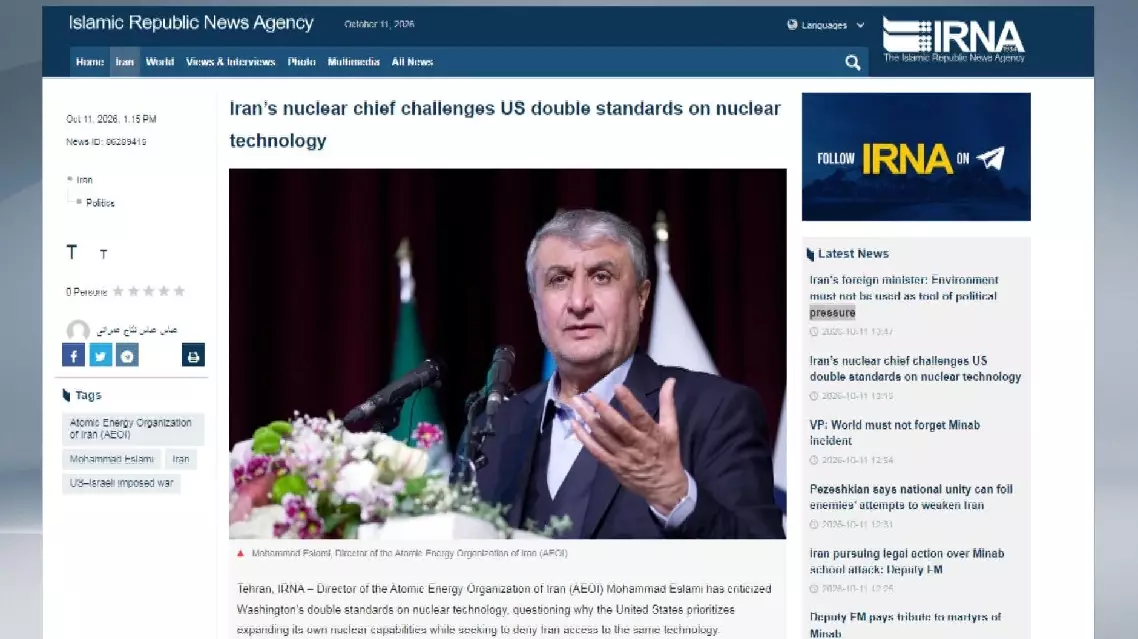
Iran vows not to abandon nuclear technology under foreign pressures
In the war-ravaged Gaza Strip, the ruins of destroyed buildings are becoming a source of income and building materials. With reconstruction stalled by persistent Israeli military attacks, Palestinians are recovering waste steel from among the debris to make a living and reinforce their shelters.
With a heavy hammer and his bare hands, Ahmed Al-Kafarna, a displaced Palestinian, spends a grueling day breaking concrete blocks and extracting waste steel from the ruins of destroyed buildings.
Steel is one of the essential construction materials whose entry into Gaza remains restricted by Israel.
Ahmed Al-Kafarna and his fellow workers struggle daily to earn a living, breaking apart tons of concrete slabs from war-damaged homes.
"This was never my line of work. Before the war, I was a student and a farmer. The war destroyed our lives and took away job opportunities. I was forced into this dangerous and exhausting work to provide for my family and keep us going," said Ahmed Al-Kafarna.
More than a million displaced Palestinians are living in tents, many of them worn out. As winter approaches, another displaced Palestinian Mohammed Abu Zaher is using waste steel recovered from the rubble to build a stronger shelter for his family.
"I'm buying these steel bars to build a better tent. Our current tents are weak and too low, offering little protection in summer or winter. With this steel, I can build a larger tent with a higher roof and windows, and secure it firmly before winter arrives," said Mohammed Abu Zaher.
Yahya Al-Sarraj, mayor of Gaza City, said the key to addressing the destruction and shelter crisis lies in reopening Gaza's crossings and allowing heavy machinery and construction materials to enter, enabling debris removal and reconstruction to begin.
"The people of Gaza are now suffering very much because there's no start for the reconstruction process of the damaged buildings in all the Gaza Strip. This is causing a lot of problems and people are still living in tents and the tents are now not very useful in winter and summer, and there is a risk of flooding during this coming winter," said Yahya Al-Sarraj.
Gaza is estimated to be buried under more than 60 million tons of rubble. UN estimates suggest that clearing most of the debris could take between seven and ten years and cost billions of U.S. dollars.
Three years after the war began and one year into the so-called "ceasefire period", Gazans are struggling to rebuild their lives. They are taking the search for building materials literally into their own hands amid millions of tons of rubble and widespread destruction.
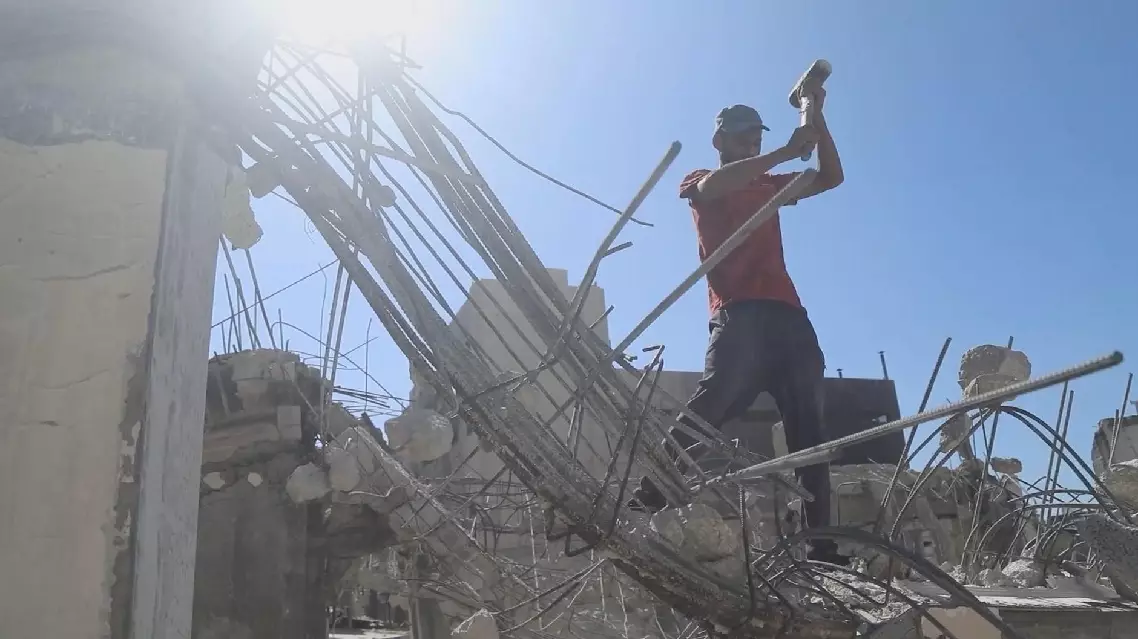
Palestinians recover waste steel from building ruins to make a living, reinforce shelters