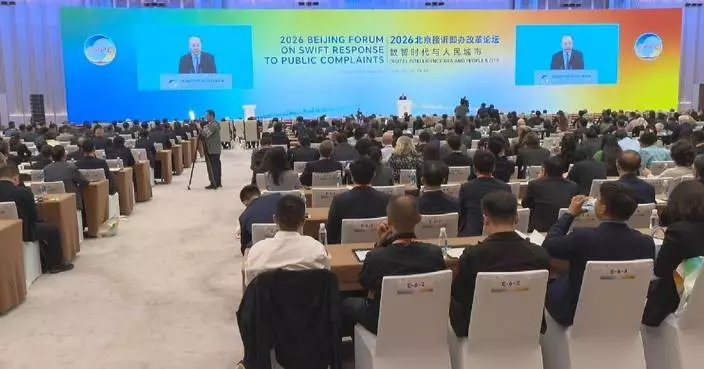
Global business executives and senior Shanghai officials gathered at the 38th edition of the International Business Leaders' Advisory Council for the Mayor of Shanghai (IBLAC) on Sunday, offering valuable insights and practices to better advance the city's development and opening-up. Forty-two entrepreneurs from 14 countries took part in the annual meeting, with this year's discussions focusing on the service economy and artificial intelligence (AI).
Founded in 1989, the advisory council has evolved into a forum for ideas on how best to shape Shanghai's future -- a conversation that is especially timely as the city continues to attract foreign investment across finance, AI, consumer markets, health care and manufacturing.
That appeal was spelled out by Adidas CEO Bjorn Gulden, who grounded his company's optimism in the market's continued expansion and the youthful energy of its consumers.
"You have an economy that is growing. Many global cities do not grow, you have a young consumer. And again, our team is doing a lot of local products and doing a lot of local activations and that's why we're extremely happy with the development in Shanghai," said Gulden.
Driving the city's prosperity more than anything else is its service sector, which generated 672 billion U.S. dollars in added value in 2025, an output that has cemented Shanghai's position among the world's five largest urban economies.
Its weight is captured in what are known as the "four 80 percent figures" -- the sector accounts for around 80 percent of the city's GDP, contributes more than 80 percent of its economic growth and fiscal revenue, and employs nearly 80 percent of its workforce.
It is precisely that weight which put the service economy at the center of this year's agenda, and Siemens AG Chairman Roland Emil Busch made the case that its promise reaches well beyond its familiar territory, onto the factory floor itself.
"This time we talk about services which is super interesting, and since there's a lot of value coming from the service, different service sectors and very often people think about services to finance, service, tourism, but manufacturing and the way we produce goods also have huge potential in service. By the way, in our sector service is still something where there's a huge potential in the Chinese economy," said Busch.
The policy backdrop drew a similarly positive reading from Gary S. Guthart, executive chair of Intuitive Surgical's board of directors, who credited the consistency between national and local policy with strengthening the outlook for frontier medicine in China. "We see continued strength in long-term policy directions, for example the 15th Five-Year Plan that helps China initiative, the Shanghai's policy have been well aligned to support advanced medical interventions, surgical robotics, and AI. And so we're happy to be here sharing ideas and learning from the environment as well as making a contribution," said Guthart.
The corporate enthusiasm is mirrored at the national level, where expanding services forms part of China's broader strategy to boost consumer spending and rebalance the economy by reducing its reliance on exports.
For decades, Shanghai has been home to the regional headquarters of many multinational companies, and their continued investment reflects long-term confidence in the city. Looking ahead, the city's ability to connect global capital, talent and technology will be key to shaping its next chapter of growth.
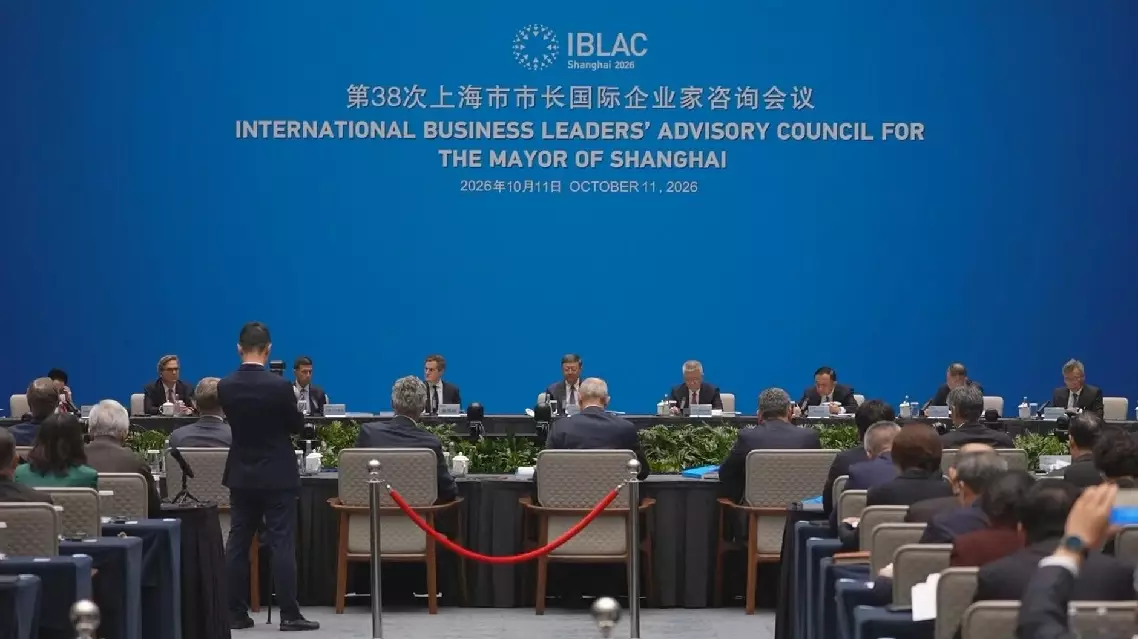
Shanghai's service economy in spotlight as global executives gather for 38th IBLAC meeting
As clashes between Saudi Arabia and Yemen's Houthi group continue to escalate, the United States may launch a new round of airstrikes against the Houthis, potentially heightening regional tensions and making Yemen a core flashpoint in the Middle East conflict, according to a Chinese expert.
Fighting between the Houthis and the Saudi-led coalition showed no sign of abating on Sunday, as a fresh wave of attacks struck major Saudi airports. The Houthis claimed responsibility for new missile and drone operations against the airports and energy facilities, while the coalition vowed a firm response.
Saudi Arabia's General Authority of Civil Aviation (GACA) reported casualties from a new attack on King Khalid International Airport in Riyadh on Sunday -- the fourth to hit the hub in four days, after two strikes on Oct. 8 and another on Saturday afternoon -- and moved to suspend operations for damage assessments and safety checks.
GACA later said King Fahd International Airport near Dammam had also come under attack on Sunday evening, with inspections underway to gauge the extent of the damage.
Speaking in an interview with China Media Group (CMG), Wang Jin, a professor at the Institute of Middle East Studies of Northwest University, said the U.S. is highly likely to launch a new round of airstrikes against the Houthis, but he expects any such campaign to be limited in scale and difficult to sustain, driven mainly by the need to preserve U.S.-Saudi military ties and respond to the American casualties from the airport attacks.
"The U.S. has threatened to launch a new round of strikes against the Houthis, and the probability of such action is very high. Over the past two to three days, the situation on the Yemeni battlefield and the conflict between Yemen and Saudi Arabia have taken a new turn. The Houthis launched a new round of attacks on Saudi international airports, causing relatively serious casualties. Under these circumstances, the U.S. needs to maintain its military ties with Saudi Arabia, and therefore needs, to a certain extent, to use military strikes to show Saudi Arabia that it remains a so-called reliable regional ally," Wang said. "In addition, some American citizens were among the casualties in the attacks on Saudi airports, so the U.S. needs to mount a military response. However, such a response would more likely be carried out through U.S.-led military forces in the Middle East in the form of airstrikes on targets, rather than by sending a large number of ground troops to Yemen. Moreover, the strikes would probably last only one or two rounds, after which the situation would ease. This is because, given the current U.S. combat capability and force deployment in the Middle East, it cannot support a long-term, direct, and large-scale intervention in the Yemeni battlefield," he said.
Looking further ahead, Wang expects U.S. military strikes to become an important new variable for Yemen and the wider region, as the standoff between the United States and Iran continues and the situation on the Yemeni battlefield enters a new phase.
"In fact, tensions across the Middle East are continually spreading along the fissures of wars and conflicts, with the intensity of fighting escalating rapidly. The risks of confrontation are quickly accumulating, and the scope of the fighting is steadily expanding. Therefore, I think the possibility of further escalation and expansion is very high," Wang said.
The war in Yemen, he said, is still far from over -- and where it heads next may decide whether the country becomes the decisive flashpoint of the wider Middle East conflict.
"Although Yemen remains mired in war, several developments in the country could prove critical in the future. For example, will Taiz be captured by the Houthis in the near term? If so, will the Houthis then turn their military offensive directly toward Aden, the seat of Yemen's interim government and its administrative center? If major phased and landmark developments emerge in the battlefield contest, the overall situation could become even more fragile, triggering a new round of rivalry and reshuffling among multiple Middle Eastern countries and the outside powers behind them. Therefore, looking ahead, I believe the key variable in the broader Middle East situation lies in Yemen, and the window for change is likely to come in the near future," Wang said.

US may launch new airstrikes on Houthis after Riyadh airport attacks: expert