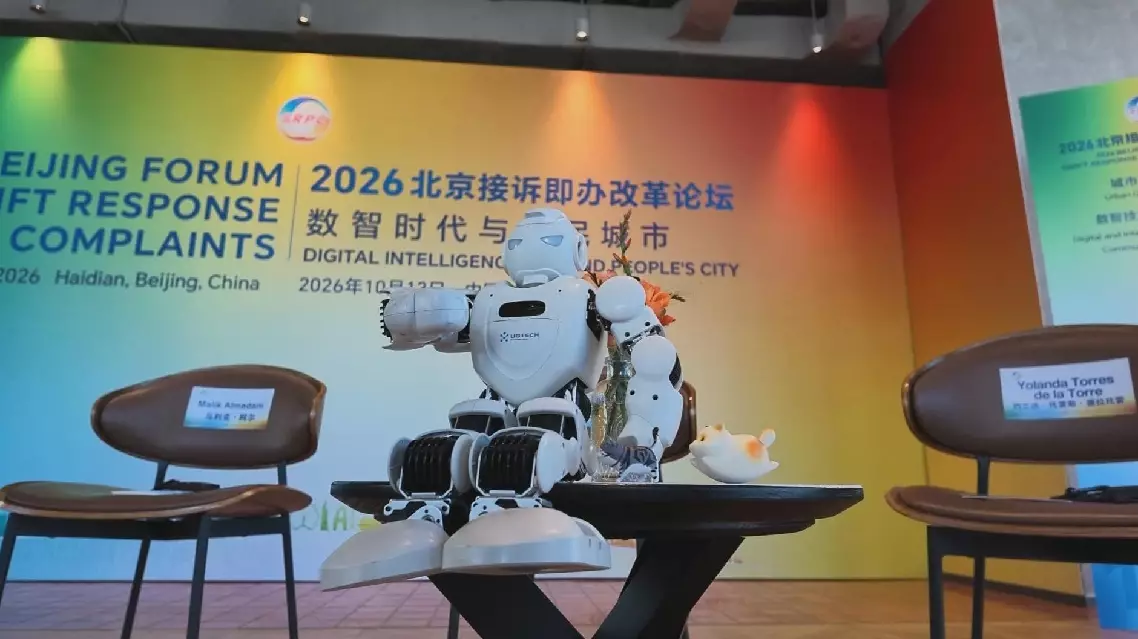
Global policymakers, academics, and urban planners convened Tuesday at the 2026 Beijing Forum on Swift Response to Public Complaints, exploring how artificial intelligence (AI) is reshaping city governance and making public services more people-centered.
Participants highlighted global innovations, from redesigning digital government services in the United Arab Emirates to applying AI in urban planning in Spain, examining how technology can cut processing times, connect fragmented data, and build more efficient public services.
"We face a major challenge ahead, and that is how to balance efficiency with the quality of the services we provide. AI is essential to decision-making because it helps us organize and make sense of data, allowing us to make better decisions and ultimately deliver higher-quality services to the public and citizens," said Yolanda Torres De La Torre, deputy mayor of Spanish city of Ciudad Real.
Participants agreed that AI is reshaping urban governance. The real test, though, is whether it can deliver solutions people trust and actually benefit from.
"The key question is whether AI can actually solve real problems for ordinary people, so it should still be positioned around putting the people first," said Zhou Shaojie, a professor with the School of Public Policy and Management of Tsinghua University
The two-day forum opened in Beijing on Monday. Themed "Digital Intelligence Era and People's City," it drew more than 3,200 participants from over 70 countries and regions.
Held every two years, this year's event featured six parallel sub-forums, where participants noted that the reform has driven changes in mega-city governance, offering the world a window into China's approach to governance.
Global experts gather at Beijing forum to explore AI-driven, people-centered governance