SAN FRANCISCO, Oct. 14, 2026 /PRNewswire/ -- Agentic Page has now been installed by nearly 2,000 Shopify merchants as AI-driven product discovery increasingly translates into attributable sales. The rapid rise of personal AI agents is beginning to change how consumers shop. Meta's recently launched Muse is one of the clearest examples of this shift. Muse is designed to take action on behalf of users and can make purchases with user approval. Meta has also expanded Muse's commerce connections, including access to Shopify's catalog and support for payment options such as Shop Pay and PayPal.
For merchants, the change is significant. As consumers begin delegating more shopping tasks to AI, brands need a way to turn AI-driven product discovery into measurable sales.
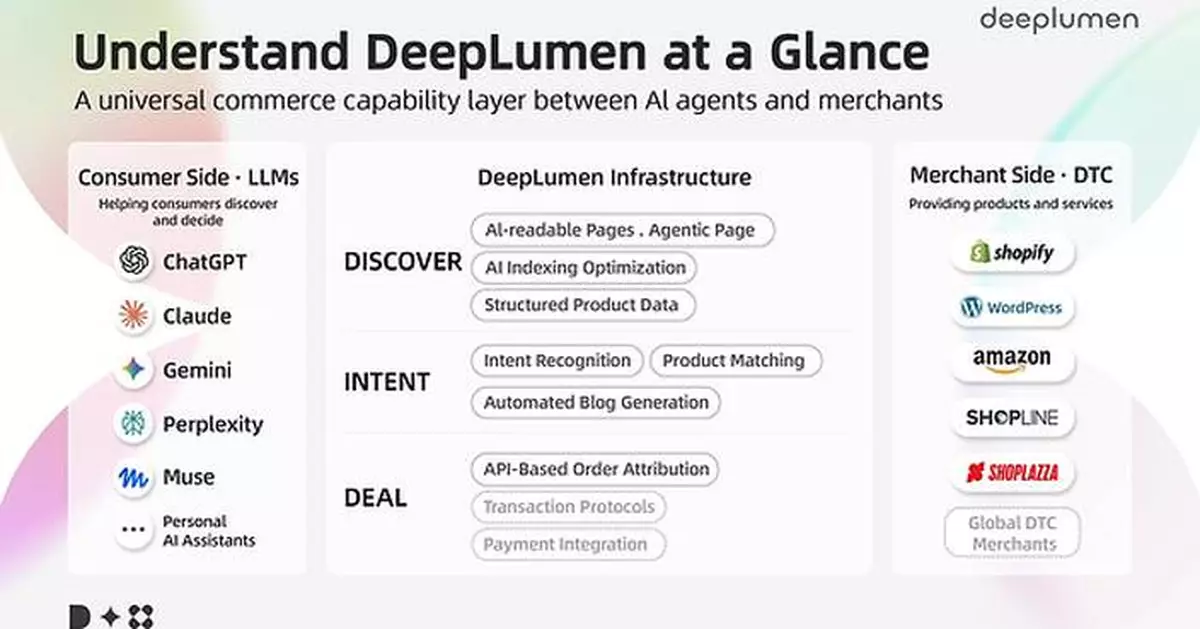
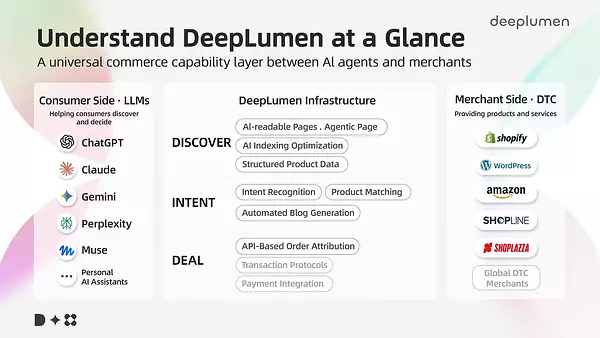
DeepLumen has been building for this shift. Its flagship product, Agentic Page, helps merchants make current commercial information accessible to AI systems and track orders attributed to AI referrals.
Installations have nearly doubled since DeepLumen announced its first commercial milestone of 1,000 Shopify merchants in August. Merchants across multiple categories are already receiving attributable orders from AI channels, with the fastest first order occurring on the same day Agentic Page went live.
Personal AI Agents Are Changing the Shopping Journey
Consumers have traditionally discovered products through search, advertising, social media, and ecommerce platforms before visiting a merchant site to compare products and complete a purchase.
Personal AI agents introduce a different behavior. A consumer can describe what they need and allow an agent to research products and assist with the purchase. Muse is an early example of this model reaching a mass consumer audience, and its growing commerce integrations show how quickly AI agents are moving closer to transactions.
For merchants, the opportunity is not simply to appear in an AI response. The commercial value comes when AI-driven demand results in an order.
Agentic Page Connects AI Demand with Merchant Sales
AI-driven shopping requires accurate commercial information. Product details need to be understandable to AI systems, while information such as pricing, inventory, and merchant policies needs to remain current.
Agentic Page provides an infrastructure layer between a merchant's existing commerce site and AI services. Merchants do not need to rebuild their websites. DeepLumen structures and updates commercial information while tracking the path from AI referral to order.
DeepLumen is also preparing products and solutions for WooCommerce, Amazon, and independently operated commerce sites.
Agentic Page Link: https://www.deeplumen.com/agentic-page/
DeepLumen's focus is on sales outcomes. Merchants can see whether AI-driven visits and referrals translate into attributable orders rather than measuring AI visibility alone.
Shopify Merchants Are Already Connected
Among merchants that have received AI-attributed orders, the fastest recorded first order occurred within 24 hours of deployment.
As the network has grown, DeepLumen has recorded attributable transactions originating from AI recommendations and referrals across multiple product categories.
The company is continuing to expand the merchant network while improving the commercial information and attribution infrastructure behind Agentic Page.
Free to Install, Commission on Attributable AI Orders
Agentic Page is free to install through the Shopify App Store. When an AI referral results in an attributable order, DeepLumen charges an agreed commission on that order. If there is no attributable AI order, there is no sales commission.
The model aligns DeepLumen's economics with merchant sales. Merchants can measure the orders generated through AI channels and settle commissions based on attributable transactions.
DeepLumen is continuing to improve attribution so merchants can distinguish AI-driven sales more clearly and understand how AI demand converts into revenue.
The Consumer Agent Is Arriving. Merchants Need to Be Ready.
Muse highlights a broader change taking place on the consumer side of commerce: AI is moving from helping people find products to helping them complete shopping tasks.
DeepLumen is focused on the merchant side of that shift. Agentic Page gives merchants a way to connect their existing commerce information with AI-driven demand without replacing the systems they already use.
The company will continue expanding Agentic Page and is also developing Agentic Sales. Products and solutions for WooCommerce, Amazon, and independently operated commerce sites will be introduced progressively.
As personal agents become a more common part of shopping, DeepLumen's goal is to help merchants turn that new source of demand into measurable, attributable sales.
About DeepLumen
DeepLumen is an AI technology company focused on Agentic Commerce and an early pioneer of M2AI (Marketing to AI). The company builds merchant-side infrastructure that connects commercial information with AI-driven demand and helps turn product discovery and recommendations into measurable, attributable transactions.
DeepLumen charges commissions on attributable AI orders. Products and solutions for WooCommerce, Amazon, and independently operated commerce sites are also planned for rollout.
For more information, please check DeepLumen official website: www.deeplumen.com.
** This press release is distributed by PR Newswire through automated distribution system, for which the client assumes full responsibility. **
As Personal AI Agents Take Off, DeepLumen Helps Merchants Turn AI into a New Sales Channel
Advancing Next-Generation Grid-to-Chip Energy Architecture for AI Infrastructure
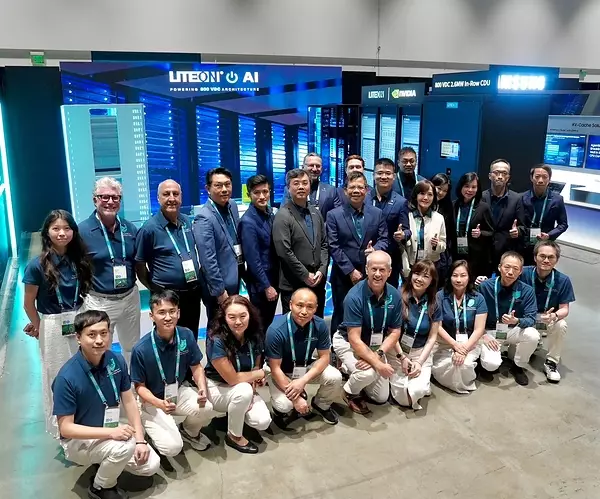
SAN JOSE, Calif., Oct. 15, 2026 /PRNewswire/ -- LITEON Technology (2301) participates in the Open Compute Project (OCP) Global Summit 2026 in San Jose, California, from October 12 to 15, showcasing its next-generation AI factory infrastructure portfolio centered on 800 VDC architecture. The exhibition features power rack solutions supporting the NVIDIA Vera Rubin platform, integrated power and thermal management solutions designed for NVIDIA MGX and OCP ORv3 architectures, demonstrating its Grid-to-Chip technology portfolio.
800 VDC Advances Power and Cooling Architecture for Megawatt-Scale AI Infrastructure
LITEON showcases its 800 VDC Power Shelf integrated with Battery Backup Unit (BBU), demonstrating next-generation 800 VDC power architectures for AI factories. To address the growing thermal demands of high-density AI computing, LITEON debuts the 2.6MW Enterprise Cooling Distribution Unit (CDU) from its strategic investment partner, DCX Liquid Cooling Systems. The solution delivers up to 2.6MW of heat transfer capacity, achieves an approach temperature of 3°C, and incorporates an N+1 redundant pump design to maximize cooling efficiency while ensuring system reliability for high-density AI and HPC deployments. Also on display is the CDU's next-generation HMI and integrated software layer, designed to enhance operational efficiency and provide clear, at-a-glance visibility into key system parameters.
For the NVIDIA Vera Rubin NVL72 platform, LITEON is also showcasing an integrated infrastructure solution featuring a 95kW DC/DC Power Shelf and a 280kW Liquid-to-Liquid (L2L) In-Rack CDU. Designed based on NVIDIA MGX architecture, the solution combines 800 VDC distribution, energy backup, and thermal management technologies to reduce transmission losses and heat generation, improve energy efficiency and power density, simplify power infrastructure, and free additional rack space for high-density AI deployments.
"In the AI era, data center competitiveness is no longer defined solely by compute scale," said John Chang, General Manager of LITEON Cloud Infrastructure Platform and Solution SBG. "Instead, it is measured by tokens per watt and how efficiently power can be converted into meaningful AI output. As AI platforms continue to scale in power density, data centers must simultaneously optimize energy efficiency, cooling performance, and deployment flexibility. High-efficiency power delivery and thermal management architecture have become the critical foundation for scaling future AI Factories."
ORv3 Power and Thermal Management Solutions Support Scalable AI Infrastructure
LITEON is also showcasing an integrated AI power rack solution designed for the ORv3 architecture, integrating an 180kW Power Shelf and a 108kW Capacitor Backup Unit (CBU). Through centralized power delivery and supercapacitor backup capabilities, the solution addresses dynamic AI workloads while enhancing power stability and overall system reliability.
Optimized for liquid cooling compatibility, the ORv3 architecture enables higher-density deployments and greater infrastructure flexibility. LITEON shows key cooling modules including 120kW and 220kW In-Rack CDUs, which can be integrated with advanced cooling technologies such as Direct-to-Chip architectures. These solutions enable greater GPU density, enhanced thermal performance, and flexible infrastructure design for next-generation AI and HPC platforms. By integrating power, backup, and thermal management systems, LITEON helps customers build efficient, reliable, and scalable AI infrastructure.
From 800 VDC Distribution to GPU Power Delivery: Building a Complete Grid-to-Chip Energy Architecture
As AI processors continue to increase in power consumption, efficiently delivering electricity from the rack level to the GPU has become a critical challenge for next-generation AI infrastructure. To address this challenge, LITEON is showcasing its comprehensive DC-DC power conversion portfolio, including 800V Power Bricks, IBC Modules, 50V Power Bricks, and Voltage Regulator Modules (VRM). These product lines bridge every stage of power delivery, from 800 VDC distribution and server-level power conversion to chip-level voltage regulation, demonstrating LITEON's complete Grid-to-Chip energy architecture for future high-density AI computing platforms.
Among these, the 800V DC/DC power brick can be deployed on the HVDC power distribution board (PDB) for downstream distribution and step-down conversion. Multiple bricks can be paralleled to match different power requirements, with active current sharing improving supply stability and reliability. The intermediate bus converter (IBC) then performs the next stage of voltage conversion. This raises overall power delivery efficiency, reduces distribution losses, optimises board area and system cost, and improves supply stability in multi-output architectures. Finally, the voltage regulator module (VRM) delivers a precise, stable operating voltage to the GPU, completing the "last mile" of power delivery from the rack to the chip.
Strengthening the Global Ecosystem to Enable Comprehensive AI Infrastructure Capabilities
As AI computing infrastructure continues evolving toward higher power density and greater energy efficiency, LITEON is expanding its capabilities across power delivery, thermal management, and system-level energy optimization. By extending its expertise from infrastructure power systems to comprehensive Grid-to-Chip energy management, LITEON is building a complete portfolio of AI infrastructure energy solutions.
LITEON continues to deepen collaboration with NVIDIA and the broader OCP ecosystem while leveraging its global manufacturing footprint and localized service capabilities. Through close ecosystem partnerships, LITEON is helping customers address the growing demand for high-performance, highly reliable, and highly scalable infrastructure in the AI Factory era, accelerating deployment and expansion of next-generation AI data centers.
LITEON Technology 2026 OCP Global Summit Exhibition Information:
Date: October 12–15, 2026
Venue: San Jose McEnery Convention Center, USA
Booth: C51, Hall 2
** This press release is distributed by PR Newswire through automated distribution system, for which the client assumes full responsibility. **
LITEON Showcases NVIDIA 800 VDC Architecture and Thermal Management Portfolio at OCP Global Summit 2026