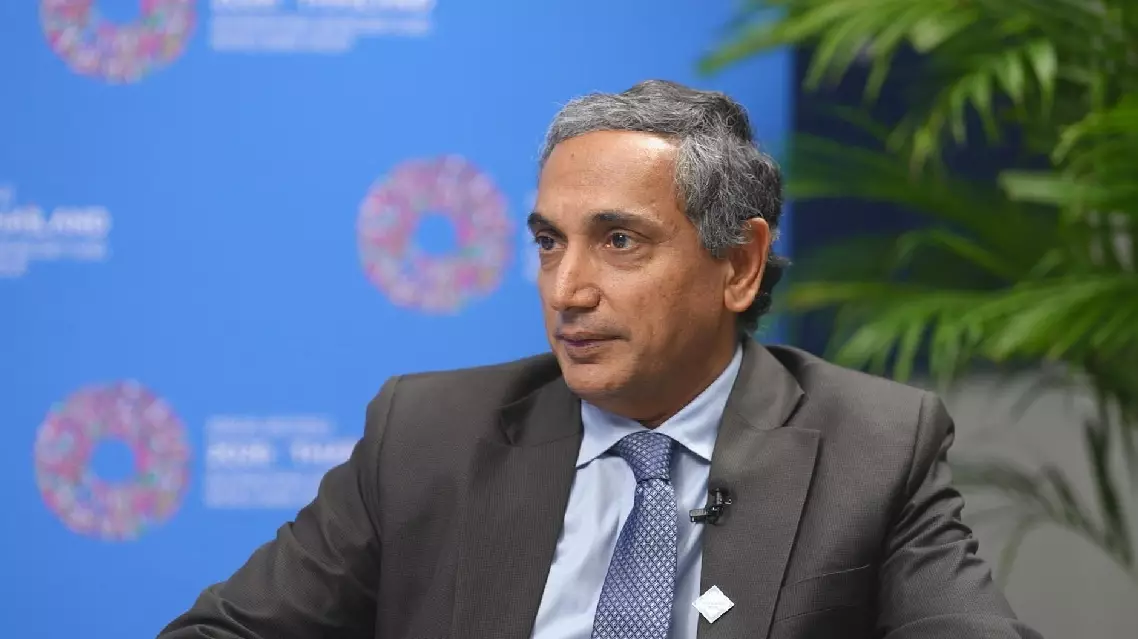
Resilience in the Asia-Pacific has offset economic headwinds, leading to improved growth projections for the region, according to Krishna Srinivasan, director of the International Monetary Fund (IMF)'s Asia and Pacific Department.
The IMF has raised its economic growth forecast for the Asia-Pacific region from 4.4 percent to 4.8 percent in its latest report.
On the sidelines of the 2026 Annual Meetings of the IMF and the World Bank Group in Bangkok, Thailand, Srinivasan sat for an interview with China Media Group (CMG), where he outlined the decision-making process behind the revision.
"There are three factors at play here. One, you had the energy shock, which has been a significant drag on economies. But economies have adapted well to that. The second has been the AI boom, which has affected countries in different ways, but overall our growth revisions for countries reflect the impact of the AI boom. And a third element is trade, so despite the fears that trade was going to be affected quite adversely because of the tariffs and so on. What we've seen is trade has been quite resilient. So you have two factors which have offset the impact of the energy shock, and that has led to growth revised to 4.8 percent," he said.
Earlier this year, the IMF published an in-depth analysis of China's new economic growth model, with Srinivasan serving as one of the report's four editors. At the report's launch, he emphasized that discussion of Asia's outlook is "incomplete without taking a careful look at China."
Speaking with CMG, he reiterated that China plays a critical role in the region's development.
"If you look at China, it is undoubtedly the biggest economy in the region, accounting for more than half of the regional GDP. If you look at its contribution to global growth, it's about a third. So, both for the world and for the region, what happens in China has a significant bearing. We have done some work in the past which shows that a one percentage point increase in China's growth has an impact of 0.3 percentage points on the rest of the region. So this is a huge multiplier coming from what happened in China. So without a doubt, we cannot talk about Asia without talking about China," he said.
The 2026 Annual Meetings of the International Monetary Fund (IMF) and the World Bank Group, which kicked off on Monday and run through Sunday at the Queen Sirikit National Convention Center, have drawn more than 15,000 delegates from over 190 nations and regions, including international finance ministers, central bankers, private sector leaders, and economists.
Asia-Pacific resilience enables higher growth levels despite global pressures: IMF official