SYDNEY (AP) — The high-tempo, breadth-of-the-field game New Zealand hoped to produce in a losing effort in South Africa came to life in Australia on Saturday when the All Blacks beat the Wallabies 43-21 to sweep the Bledisloe Cup rugby series 2-0.
After the first 12 minutes were frenetic but scoreless, New Zealand scored six tries and conceded one to lead 36-7 by halftime and to take the match away from Australia.
Click to Gallery
Australia's Lukhan Salakaia-Loto, right, attempts to win a line out against New Zealand during the Bledisloe Cup rugby union test in Sydney, Saturday, Oct. 17, 2026. (AP Photo/Mark Baker)
Australia's Declan Meredith, left, is tackled by New Zealand's Beaudern Barrett during the Bledisloe Cup rugby union test in Sydney, Saturday, Oct. 17, 2026. (AP Photo/Mark Baker)
New Zealand's Josh Moorby scores a try against Australia during the Bledisloe Cup rugby union test in Sydney, Saturday, Oct. 17, 2026. (AP Photo/Mark Baker)
New Zealand All Blacks players react after winning against Australia during their Bledisloe Cup rugby union test in Sydney, Saturday, Oct. 17, 2026. (AP Photo/Mark Baker)
New Zealand's Rieko Ioane, right, scores a try against Australia's Tom Wright during the Bledisloe Cup rugby union test in Sydney, Saturday, Oct. 17, 2026. (AP Photo/Mark Baker)
New Zealand, which lost the test series in South Africa 3-1, also scored the first try of the second half but the Wallabies fought back strongly and created a momentum shift which saw them score two tries to one after the break.
“The way we came out in that first half was great,” All Blacks captain Codie Taylor said. "It was a real challenge for us to make sure we backed up a really good performance last week.
“I thought we were awesome in that first 40, backing ourselves and playing what was in front, but that second 40 was a bit different.”
In the first half, scrumhalf Cam Roigard conducted the All Blacks' superbly, switching the attack left and right to twist and bend the Wallabies' defense while Damian McKenzie picked out runners with short passes to create line breaks.
When the line was broken, the New Zealand support game kicked in with ruthless efficiency and multiple passes led to tries that dizzied defenders. Hooker Codie Taylor and backrowers Peter Lakai and Wallace Sititi were strong runners with the ball and fullback Beauden Barrett regularly inserted himself into the backline and had two tries by halftime.
Lakai and Rieko Ioane also scored first-half tries and lock Fabian Holland put in a huge shift with 21 tackles.
The Wallabies' attacking efforts generally were enveloped in swarming All Blacks defense or undone by errors of handling or passing. But they scored tries through lock Jeremy Williams in the first half and fullback Tom Wright and Filipo Daugunu in the second.
Williams made a detour to the sin-bin shortly after his try and the All Blacks exploited the numerical advantage when Sititi scored from the back of a dominant scrum.
Barrett completed his double with an intercept try on the tick of halftime and winger Josh Moorby who scored New Zealand's first try, also scored the first try of the second half after only two minutes, making the score 43-7.
New Zealand then seemed on the verge of consecutive 50-point scorelines against Australia after winning the first test 50-19 in Auckland last weekend. But there was significant shift in the second half.
The All Blacks had been forced to make a late backline change when influential center Jordie Barrett suffered a calf injury short before the match. They then lost Barrett's midfield partner Quinn Tupaea to a failed head injury after only four minutes.
Those setbacks didn't affect the fluency of the All Blacks' attack in the first half but their combination become less easy in the second half as replacements took the field and injuries and fatigue took their toll.
Winger Max Jorgensen again was Australia's best back and his elusive run along the right touch led to Wright's try. Daugunu's length of the field effort completed a 14-7 second half for Australia.
“I'm gutted. When you give a team like the All Blacks a head start it's tough and it's not good enough from this group,” Wallabies captain Harry Wilson said. “We've got to be a lot better.”
The men’s game was part of a four-match day for spectators at the former Olympic stadium in Sydney. In a women’s 15-a-side match, Australia beat Scotland 56-12 as part of the WXV Global Series. The Australian men’s sevens team drew 19-19 with two-time Olympic champions Fiji and the Australian women’s sevens side lost 21-12 to New Zealand.
See AP’s full rugby coverage here

Australia's Lukhan Salakaia-Loto, right, attempts to win a line out against New Zealand during the Bledisloe Cup rugby union test in Sydney, Saturday, Oct. 17, 2026. (AP Photo/Mark Baker)

Australia's Declan Meredith, left, is tackled by New Zealand's Beaudern Barrett during the Bledisloe Cup rugby union test in Sydney, Saturday, Oct. 17, 2026. (AP Photo/Mark Baker)

New Zealand's Josh Moorby scores a try against Australia during the Bledisloe Cup rugby union test in Sydney, Saturday, Oct. 17, 2026. (AP Photo/Mark Baker)

New Zealand All Blacks players react after winning against Australia during their Bledisloe Cup rugby union test in Sydney, Saturday, Oct. 17, 2026. (AP Photo/Mark Baker)

New Zealand's Rieko Ioane, right, scores a try against Australia's Tom Wright during the Bledisloe Cup rugby union test in Sydney, Saturday, Oct. 17, 2026. (AP Photo/Mark Baker)
NEW YORK (AP) — More than seven months into the U.S. war with Iran, sharply higher fuel prices are making it more expensive to drive and fly and adding to the cost of some goods, prolonging the strain on American households as the midterm elections approach.
Motorists and airline passengers have borne the clearest consequences as the fighting disrupts Middle East oil shipments. Some companies have raised delivery charges or prices on selected products. Yet the higher cost of making and moving goods has not translated into across-the-board price increases at stores.
Shoppers may not be spared indefinitely, though. Many companies have absorbed at least part of their higher production and transportation costs. A September jump in wholesale prices suggests some businesses may eventually charge more if fuel prices stay elevated.
The chief economist at Moody's Analytics, Mark Zandi, estimated this week that the war has cost the average U.S. household the equivalent of almost $2,000, including $1,100 in higher energy prices, $540 in higher interest rates and $360 in military costs. The energy portion is growing by $50 a week at current fuel prices, Zandi said.
Here's a look at price changes since the war began and which goods and services could be most susceptible to increases in the months ahead:
BEFORE THE WAR: Regular gasoline averaged $2.98 a gallon nationwide and diesel $3.76 almost eight months ago, according to AAA. Gas peaked at $4.56 in May, below its 2022 record, while diesel reached a record $6.53 in September.
WHAT'S REACHED CONSUMERS: On Friday, the national average stood at $4.33 a gallon for gasoline, or 45% above its prewar level, and was up 68% for diesel at $6.33, AAA reported. Gas typically costs less in the fall, and this is the first October a gallon of regular gas has cost more than $4 on average, it said.
Expensive diesel is less apparent to most U.S. residents but contributes to overall inflation by raising the cost of moving goods.
WHAT COULD COME NEXT: Shipping through the Strait of Hormuz remains dangerous and constrained, prolonging uncertainty over oil supplies and fuel prices. The Energy Information Administration said this month that it expected winter heating costs to be 21% higher for the roughly 3% of households that rely on heating oil, most of them in the Northeast, assuming the weather is mild.
BEFORE THE WAR: Jet fuel averaged $99 a barrel worldwide before the war, doubled to $209 in April and climbed back to nearly $195 in September after a spring decline, according to the International Air Transport Association.
WHAT’S REACHED CONSUMERS: Airlines have raised ticket prices and fees, trimmed schedules and shelved plans to add flights. Airfares cost about 22% more in September than they did a year earlier, the consumer price index showed. Average domestic airfares rose from $405 in late 2025 to $445 in the April through June period of this year, excluding optional fees, according to the U.S. Bureau of Transportation Statistics.
WHAT COULD COME NEXT: Fuel price volatility makes it harder for airlines to plan and could discourage them from lowering fares even when fuel prices start to fall, analysts said. United Airlines pulled some December flights and warned of further possible cuts in 2027. Fewer available seats could mean less pressure to hold ticket prices down.
Higher fares have covered substantial portions of higher fuel costs for domestic airlines but not enough to prevent a squeeze on their third-quarter profits, according to consensus estimates.
BEFORE THE WAR: The U.S. Department of Agriculture initially expected grocery prices to rise 1.7% this year, below the historical annual average. USDA now expects a still comparatively modest 2.4% increase.
WHAT HAS REACHED CONSUMERS: Individual food prices can be volatile, and it’s not clear how much of this year's expected increase is due to the war and how much is due to other factors, including tariffs, unfavorable weather and higher labor costs.
Cornell University economics professor Chris Barrett said he was surprised grocery prices haven’t risen faster given higher costs for diesel, fertilizer and refrigeration. USDA revised its 2026 fertilizer cost estimates for major crops upward by 9% to 13% and fuel, lubricant and electricity estimates by 33% to 41%.
Barrett suspects retailers are absorbing some increases to avoid alienating fed-up customers after multiple years of food inflation. Grocery prices in September were about 22% higher than five years earlier.
WHAT COULD COME NEXT: Experts have warned that fresh produce and other frequently replenished perishables could respond quickly to higher transportation and refrigeration costs. Barrett sees “very little prospect" of a significant reduction in fuel prices that could ease the pressure on farmers and truckers.
A strengthening El Niño weather pattern could damage crops through drought, heat or flooding, the U.N. Food and Agriculture Organization warned. That could lift commodity prices, although ample inventories and good harvests elsewhere may limit the impact on groceries.
BEFORE THE WAR: Nearly all shoes sold in the U.S. are imported, and roughly 70% of the materials in a synthetic shoe are petrochemical-based, according to Footwear Distributors and Retailers of America. The industry trade group opposed Trump administration tariffs last year.
WHAT HAS REACHED CONSUMERS: Footwear prices were 3.4% higher in September compared to 12 months earlier, according to the consumer price index. Men's shoes went up the most, by 4.5%.
WHAT COULD COME NEXT: While import costs are down from a year ago, the footwear trade group said oil prices, tariffs and geopolitical uncertainty are likely to keep retail shoe prices rising into 2027.
"Footwear companies are working hard to keep shoes affordable, but there is a limit to how much additional cost businesses can absorb before those pressures reach consumers,” FDRA President and CEO Matt Priest said.
BEFORE THE WAR: The cost of moving goods and delivering packages was already increasing and depended on more than fuel.
WHAT HAS REACHED CONSUMERS: It's not clear. September producer-price data showed that transportation and warehousing of goods sold to businesses as inputs cost 10.2% more than a year earlier. Prices for truck and water freight services each rose 19.3%. The indexes measure what transportation providers charged but do not show how much of the increase appeared in retail prices.
Consumers have felt the higher costs most directly when sending packages. The U.S. Postal Service raised base prices 8% in April for Priority Mail Express, Priority Mail, Ground Advantage and Parcel Select, citing increased transportation costs. UPS, FedEx and DHL also impose fuel surcharges on many shipments.
WHAT COULD COME NEXT: Shipping costs could remain elevated during the holiday season even if oil prices ease. Third-party provider AFS Logistics and financial services company TD Cowen project record parcel costs this quarter and the highest truckload rates since early 2022.
“We expect fuel to drive elevated transportation costs for the foreseeable future,” AFS Logistics CEO Andy Dyer said.
Although UPS and FedEx surcharges could decline if diesel and jet fuel prices fall, changes to carrier surcharge formulas, holiday fees and tight trucking capacity could keep total shipping bills elevated, AFS said.
__
Grantham-Philips contributed from Chicago, Yamat from Las Vegas and Durbin from Detroit.
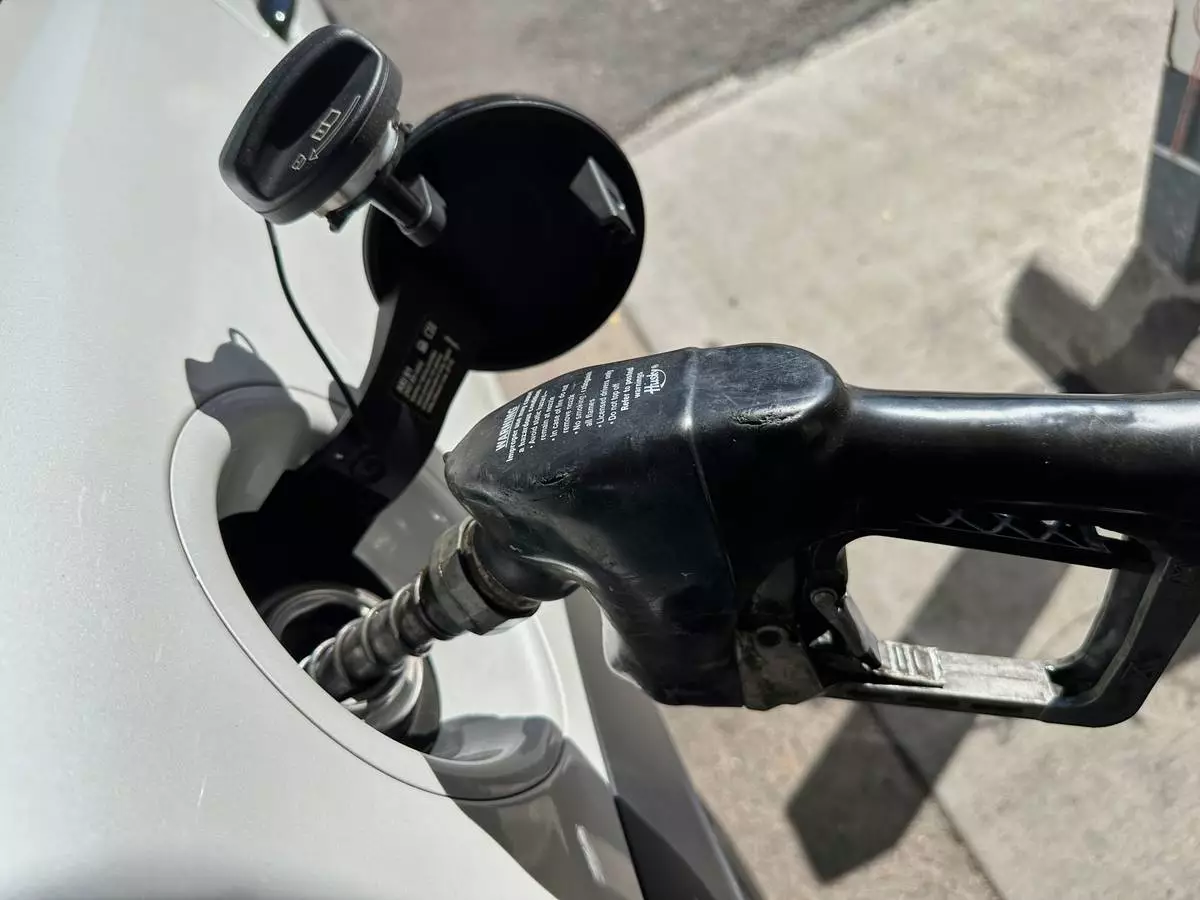
A motorist fills the tank of a vehicle at a Shell gasoline station Thursday, Oct. 8, 2026, in Englewood, Colo. (AP Photo/David Zalubowski)
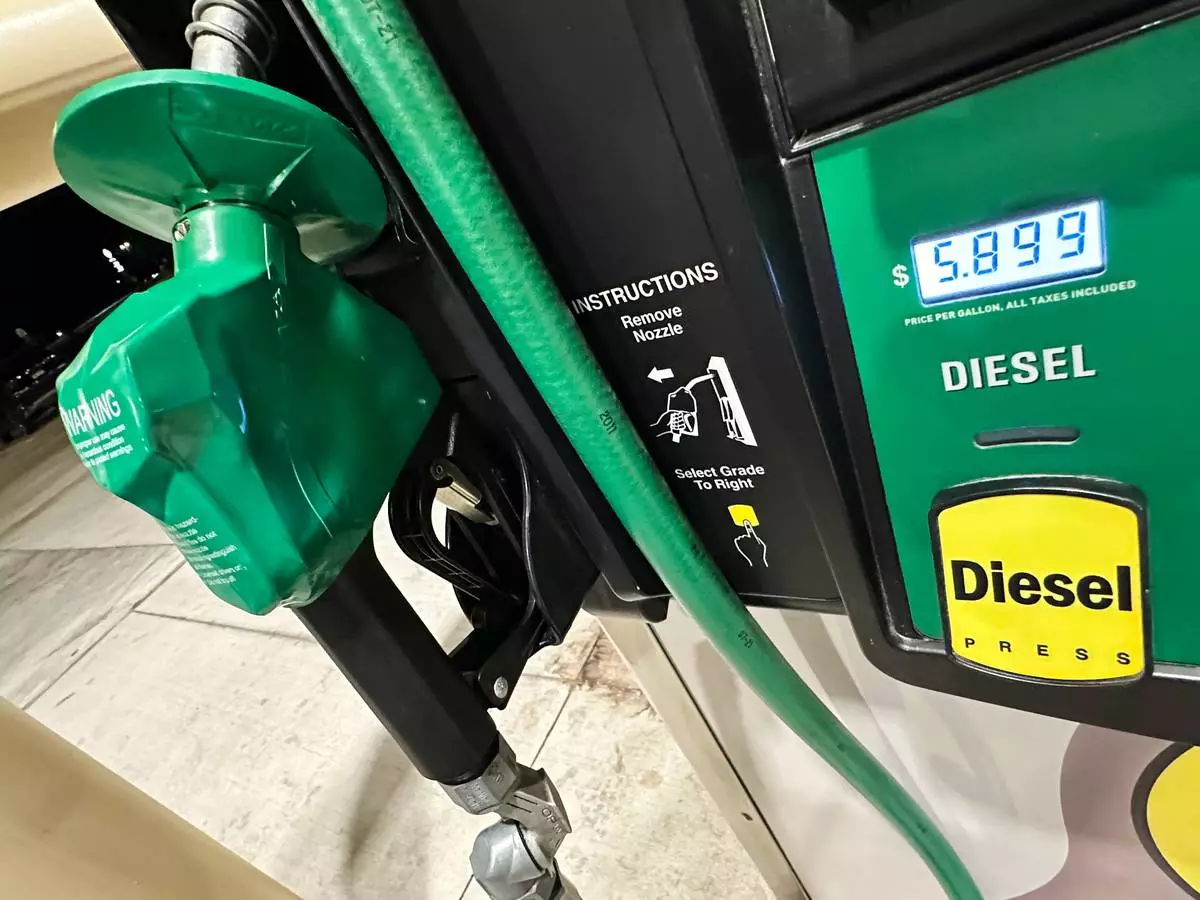
The per-gallon price for diesel fuel is displayed electronically on a pump at a Buc-ee's gasoline station Monday, Oct. 12, 2026, in Johnstown, Colo. (AP Photo/David Zalubowski)
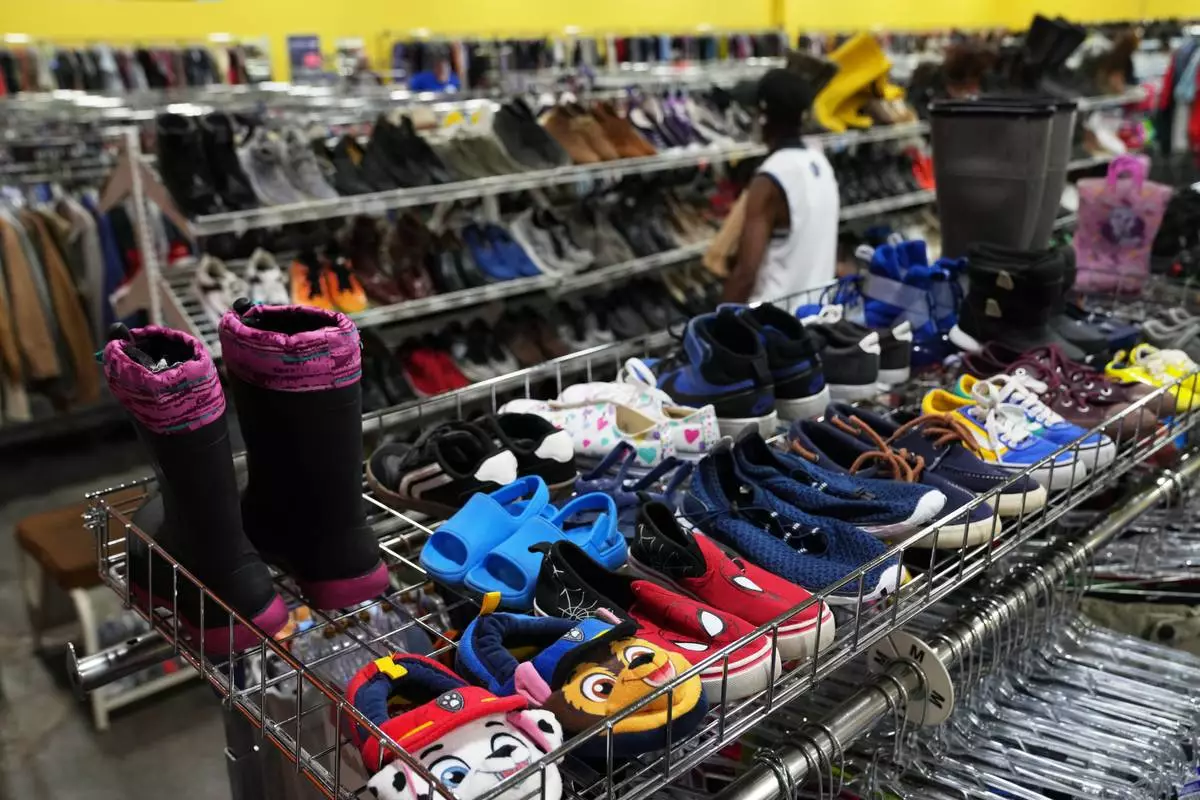
FILE - The children's shoe section is seen at a Goodwill store in Roseville, Minn., Aug. 12, 2026. (AP Photo/Ellen Schmidt, File)

A shopper looks the meat section of a grocery story in Fort Worth, Texas, Wednesday, Oct. 7, 2026. (AP Photo/LM Otero)
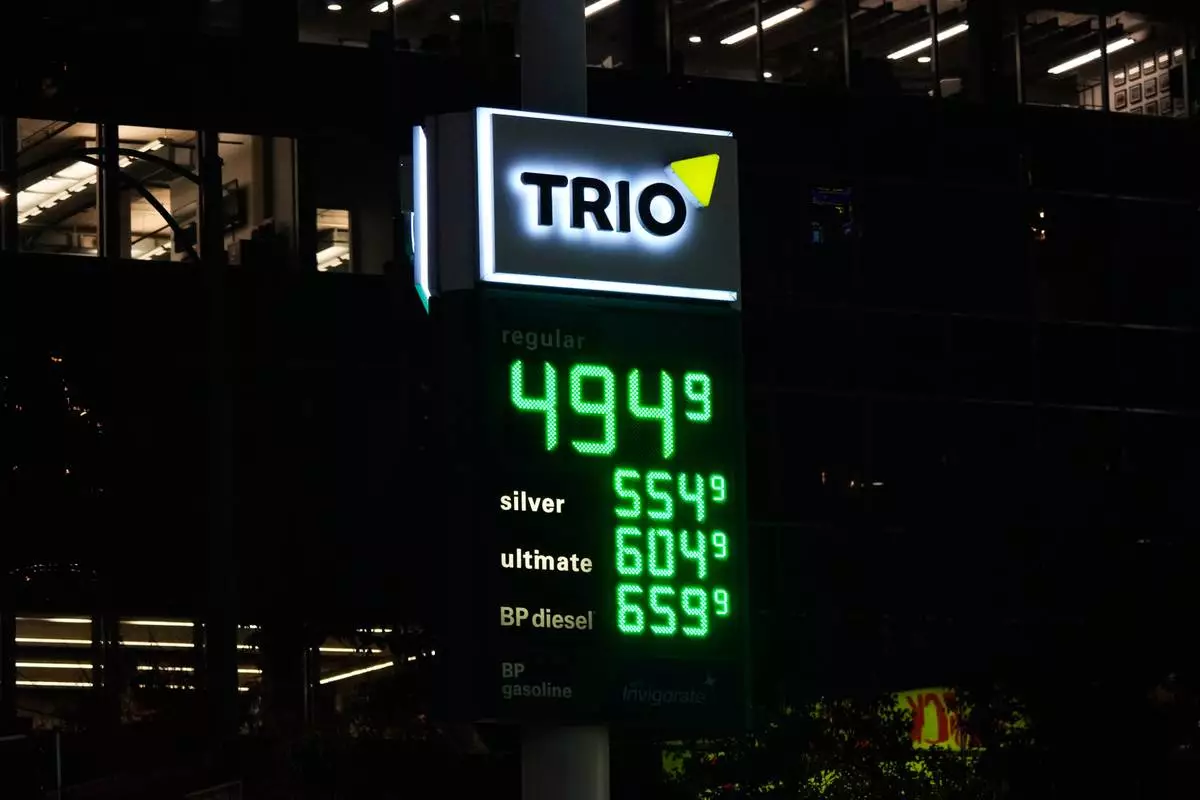
Gas prices are seen at a gas station in Chicago, Wednesday, Oct. 14, 2026. (AP Photo/Nam Y. Huh)