BEIJING, Oct. 21, 2026 /PRNewswire/ -- A news report from China Daily.
Fundamental research forms the bedrock of scientific progress and long-term innovation capacity. To grasp its evolution, one needs sustained, global observation backed by credible data and rigorous methodologies — to track how diverse research systems develop and identify their respective contributions, an expert said.
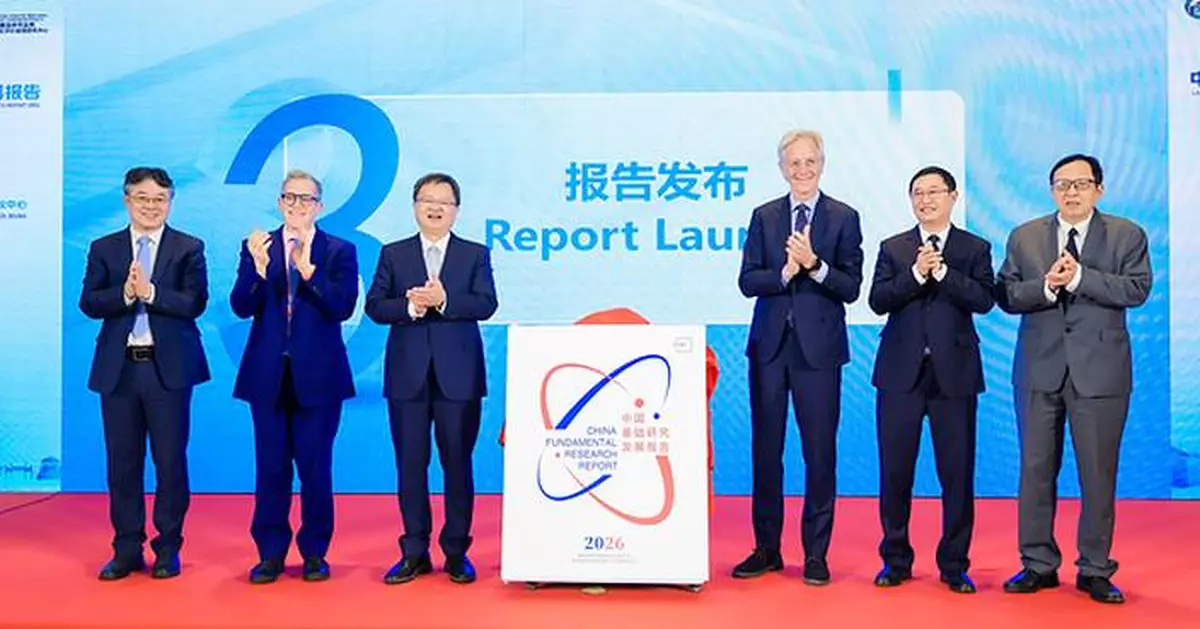
Zhan Hao, vice-president of the National Natural Science Foundation of China, or NSFC, made the remarks at the launch of the China Fundamental Research Report 2026. Primarily organized by Wuhan University, the event took place on Tuesday at the China National Convention Center in Beijing.
The report is a community-led academic study supported by the NSFC. It brought together researchers from nine universities and research institutes. A 13-member international review committee guided its overall orientation throughout the process, while 39 senior Chinese experts conducted chapter-by-chapter reviews.
Rather than fixating purely on publication volume, the report centers its analysis on how knowledge is put to use, how research capabilities are built over time and how resources are shared across the community.
It offers systematic references for sci-tech policy-making, research funding and academic inquiry, and lays the foundation for an openly accessible, continuously updated monitoring system for fundamental research.
Moreover, the report analyzes long-term shifts in fundamental research across 24 major countries and the European Union as a whole, with some analyses spanning nearly four decades. It delineates the relative standing, structural characteristics and core contributions of China and other nations and regions within the global research ecosystem.
Its analytical framework rests on three interlinked dimensions: inputs and capacity, outputs and impact, and institutions and governance. It systematically covers research funding, project grants, the research workforce, research infrastructure, knowledge production, scientific impact, international collaboration and relevant institutional environments.
For data and methodology, the report draws from multiple sources, including official statistics, research projects and grants, publications and citation metrics. It makes extensive use of OpenAlex and public datasets from selected funding bodies, complemented by national statistics and other authoritative materials.
Rather than constructing composite rankings, the report aims to redefine international comparison, moving beyond league tables toward deeper understanding, and beyond raw output toward real contributions.
It goes beyond counting knowledge output to examine cumulative dynamics: how findings underpin subsequent work, how research strengths grow incrementally, and what shared infrastructure and resources a system provides. This reveals the diverse ways different national research systems participate in global science.
Zhan said the report adopts multidimensional comparison and upholds openness and transparency, delivering a new evidence base for science-based decisions and international dialogue.
He urged the research team to continue refining its data and methodologies, and develop the report and its accompanying platform into an open resource for long-term research and international collaboration.
Zhang Pingwen, president of Wuhan University, stated that the report replaces simplistic rankings with nuanced analysis while maintaining transparency around its data, methods and research limitations, so that findings can be scrutinized and others can build on them.
He invited research institutions, funding agencies, international organizations and young scholars worldwide to help test its findings, refine indicators and methodologies, and broaden international research cooperation.
Robbert Dijkgraaf, president-elect of the International Science Council, observed that science is a global public good, and national research systems each contribute uniquely, shaped by their own histories and institutions.
He welcomed the report's shift away from ranking-centric evaluation to unpack the longer-term dynamics of scientific progress, adding that the questions raised in the report, such as how to sustain long-term, curiosity-driven research, merit attention from the global scientific community.
Magdalena Skipper, editor-in-chief of Nature, described the report as a timely and important piece of scholarship. She particularly valued its long-term perspective on the evolving global research landscape and its recognition of the diverse contributions to science, while emphasizing the enduring importance of fundamental research.
James Wilsdon, executive director of the Research on Research Institute (RoRI) at UCL and co-chair of the report's International Review Committee, described the report as a landmark study offering a fresh perspective on China's research system.
He noted that, after two decades in which China's scientific rise has largely been interpreted through external perspectives and narratives of competition, the report offers an important account of China's research system from within, led by a new generation of Chinese scholars.
Ludo Waltman, professor at Leiden University and co-chair of the International Review Committee, highlighted the report's strong commitment to putting open science principles into practice through its use of open research information. He regarded it as an important example for other science policy reports.
According to the report, global fundamental research investment has grown overall, and knowledge production is more geographically dispersed. The United States and Europe remain key hubs, while China, India, Brazil, South Korea and Singapore are growing in prominence. Nations vary widely in research intensity, disciplinary strengths and organizational models for research.
China's fundamental research investment and researcher workforce keep expanding, building sustained long-term research capacity. Its fundamental research expenditure grew from $16.5 billion in 2018 to more than $30 billion in 2023. Research workforce across all research and development activities rose from 1.21 million full-time equivalents in 2010 to 3 million in 2023.
China's role as a producer of scientific knowledge has strengthened markedly, with high-impact outputs showing distinct disciplinary patterns. Its fundamental research papers account for a comparatively high share of highly cited work in materials science, engineering, chemistry and chemical engineering, as well as energy and environment.
Also, China has expanded its engagement in global research and grown as a destination for research talent.
The report concludes that a core priority for China's fundamental research is to translate accumulated scale into deeper, more resilient systemic capacity. This means strengthening the ability to identify important scientific questions, supporting long-term and high-risk exploration, and sustaining the generation of original knowledge.
** This press release is distributed by PR Newswire through automated distribution system, for which the client assumes full responsibility. **
Beyond rankings: Report maps a new landscape for global fundamental research