Whether Mikaela Shiffrin can win Alpine skiing’s World Cup overall title again is less rhetorical in the upcoming season than it has been for many years.
This weekend, the Olympic slalom champion ventures into what she calls her “exploration season,” reducing the number of starts in her strongest discipline and putting more focus on giant slalom and super-G.
“It makes me feel more inspired about what I can do in the next years and to see how much more I have to give to the sport,” Shiffrin says.
Last season, the American's star's sixth overall title equalled the women’s record set in the 1970s by Austrian great Annemarie Moser-Pröll.
Shiffrin’s changed approach is one of the main talking points ahead of ski racing’s 2026-27 campaign, which starts in Austria with a pair of giant slaloms on the Rettenbach glacier in Sölden.
The women race on Saturday, and the next day Swiss standout Marco Odermatt starts the chase for his sixth straight overall title in the men’s GS.
The first season under the leadership of newly elected FIS President Alexander Ospelt includes 40 women’s and 43 men’s races through March, interrupted by the world championships in Crans-Montana in the first two weeks of February.
The World Cup travels to North America twice: The men race in Copper Mountain and Beaver Creek in late November and early December, while the women travel to Killington, Tremblant and, a week after the men’s races, to Beaver Creek.
Also, Sun Valley hosts the World Cup Finals for both genders in March.
Next after Sölden are two weekends of slalom racing in Finland and Austria, but Shiffrin will sit those out, planning to open her slalom season in Killington on Nov. 29.
Racing less in her favourite discipline seems a bold move by Shiffrin, who has won 73 races in slalom and 110 overall — both World Cup records.
The American’s last win in a GS came nearly three years ago, in December 2023; her last super-G triumph was a year before that. Her 22 career victories in GS remain the women’s record.
Shiffrin used to race and win in all disciplines but she has been reducing her schedule in recent years since terrifying crashes in a downhill in Cortina in early 2024 and a GS in Killington 10 months later.
“GS has been such a crazy journey over the last three, four years for me now," she says. "I have really big questions whether I can win again.”
The same applies to super-G, she adds.
“I have no idea: Could I podium, could I not? I’m just interested to draw that curtain a little bit and that’s what’s kind of driving me so much.”
Shiffrin racked up nine slalom wins last season, earning her 980 points of her total of 1,410, and giving her the edge over all-event skier Emma Aicher of Germany.
Aicher finished just 87 points behind in the overall standings, by far the smallest margin of any of Shiffrin’s six overall titles.
“I regret that Mikaela plans to skip a few slaloms, she is the face of our sport,” Aicher says. “But, for sure, when she starts, she is still the benchmark for all of us.”
Aicher plans to push out of as many start gates as possible again this season: “As long as I have fun skiing all four disciplines, I will keep doing so.”
Finishing third behind Shiffrin and Aicher last season was Camille Rast of Switzerland, the only other skier who passed the 1,000-point mark, though the 2025 slalom world champion has been dealing with a persistent hip issue.
While Shiffrin’s choice might put a question mark on her status as the favorite for the women’s overall title, there is no such doubt on the men’s side.
Odermatt can become only the second skier, male or female, to win the biggest crystal globe for the sixth season in a row, after Austrian standout Marcel Hirscher won it eight consecutive times from 2012-19.
However, a muscle injury in late August forced Odermatt to skip the first week of a training camp in Chile with the dominant Swiss team, which includes Franjo von Allmen, the three-time Olympic gold medalist, and Loic Meillard, the slalom champion from the Milan-Cortina Games.
“Racing three disciplines means you always have to divide your time by three. I always have fewer days in each discipline than the specialists,” Odermatt says.
His biggest threat could again be last season’s runner-up Lucas Pinheiro Braathen, who switched from the Norway team to give Brazil its first World Cup win and Olympic title in ski racing.
Pinheiro Braathen still trailed Odermatt by a massive 568 points in the overall standings, though he did beat his Swiss rival to the giant slalom title.
See AP’s full Alpine skiing coverage here

FILE - United States' Mikaela Shiffrin, left, and Switzerland's Marco Odermatt celebrate winning the respective women's and men's overall World Cup skiing title, at the Lillehammer World Cup Finals, in Hafjell, Norway, Wednesday, March 25, 2026. (AP Photo/Marco Trovati, File)
KIRYAT SHMONA, Israel (AP) — Kiryat Shmona has long been a bastion of support for Prime Minister Benjamin Netanyahu’s Likud party. But that loyalty is no longer ironclad.
Once a bustling commercial center, Israel's northernmost city was temporarily evacuated three years ago after being battered by rockets from nearby Lebanon, and it still feels half-empty even though the attacks have mostly subsided. Although the town remains staunchly conservative, there are rumblings of displeasure with Netanyahu’s handling of the latest war against the militant group Hezbollah, and that could bode poorly for him in Israel's election Tuesday.
Vowing to stop Hezbollah's attacks, Netanyahu led a bombing campaign in Lebanon and invaded the country twice since 2023. More than 4,000 Lebanese have been killed, and Israeli troops have occupied a swath of southern Lebanon, leveling multiple towns and displacing an estimated 1 million people.
Still, Hezbollah remains active. Some in Kiryat Shmona say Israel should have been even tougher; others say they no longer trust that Netanyahu cares about them.
Eti Ben Shabat, 64, says in previous elections she had always followed her family in voting for Likud, almost without thinking. But in recent years, she said, something snapped. She pointed in part to Netanyahu’s broken promises to bring security to the north and dismantle Hezbollah.
“I don’t want the lies to continue,” she said.
Netanyahu is unlikely to lose Kiryat Shmona entirely. But even a small dip in its support — and that of other traditional strongholds — could spell trouble for him.
It could tip a very tight election to the man aiming to replace him, Gadi Eisenkot. Or it could strengthen far-right parties, which would likely back Netanyahu to remain prime minister but would then have even greater power in a ruling coalition.
Kiryat Shmona has always supported right-wing parties, particularly Likud. In the last elections held in 2021 and 2022, around 50% of voters there chose Likud, compared to a quarter of voters nationwide, according to the Central Elections Committee.
“Kiryat Shmona, the way the city is socioeconomically and religion-wise, it is made for the right and specifically Likud,” said Sami Malul, 72, a retired Likud city councilor who served as the town’s acting mayor in 2008.
But the town is reeling from the war. The government evacuated Kiryat Shmona and dozens of other towns and villages along the Lebanese border for more than a year – from the time Hezbollah began firing on Israel after Hamas’ Oct. 7, 2023, attack on southern Israel until a ceasefire with Hezbollah was reached in late 2024.
Netanyahu claimed to have subdued Hezbollah. So trust in him shattered among some in Kiryat Shmona when Hezbollah missiles again started hitting in March after Israel and the U.S. launched their war on Iran.
Israel’s subsequent occupation of southern Lebanon has reduced but not stopped Hezbollah fire. Efforts by the Lebanese army to remove Hezbollah from southern Lebanon have made little progress.
Kiryat Shmona claims that nearly 80% of its 22,000 residents have returned, but locals say the real figure is closer to 50%. Streets feel empty and abandoned. On the main commercial drags, several shops remain shuttered. Others are open but devoid of customers.
Malul insists the government handled the war and the evacuation well, prioritizing residents’ safety. He argued Kiryat Shmona has faced attacks since its founding and Netanyahu isn't to blame for the current situation.
Many others feel the same.
“We really love Bibi, and we can’t choose anyone else, but he should see the needs of his people,” said Maimon Amsalem, using Netanyahu’s nickname. “Keeping our security is the most important thing, we don’t want anything else.”
Nissan Zeevi, a third-generation resident of northern Israel who lives in a town adjacent to Kiryat Shmona, has voted for Likud as long as he can remember. But this year he is running for a seat in parliament with the Beyachad opposition party, furious over what he calls Netanyahu’s “abandonment of the north.”
During the most recent war with Hezbollah, Zeevi founded Lobby 1701, an activist group advocating for better security in the north. He wants the Israeli military to increase its attacks against Hezbollah and maintain its buffer zone in southern Lebanon until the Lebanese government identifies Hezbollah as a terror organization.
“Residents in the north have been in a war for three years that hasn’t ended,” said Zeevi. “You can see the people’s great frustration and great disappointment in Netanyahu.”
“Netanyahu still has his base here, who will go with him through fire and water. But people have much more political awareness now,” said Zeevi. “After 20 years, he needs to make way for new leadership.”
Around town, there’s little evidence that elections are just days away, and little outward excitement for Likud or Netanyahu. A few scattered campaign posters for the smaller right-wing parties flutter at intersections or are glued onto mobile bomb shelters. Few residents wanted to speak about politics, citing a general feeling of hopelessness and frustration.
No candidates have offered a concrete plan for the conflict with Hezbollah, beyond offering vague promises of “strong defense.”
In northern Israel as a whole, support for Netanyahu dropped from around 29% just before the last election in 2022 to around 17% in a poll conducted earlier this month for Agam Labs at Hebrew University.
Nimrod Nir, the director of Agam Labs, said most Likud voters frustrated with Netanyahu will likely support hardline parties like Otzma Yehudit (Jewish Power) and the Religious Zionist Party, which advocate tough military action against Israel's enemies.
Waiting outside a downtown hairdresser in Kiryat Shmona, Ben Shabat talked about her decision to support Eisenkot, a former military chief who ordered disproportionate force in response to Hezbollah attacks when he was a general during a 2006 war.
Ben Shabat said she trusts Eisenkot as a more honest leader than Netanyahu, who she feels made little effort to connect with residents in the north and sent soldiers to fight while his own son was in a luxury apartment in Miami. She also pointed to his ongoing corruption trial.
Netanyahu made a brief campaign stop in the town on Tuesday. He visited a high school and university, events that were closed to the public, but did not walk around downtown to mingle with residents, as other candidates have done.
Her decision to vote for Eisenkot wasn't easy in a place where Likud support is a matter of identity more than ideology. The town is overwhelmingly made up of Mizrahi Jews, who arrived from Arabic-speaking countries in the Middle East and North Africa in the 1950s.
Mizrahi Jews often identify with the right and especially Likud, having faced discrimination by the European-descended elites that traditionally dominate Israeli government, military and business institutions.
“Kiryat Shmona is like a small family, we’re always helping each other, it’s one of the things I love about it,” Ben Shabat said. But that close-knit support also comes with social pressure to vote a certain way.
At a recent meetup for Eisenkot supporters, the room was packed, but people did not want photos taken of the audience, worrying what their family or neighbors would think, Ben Shabat said.
“It’s a small place, so people aren’t speaking about it openly,” she said. “But inside, people really want a change.”
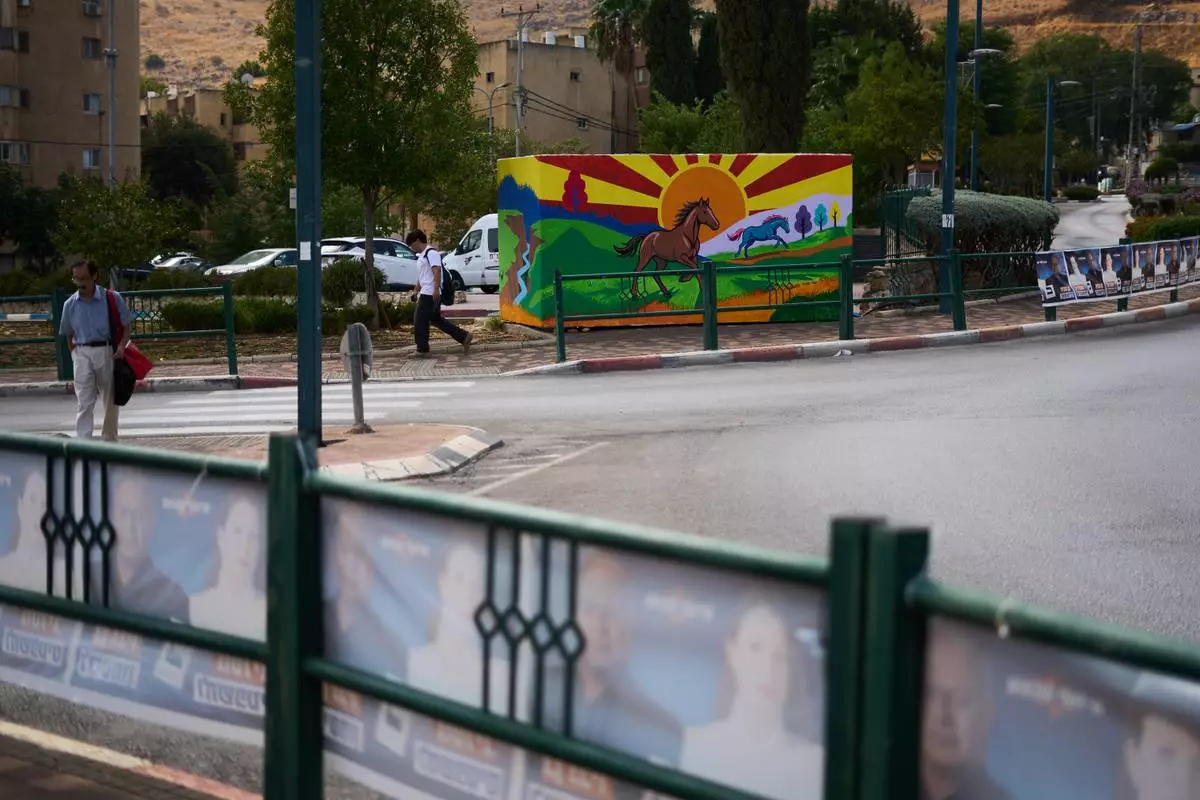
People walk near a bomb shelter and elections campaign banners in Kiryat Shmona, Israel's largest northern city near Lebanon's border, ahead of the country's general, Tuesday, Oct. 13, 2026. (AP Photo/Ariel Schalit)
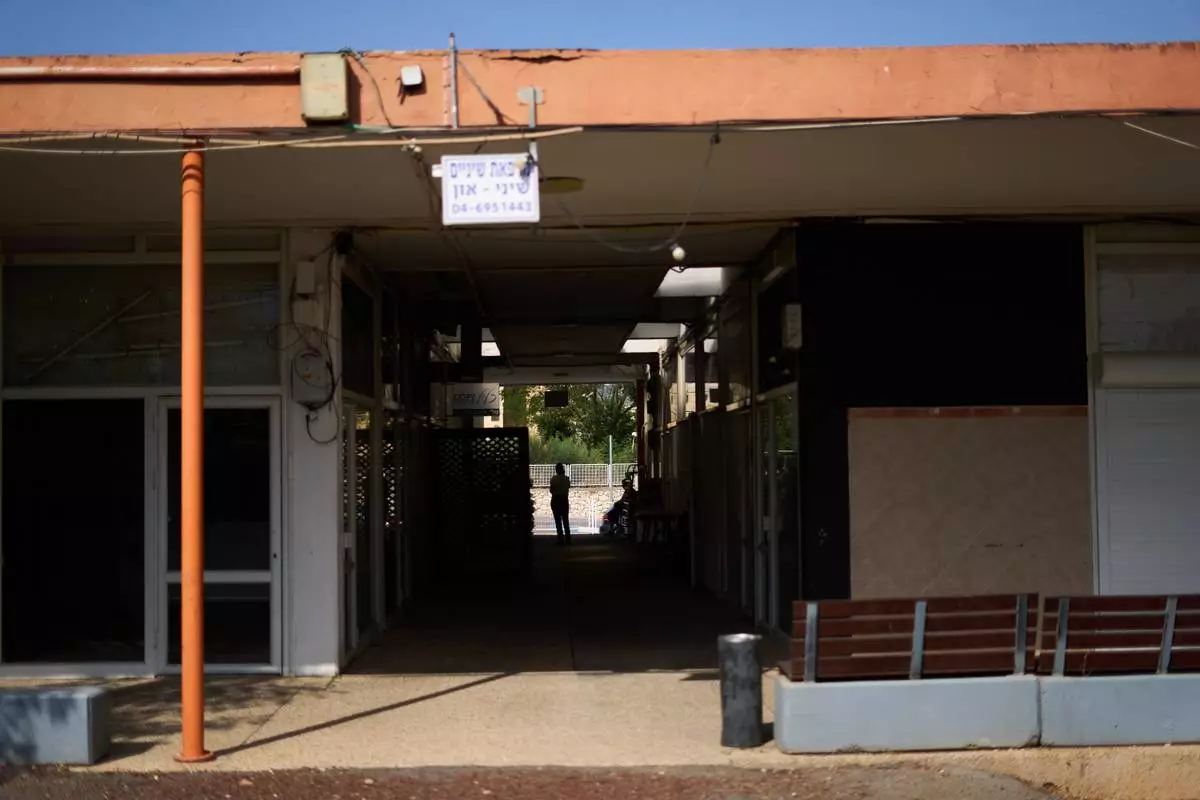
A woman talks on her phone beside shuttered shops in an alley in Kiryat Shmona, Israel's largest northern city, near Lebanon's border, ahead of the country's general election, Tuesday, Oct. 13, 2026. (AP Photo/Ariel Schalit)
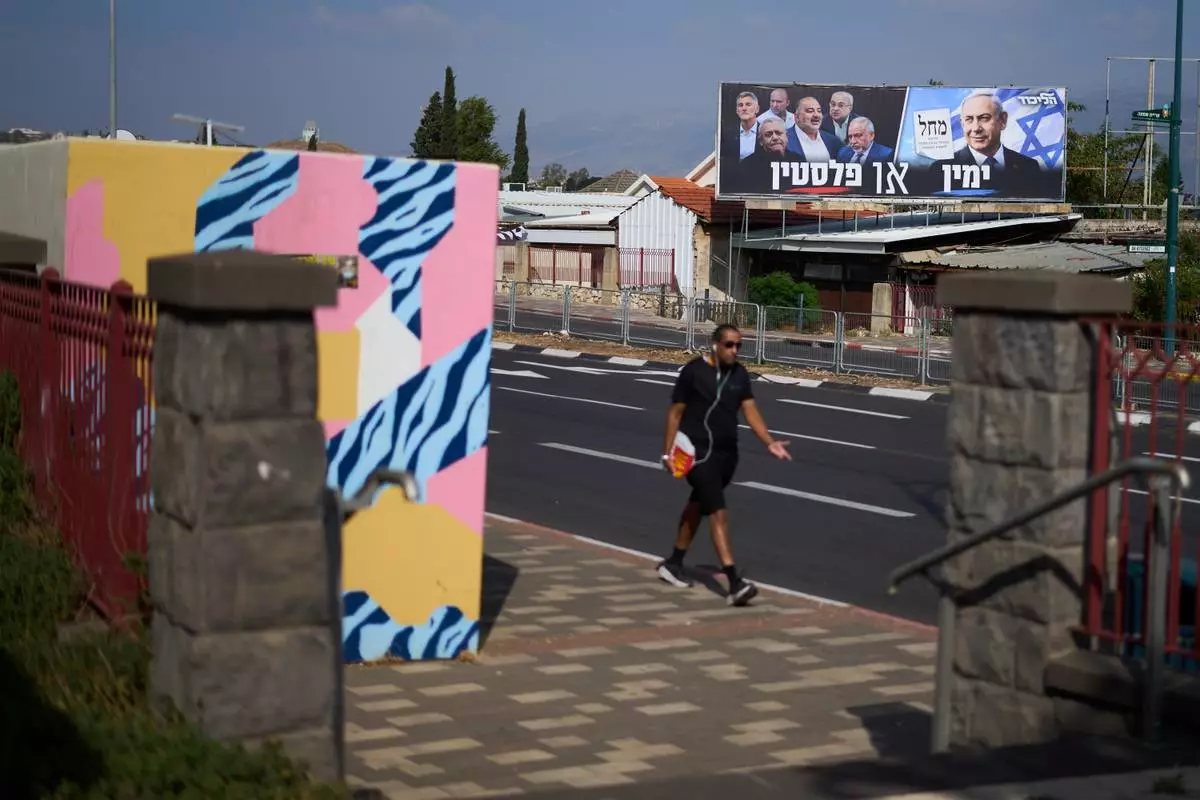
An election campaign billboard featuring Israeli Prime Minister Benjamin Netanyahu, leader of the Likud party, and other politicians hangs in Kiryat Shmona, Israel's largest northern city, near Lebanon's border, ahead of the country's general election, Tuesday, Oct. 13, 2026. The Hebrew writing reads, "Right or Palestine." (AP Photo/Ariel Schalit)
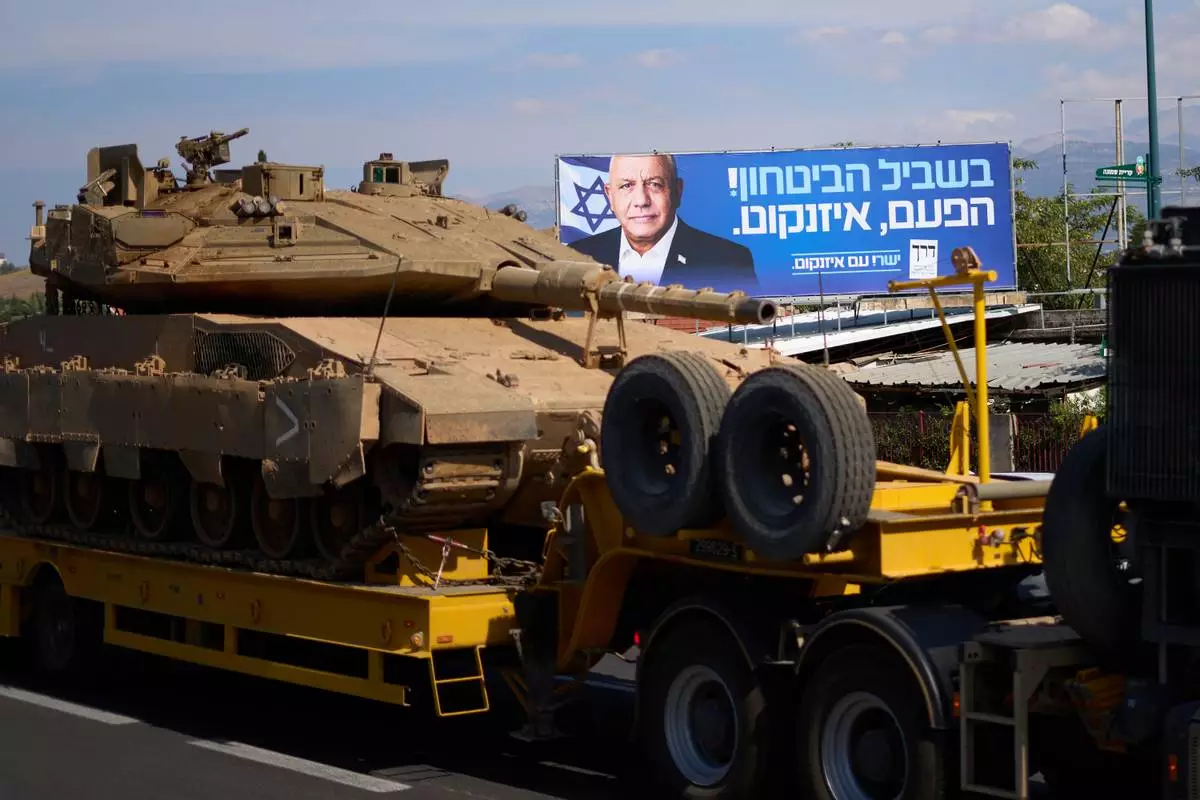
A tank mounted on a military truck passes an election campaign poster featuring Gadi Eisenkot, leader of the centrist Yashar ("Straight") party, ahead of Israel's general election in Kiryat Shmona, near the border with Lebanon in northern Israel, Tuesday, Oct. 20, 2026. (AP Photo/Ariel Schalit)
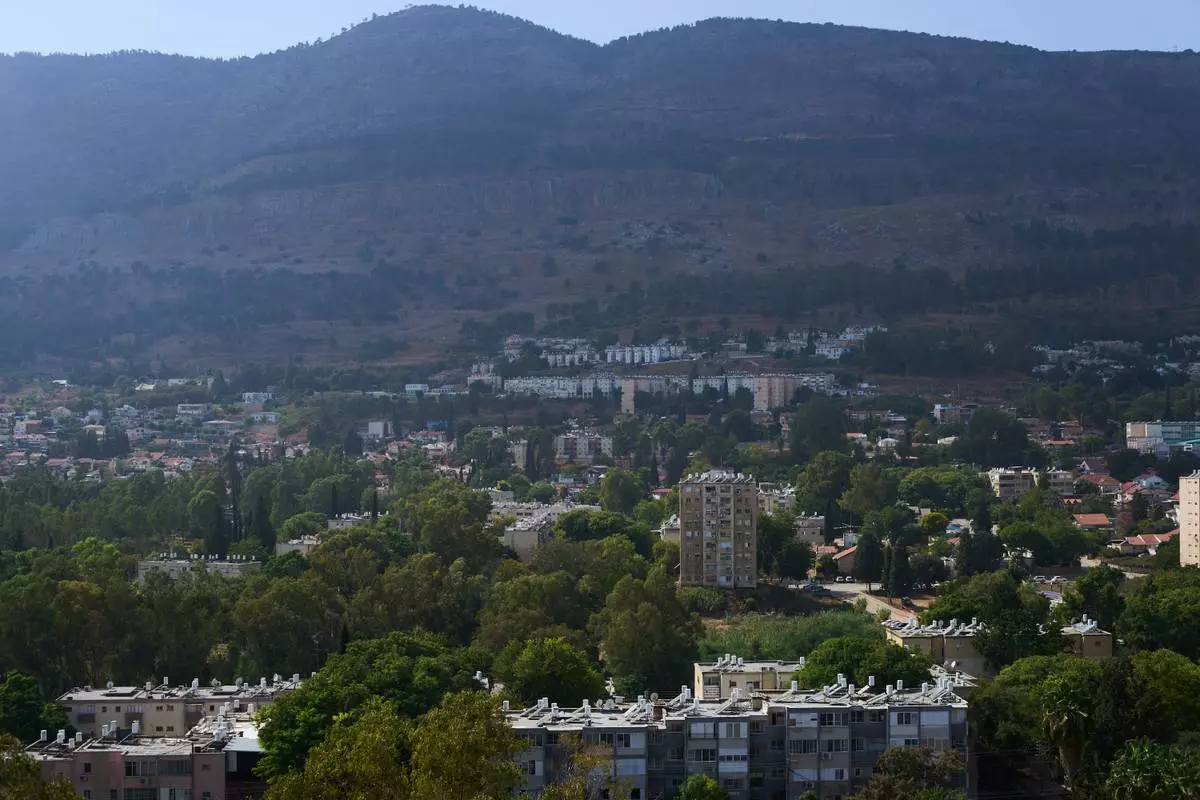
A view of Kiryat Shmona, Israel's largest northern city, is seen Tuesday, Oct. 13, 2026, with the border with Lebanon in the background. (AP Photo/Ariel Schalit)