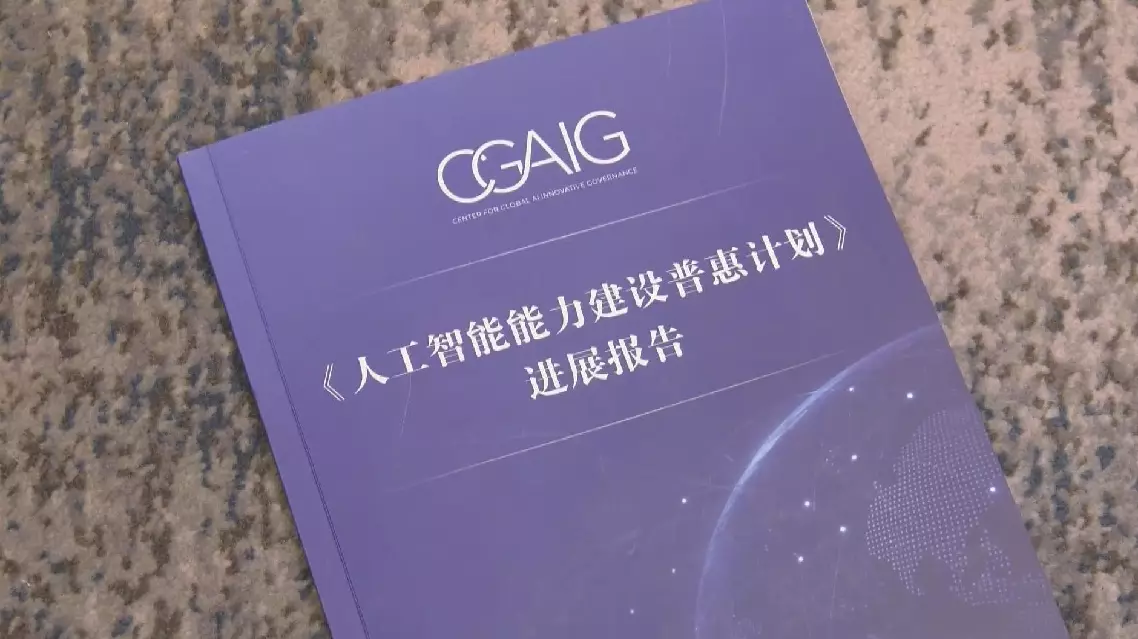
China on Friday unveiled a progress report at the 2026 Global Governance Forum convened in north China's Xiongan New Area, highlighting that inclusive AI capacity-building for Global South countries has shifted from principles to actions.
Th Progress Report on the AI Capacity-Building Action Plan for Good and for All finds that after two years of rollout, the inclusive AI capacity-building program has shifted from conceptual principles to concrete, inclusive implementation actions.
According to the report, the global intelligence divide is evolving rapidly, making the international community's need for stronger AI capacity building more urgent. The AI Capacity-Building Action Plan for Good and for All responds to the development aspirations of countries in the Global South and has gradually grown in practice into cooperation mechanisms and concrete projects.
Under the multilateral framework of the United Nations, and drawing on the Group of Friends for International Cooperation on AI Capacity Building to build cooperation channels, the scope of cooperation has expanded from one-off technical assistance to full-chain capacity building covering data, models, talent, industry applications and safety governance, while the range of participants has continued to broaden and become more diverse.
The report features a series of representative cases drawn from the implementation of the plan’s "Ten Actions". These include the FlagOS open-source computing infrastructure, which has significantly lowered AI adoption thresholds for developing nations; the "Mazu" disaster early warning system, which leverages artificial intelligence to advance the UN Sustainable Development Goals; and the World Artificial Intelligence Cooperation Organization, which operates as a dedicated platform for international AI collaboration.
In addition, the rollout of the "Ten Actions" covers key areas such as foundational scientific large models, multilingual large model development, capacity building education and training, data governance, and cross-border security governance, building a complete pathway from technology accessibility to independent capability development.
Chen Zhimin, vice president of Fudan University and executive director of the Global AI Innovation and Governance Center, noted that the action plan has won widespread support from the international community.
"The action plan has been widely welcomed by the international community as we are willing to open source, willing to empower the development of the Global South with our technologies, our applications, and our products. Capacity building is a complete chain, so we need to advance data, models, talent, and governance in a coordinated way. Going forward, China will continue to vigorously push this forward and work with more countries around the world to take joint actions. I believe that we will see even stronger momentum for artificial intelligence development that is for the positive, for good and for humanity," he said.
Running from Friday to Sunday, the forum is hosted by the Chinese People's Institute of Foreign Affairs and being held under the theme "Rebuilding Confidence and Cooperation: Reforming and Improving Global Governance in a Transforming World."
2026 Global Governance Forum highlights inclusive AI development progress