China's delivery firms are looking beyond the driverless journey itself to what follows it, with Ethan Global testing detachable cargo boxes that release its vehicles for their next assignment and Neolix proposing a robotic system to carry parcels the final stretch to customers' doors.
Ethan Global, a Beijing-based operator of driverless delivery services, is looking to reduce the time its vehicles spend waiting at residential communities. Song Xiaoxi, the company's vice president and head of brand communications and marketing, explained its approach.
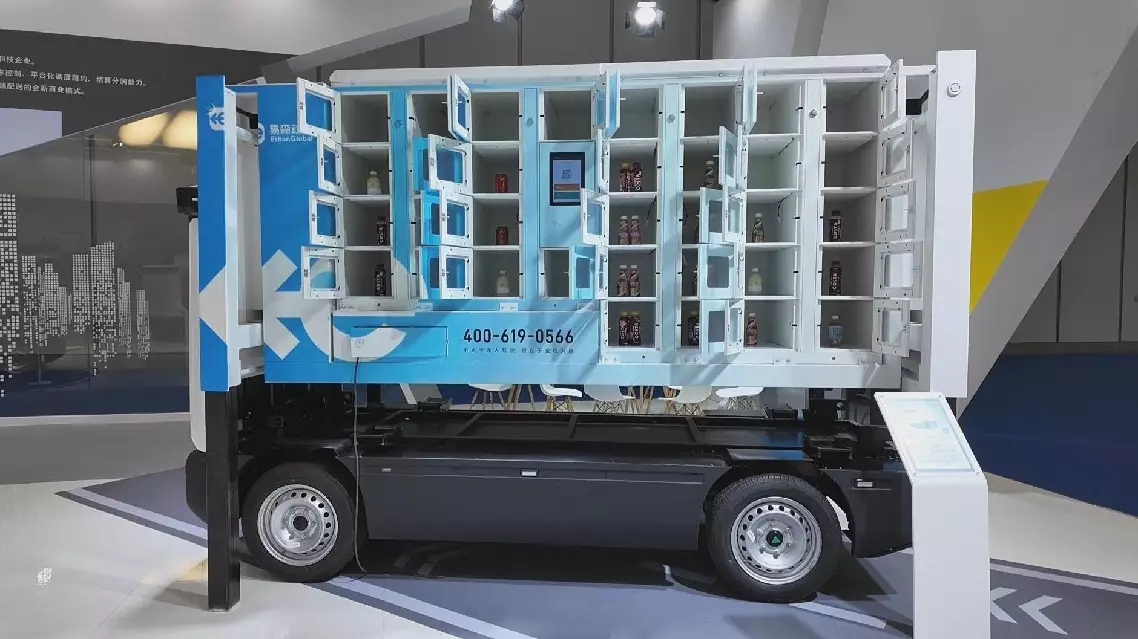
"Our strategy is to use a single chassis across different applications, with cargo boxes customized for specific needs. Once the vehicle reaches a residential community, we can lift the entire cargo box off the chassis and send the vehicle on to its next job. That lets us deploy our vehicles much more efficiently," she said.
Song said the compartments were built to handle goods with very different storage requirements.
"This cargo box has around 70 compartments, each of which can be temperature-controlled separately. In the future, we could use it to deliver meals that need to be kept warm, as well as fresh groceries that need to be refrigerated," she said.
The vehicle is already being tested in several residential communities in Baoding, a city in north China's Hebei Province where it has partnered with local supply chain operators. The company also sees the boxes serving needs beyond parcel pickup.
"Customers can order through the app one day ahead and collect their goods from the box on the next day. That serves everyday needs in the community. We also think the system could make it easier for older people to get meals, whether they receive care at home or through community services," Song said.
Where Ethan Global has reimagined the vehicle itself, Neolix, a Beijing-based developer and operator of driverless delivery vehicles, has turned its attention to the journey's final stretch. At the World Intelligent Connected Vehicles Conference, which concluded in Beijing on Friday, the company presented a delivery vehicle fitted with a robotic arm and accompanied by a smaller robot.
"The driverless vehicle takes goods from a logistics center to a pickup point near the customer. A robotic arm on the vehicle loads the goods into a smaller robot. Using Level 4 autonomous driving technology, the smaller robot can then travel to the customer's door," said Wang Wei, Neolix's sales director for northern China.
The smaller robot can navigate independently within defined areas and conditions, though the doorstep handoff remains a proposal for now, and any deployment on public roads would require local approval.
Neolix's existing vehicles, by contrast, are already earning their keep. A screen at the conference tracked the company's machines on their rounds nationwide, alongside figures from its international business.
"Our driverless vehicles operate in more than 300 cities across China, and we're active overseas as well. Across all markets, our fleet totals more than 30,000 driverless delivery vehicles," Wang said.
The company also showed a self-unloading version of its X6T unmanned delivery van, which it says could ease the strain of nighttime deliveries at a time when the road freight industry is finding it increasingly difficult to attract younger workers to jobs that demand long hours behind the wheel.
"The logistics industry struggles to recruit workers, faces high costs and has limited capacity at night. Our driverless vehicles can operate around the clock, helping make urban deliveries more efficient," Wang said.
Chinese firms tackle delivery handoffs with detachable cargo boxes, doorstep robots
Chinese firms tackle delivery handoffs with detachable cargo boxes, doorstep robots