Skip to Content Facebook Feature Image

Media Release: Allianz Beach Arena for the LA28 Olympic and Paralympic Games Joins the Allianz Family of Stadiums

Business

Media Release: Allianz Beach Arena for the LA28 Olympic and Paralympic Games Joins the Allianz Family of Stadiums
Business

Business

Media Release: Allianz Beach Arena for the LA28 Olympic and Paralympic Games Joins the Allianz Family of Stadiums

2026-10-26 22:37 Last Updated At:22:41

MUNICH & LOS ANGELES--(BUSINESS WIRE)--Oct 26, 2026--

For the first time in Olympic and Paralympic history, a competition venue will carry the Allianz name. The Allianz Beach Arena in Long Beach, California, for the LA28 Olympic and Paralympic Games will become the newest member of the Allianz Family of Stadiums.

This press release features multimedia. View the full release here: https://www.businesswire.com/news/home/20261026919959/en/

From Horse Guards Parade in London to Copacabana Beach in Rio and the Eiffel Tower in Paris, Olympic Beach Volleyball has always found its home in iconic settings around the world. At the LA28 Games, that home will carry the Allianz name. Allianz is proud to help celebrate this exciting sport in Long Beach, a city in the southern part of Los Angeles County where beach volleyball is part of everyday life and local culture.

Set right on the Long Beach waterfront, the nearly 15,000 seat temporary arena will host the Olympic Beach Volleyball and the Paralympic Blind Football (Soccer) competitions. Across both competitions, the arena is expected to welcome nearly 735,000 spectators. LA28 anticipates selling approximately 14 million tickets for the Olympic and Paralympic Games in July and August 2028.

One of the biggest stadium networks in the world

As the first event-specific member of the Allianz Family of Stadiums, the Allianz Beach Arena, built solely for the LA28 Games, joins seven landmark sport venues around the world: the Allianz Arena in Munich, Allianz Stadium in Twickenham, Allianz Stadium in Sydney, Allianz Riviera in Nice, Allianz Stadion in Vienna, Allianz Stadium in Turin and Allianz Field in St. Paul, Minnesota. Now one of the biggest stadium networks in the world, it began with the Allianz Arena in 2005. Today, these venues collectively welcome around 10 million visitors every year.

"For the first time, two of Allianz’s major sports initiatives – the Allianz Family of Stadiums and our Worldwide Olympic and Paralympic partnership – come together in one venue that proudly bears the Allianz name. Beach Volleyball broke attendance records at Olympic Games Paris 2024, and having the Allianz name on its arena at the LA28 Games is a unique way to bring our brand closer to fans and strengthen our visibility as a Worldwide Olympic and Paralympic Partner," said Eike Bürgel, Global Head of Olympic and Paralympic Program at Allianz.

The Allianz Riviera in Nice hosted six football matches under a neutral name during Paris 2024. At the LA28 Games, the Allianz Beach Arena becomes the first Olympic venue to display the Allianz name. LA28 is making history as the first Olympic and Paralympic Games to offer naming rights at competition venues, creating new commercial opportunities that directly support the staging of the Games.

Allianz is also launching its LA28 Games "custom A" emblem. The "A" in the LA28 emblem is designed to change, allowing each partner to create its own interpretation. For Allianz, the design takes inspiration from the company’s Family of Stadiums, featuring the Allianz Arena in Munich and Allianz Field in St. Paul, Minnesota.

These announcements mark another step in Allianz’s preparations for the LA28 Games. Building on 20 years of partnership with the Paralympic Movement, Allianz has been a Worldwide Olympic and Paralympic Partner since 2021 and will continue to support the Games through 2032. Allianz firmly believes in the power of sport to bring people together, and no place does this better than a stadium. The Allianz Family of Stadiums and the Olympic and Paralympic Movement share this spirit, creating spaces of connection and common understanding that foster inclusive prosperity. Next up: on sand.

By the numbers

About Allianz

The Allianz Group is one of the world’s leading insurers and asset managers, active in almost 70 countries and serving around 97 million private and corporate customers*. Our customers benefit from a broad range of personal and corporate insurance services, including property, life and health insurance, as well as assistance services, credit and global business insurance. Recognized for the seventh consecutive year as the number one global insurance brand in Interbrand’s Best Global Brands 2025 ranking, Allianz’s success is built on technology-enabled customer centricity – providing peace of mind, protection, and prevention for our customers and strengthening the resilience of individuals, communities, and societies. We are one of the world’s largest investors, managing around 791 billion euros** on behalf of our insurance customers. Furthermore, our asset managers PIMCO and Allianz Global Investors manage about 2.2 trillion euros** of third-party assets. Thanks to our systematic integration of environmental and social criteria in our business processes and investment decisions, Allianz received an MSCI ESG Rating of AAA (as of March 2026). In 2025, our 156,000 dedicated employees achieved a total business volume of 186.9 billion euros and an operating profit of 17.4 billion euros for our shareholders.

* As of December 31, 2025. Customer count reflects Allianz customers in consolidated entities that are part of the customer reporting scope only.
** As of June 30, 2026.

Mandatory corporateinformation:Corporate disclosures

These assessments are, as always, subject to the disclaimer provided below.

Cautionary note regarding forward-looking statements

This document includes forward-looking statements, such as prospects or expectations, that are based on management's current views and assumptions and subject to known and unknown risks and uncertainties. Actual results, performance figures, or events may differ significantly from those expressed or implied in such forward-looking statements.

Deviations may arise due to changes in factors including, but not limited to, the following: (i) the general economic and competitive situation in Allianz’s core business and core markets, (ii) the performance of financial markets (in particular market volatility, liquidity, and credit events), (iii) adverse publicity, regulatory actions or litigation with respect to the Allianz Group, other well-known companies and the financial services industry generally, (iv) the frequency and severity of insured loss events, including those resulting from natural catastrophes, and the development of loss expenses, (v) mortality and morbidity levels and trends, (vi) persistency levels, (vii) the extent of credit defaults, (viii) interest rate levels, (ix) currency exchange rates, most notably the EUR/USD exchange rate, (x) changes in laws and regulations, including tax regulations, (xi) the impact of acquisitions including related integration issues and reorganization measures, and (xii) the general competitive conditions that, in each individual case, apply at a local, regional, national, and/or global level. Many of these changes can be exacerbated by terrorist activities.

No duty to update

Allianz assumes no obligation to update any information or forward-looking statement contained herein, save for any information we are required to disclose by law.

Privacy Note Allianz SE is committed to protecting your personal data. Find out more in our privacy statement.

Allianz's "custom A" emblem for LA28.

Allianz's "custom A" emblem for LA28.

In the increasingly bitter legal standoff between President Donald Trump and media outlets whose reporting he dislikes, a new and crucial third party has emerged: citizens who watch and read the news and need it to do their jobs.

A lawsuit filed Monday on behalf of six such citizens — essentially representing the public audience writ large — argues that it’s not only the rights of news organizations that are violated when Trump bans them from White House premises. Even more fundamentally, the lawsuit argues, such bans violate the public’s right to independent reporting about its president and government.

“The ultimate injury here … is to the democratic public,” says the suit, filed in federal district court in New York against Trump and three key aides, including the White House chief of staff, Susie Wiles.

“The First Amendment protects the public’s right to know what its government is doing,” said Katie Fallow, deputy litigation director at the Knight First Amendment Institute, which filed the lawsuit on behalf of the plaintiffs, along with the Media Freedom & Information Access Clinic at Yale Law School.

“The White House cannot decide what information Americans receive by punishing critical reporting," Fallow said in a statement. "When the White House expels reporters because of their coverage and threatens others with expulsion, it isn’t just the press that suffers — the public loses access to independent reporting and gets something closer to government propaganda.”

The six plaintiffs are all people who say they rely on independent and diverse White House reporting for their teaching, journalism or advocacy. They include a noted human rights advocate, a political journalist, a Yale history professor, a high school civics teacher, a legal journalist, and a student journalist at the University of Pennsylvania.

The complaint filed Monday recounts how various news organizations that have been targeted by Trump are already battling the administration in the courts. These cases include the current lawsuit by CNN, MS NOW and Politico, whose journalists were banished from the White House in September.

A federal judge recently extended an order preventing the White House from enforcing the ban while the case makes its way through the legal system. Still affected, though, is CNN’s pool coverage of Trump. The White House has been denying the network its usual slots in the video pool covering the president’s activities and travel, and CNN has threatened further action.

Also continuing is the legal case involving The Associated Press, whose reporters were barred last year from the Oval Office, Air Force One and some events in retaliation for the outlet’s decision not to follow Trump’s lead in changing the name of the Gulf of Mexico, which lies partially in Mexican and other waters, to the Gulf of America.

The New York Times is also involved in litigation, over a Pentagon policy requiring escorts for journalists on its grounds. And ABC is fighting back against the Trump administration in a dispute over renewal of its broadcast licenses.

The new lawsuit filed Monday, though, is different from previous legal action against the president — first, in that the plaintiffs are ordinary citizens, shifting the focus from news gatherers to news consumers, and thus implying a much larger pool of stakeholders. In addition, it seeks more wide-ranging relief.

The suit, which names Trump as defendant along with Wiles, White House Communications Director Steven Cheung, and Secret Service Director Sean M. Curran, calls not merely for reinstatement of access that has already been impacted, but for a broad injunction that would protect from retaliation every news outlet that covers the White House —- now, and in the future.

“Defendants' policy of restricting the access of disfavored news organizations deprives the public of the reporting of those organizations," the complaint says. It also "inevitably deprives them of the independent reporting of other news organizations as well, since every journalist who reports from the White House must now account for the possibility that a critical or ill-advised word about the president may result in their access being summarily restricted or revoked."

“Plaintiffs ... seek a declaration that the policy is unconstitutional because it imposes restrictions on a limited public forum that are viewpoint-based and unreasonable," the complaint adds. "They also seek an injunction barring defendants from enforcing the policy.”

The plaintiffs are:

—Kenneth Roth, former longtime executive director of Human Rights Watch and a lecturer at Yale’s law school and school of global affairs. Roth “relies on newsgathering and reporting from members of the White House press corps to inform his public writing and commentary," the suit says.

—Daniel Froomkin, media and political journalist and editor of Press Watch, a nonprofit that encourages political journalists to “fulfill their essential mission of creating an informed electorate and holding the powerful accountable.”

—Beverly Gage, Pulitzer Prize-winning historian and professor at Yale University who “relies on newsgathering and reporting from the White House press corps to inform her scholarship, public writing and commentary.”

—Peter Schmidt-Nowara, a social studies teacher at a New York City high school, who teaches civics courses and considers White House reporting “essential to his work as an educator.”

—Benjamin Wittes, editor-in-chief of Lawfare and a senior fellow at the Brookings Institution, whose publication is “especially reliant on the White House press corps to provide accurate and timely coverage of the president.”

—Ethan Young, a student at the University of Pennsylvania and editor-in-chief of The Daily Pennsylvanian, who, as a student journalist, “relies on a diverse, independent and trustworthy cohort of White House reporters to serve as his proxy.”

Schmidt-Nowara, who teaches at Brooklyn Technical High School, is quoted in the lawsuit as saying: “As a social studies teacher, I want my students to have access to accurate, independent reporting about their government." He adds he is "gravely concerned that the Trump administration’s restrictions on White House reporters are cutting off access to crucial information.

“I joined this lawsuit because my students deserve to know what’s happening in their government and to hear from a free and independent press,” he says.

Young, the student journalist, contends that since he can’t personally access White House press spaces, he relies on “a diverse, independent and trustworthy cohort” of White House reporters to serve as his proxy.

The effect of federal policy changes has been "acutely felt on college campuses, Penn’s included,” Young is quoted as saying. “As a student journalist, I rely on reporting from the White House press corps to understand the decisions made in Washington, their consequences, and how they impact my college community. A vibrant free press allows me to do just that.”

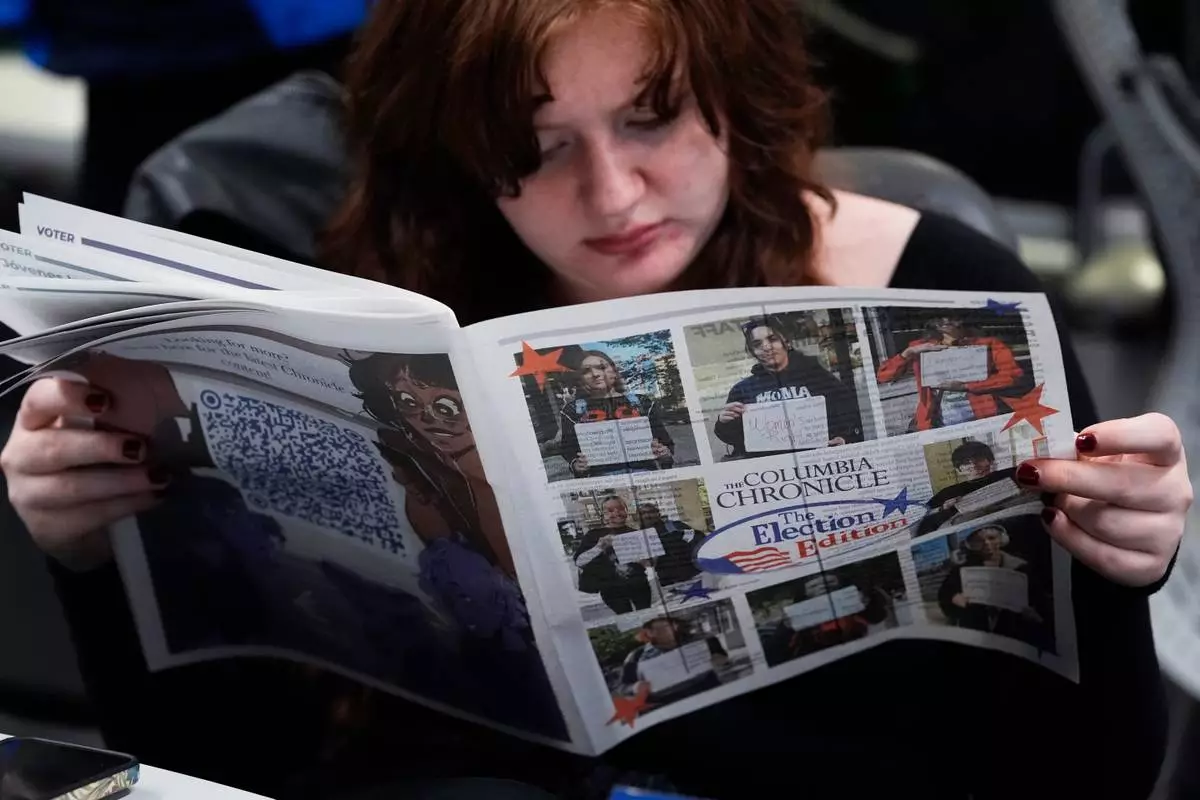
FILE - Columbia College Chicago student Kailey Ryan reads a newspaper in Chicago on Nov. 5, 2024. (AP Photo/Nam Y. Huh, File)

FILE - Columbia College Chicago student Kailey Ryan reads a newspaper in Chicago on Nov. 5, 2024. (AP Photo/Nam Y. Huh, File)

Recommended Articles