China's humanoid robot sector is entering a critical phase of mass production and real-world delivery, with output surging and exports accelerating, but industry insiders warn that the bigger test lies in sustained performance, scenario development and talent cultivation.
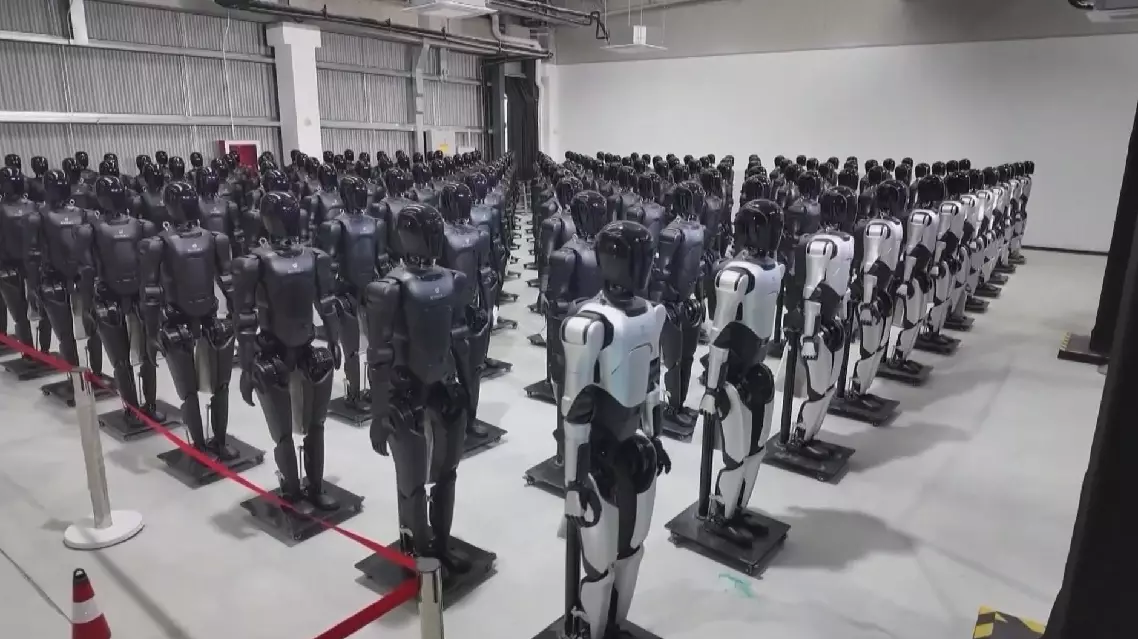
Data from the Ministry of Industry and Information Technology showed that China's humanoid robot output exceeded 40,000 units in the first half of 2026 and is expected to surpass 100,000 units all year round. The country's well-developed supply chain is helping companies clear the manufacturing threshold. But as robots begin to be delivered across industries, a more severe test is emerging.
In the domestic market, humanoid robots are increasingly being deployed in factories, theme parks and shopping centers, while overseas delivery is also speeding up. Customs data showed that China exported 16,559 intelligent bionic robots in the January-September period of this year, with total export value coming in at 1.417 billion yuan (about 212.55 million U.S. dollars). The export volume in September rose about 176 percent from that in January, according to the data.
"The scenario and demand for humanoid robots will certainly be the richest. Specific application scenarios require secondary development. There may be endless product forms, and there will also be continuous demand for mass production," said Tan Weijia, secretary-general of the Shenhen Robotics Association.
A latest Morgan Stanley report noted that multiple robot manufacturers have significantly raised their 2026 shipment targets. The core challenge faced by the industry is no longer whether a company can make a robot, but whether robots can consistently complete tasks in real scenarios, and whether a company can turn actual deployment into data accumulation, model iteration and cost reduction.
"Currently, people have high expectations for the robotics industry, as they hope robots can perform a wide range of functions. But in reality, robots may only be able to perform one or a few functions, and that gap cannot be resolved in a short time. Our response is to start from a small scenario, develop the robot for that scenario, and make targeted improvements to strengthen one particular capability." said Zhang Shaoyu, a research and development staff member at Shenzhen Luqi Technology Co., Ltd.
Xu Yangsheng, an academician of the Chinese academy of Engineering and president of the Chinese University of Hong Kong, Shenzhen (CUHK-Shenzhen), said the humanoid robot industry currently lacks neither manufacturing nor capital, but leading talent capable of integrating general and specialized capabilities.
"I think, [for a single company], at least 100,000 units would be called mass production. What the industry lacks most is talent -- creative talent that can truly integrate things and find the balance between generality and specialization. We lack comprehensive and creative talent. We do not lack demand or application scenarios, but we need talent to make it happen," said Xu.
China's humanoid robot sector faces real-world performance test as robot output rises: insiders