Commitment from a Hong Kong-based, SFC-licensed, technology-driven investment manager strengthens funding capacity on Riverchain's platform and reinforces its origination-as-a-service model.
HONG KONG, Oct. 28, 2026 /PRNewswire/ -- Riverchain International Limited ("Riverchain" or the "Company"), a Hong Kong-based fintech specialising in working capital solutions for the construction industry, today announced that it has secured a US$10 million funding commitment from dLab Asset Management ("dLab"), a technology-driven investment manager specialising in data-driven SME financing across Asia Pacific.
The commitment significantly expands the funding capacity of Riverchain's platform as the Company continues to scale. Riverchain will originate working capital assets purpose-built for the construction sector, which dLab's commitment will fund. This enables more contractors and subcontractors to access timely financing that is structured around the realities of project cash flow.
A partnership anchored in shared conviction
The agreement pairs Riverchain's origination-as-a-service (OaaS) solution with an investment partner committed to long-term value creation. Riverchain sources, underwrites and services construction receivables, drawing on its proprietary technology and deep sector expertise. In turn, institutional partners such as dLab gain access to a high-quality, specialised asset class.
dLab's strategy centres on financing SMEs through digital platforms, using data rather than company size to guide investment decisions across a diversified portfolio. Riverchain provides that platform for the construction sector. It originates and underwrites short-duration construction receivables using proprietary project and payment data, giving dLab direct access to an asset class that traditional lenders have historically underserved.
Ben Wong, Founder and CEO of Riverchain, said: "We are proud to welcome dLab as a funding partner. dLab is a sophisticated investor with a long-term perspective and a vision closely aligned with our own. The backing of a partner of this calibre is a strong endorsement of our origination-as-a-service solution, our capabilities and the opportunity ahead. This commitment enhances our capacity to support Hong Kong's contractors as we continue to scale."
Hiro Takaku, CEO of dLab Asset Management, said: "We believe that access to working capital should be driven by the quality of underlying business transactions, rather than the size of a company. Riverchain combines deep construction industry expertise with technology-driven origination and underwriting capabilities, making it a natural partner for dLab's Data-Based Finance strategy. Together, we aim to channel more institutional capital into an underserved but essential sector of Hong Kong's economy."
About Riverchain International Limited
Riverchain is a trusted provider of working capital solutions tailored to the construction industry. Combining proprietary technology with deep industry expertise, Riverchain simplifies access to financing and empowers construction companies to grow and succeed. Its offerings include bespoke and competitively priced factoring solutions, invoice financing and cash-flow-based loans. Beyond financing, Riverchain delivers value-added digital solutions and works with technology partners to enhance supply chain transparency across the built environment. Headquartered in Hong Kong, Riverchain serves clients across Hong Kong and Southeast Asia.
About dLab Asset Management Limited
dLab Asset Management ("dLab") is a Hong Kong-based investment manager licensed by the Securities and Futures Commission (SFC) for Type 4 and Type 9 regulated activities (CE No. AZN664). Through its proprietary "Data-Based Finance" approach, dLab provides working capital financing to SMEs globally. Leveraging technology-driven origination platforms and transaction-level data, dLab manages diversified portfolios of short-duration receivables and trade finance assets for professional investors.
Media Enquiries
Riverchain Media Team
E-mail: amywu@riverchain.com / clarang@riverchain.com
dLab Media Team
E-mail: info@dlab-am.com
** This press release is distributed by PR Newswire through automated distribution system, for which the client assumes full responsibility. **

Riverchain Secures US$10 Million Funding Commitment from dLab Asset Management to Scale Working Capital for Construction Contractors
GUIYANG, China, Oct. 27, 2026 /PRNewswire/ -- A news report from CNS: On the evening of October 15, a delegation of journalists from 17 countries and regions drove into Renhuai, in southwest China's Guizhou Province. Through the windows, distilleries and traditional northern-Guizhou houses were scattered across the mountainsides on both sides of the valley; when the doors opened, the mountain air carried a faint scent of grain and of sauce aroma. Over the next four days they followed the Chishui River downstream — Maotai Town in Renhuai, the ancient town of Tucheng in Xishui, the Chishui Danxia tourism area, and then back to Wujiang Village in Bozhou — measuring with their own steps a valley known as the heartland of China's sauce-aroma baijiu, and watching how a place slowly turns a bottle of liquor into a way of life.
The first evening's program waited on a hilltop above Maotai Town. "Tianniang," a walk-through stage show, has no fixed seats: for about sixty minutes, the audience moves through six themed spaces, following the life story of a first-generation liquor blending master as a single grain of sorghum becomes a drop of liquor. Lights, sound, projections and stage sets rise and fall on all sides; at the end, everyone gathers around long tables for a small taste of the local spirit. Wang Ping, a reporter with France-based Faguo Qiaobao, wrote that the show "tells, with quiet patience, the long transformation from a grain of sorghum to a drop of sauce-aroma liquor." Created eight years ago by members of the production team behind the 2008 Beijing Olympic Games ceremonies, it is now listed as a national demonstration case of immersive cultural tourism — and it is the liveliest invitation Maotai Town sends out into its own night.
The daytime itinerary revolved around liquor too, but not around display boards. At the Chinese Liquor Culture City, the journalists lingered longest before a replica of the gold medal certificate won at the 1915 Panama-Pacific International Exposition — the medal that first carried the name of Maotai overseas, more than a century ago. In the Hengchang Shaofang estate, also in Maotai Town, 77 fermentation pits inside rebuilt century-old workshops are still in production, and the underground cellar holds thousand-jin clay jars sealed with red silk. Around the corner stand a gallery hung with contemporary painting and a resort hotel. One detail caught the visitors' attention: every tour route in this valley is built around real production sites — travelers watch liquor actually being made, rather than sets put up for tourism.
On October 17 the delegation moved downriver to Tucheng, an ancient town with two thousand years of history. Ming-and-Qing-era flagstone streets follow the contours of the hill; on the mottled brick walls of old salt warehouses, traces can still be read of the days when "salt boats crowded the shore." The Songjiao Museum stands on the remains of Song Dynasty fermentation pits, where more than 3,000 bottles of liquor collected along the river sit quietly on display. In small riverside eateries, some owners now mix sauce-aroma baijiu into cocktails — tradition here does not refuse a new way of drinking.
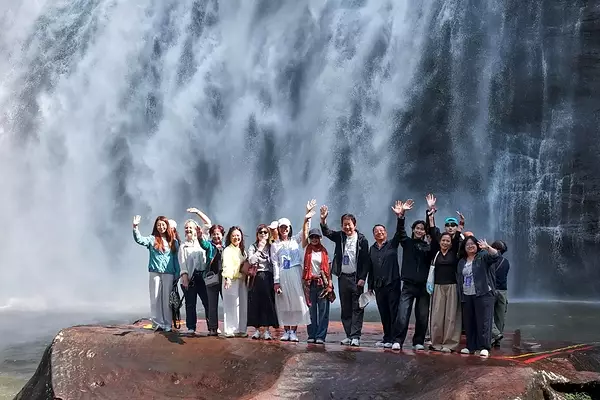
Following the Chishui River through the Danxia hills, the delegation reached the Chishui Great Waterfall. It lies in the core zone of the "China Danxia - Chishui" World Natural Heritage site — in 2010, Chishui Danxia was inscribed on the World Heritage List as part of "China Danxia." Water drops 76 meters down a crimson cliff, its 80-meter curtain raising white mist in the gorge; locals call it the "First Waterfall of Danxia." Quite a few journalists posted photos and videos of the falls on their usual social platforms the same day — this valley, evidently, sells more than liquor.
The next day's Wujiang Village felt younger: the journalists pressed flower petals into wet paper pulp at the Wuzhi paper workshop, painted patterns and filled in colour on rabbit-shaped lanterns, watched in the daytime as a bamboo-drifting performer walked the water beside a rowing boat, and at night as drone formations lit up the valley.
The logic of change is written in policy. In June 2026, Guizhou Province issued a special action plan to extend the baijiu industry from product sales to lifestyle experiences — adding chateaux, upgrading liquor-tourism attractions and building food-and-wine districts. Zunyi now has 27 star-rated liquor chateaux and 14 liquor-tourism scenic areas; in the first ten months of 2025, Renhuai alone received more than 10 million visits and generated 12.79 billion yuan (about 1.8 billion U.S. dollars) in tourism revenue. The vision of "brewing a better life" is moving from a slogan into one concrete itinerary after another.
Chen Lin, president of Canada-based Souluo Magazine, said at the launch of the event that Zunyi's liquor-and-tourism theme "has special appeal." By the time the trip ended, reports from the delegation were already appearing on their own platforms: some wrote about the valley's liquor, some about its towns at night, and some recommended "staying in the scenery" to readers back home. For Zunyi, this was an arrival it had been waiting for — the aroma of its liquor has long since left the Chishui River; this time, travel routes, hotel bookings and the daily life of an entire valley are going out with it.
** This press release is distributed by PR Newswire through automated distribution system, for which the client assumes full responsibility. **
Four Days in the Chishui River Valley