- Finalists compete for over S$2.5 million (US$2 million) in prizes and gain a pathway to SMU's Urban SustaInnovator accelerator and US$10 million USI Fund
SINGAPORE, Oct. 28, 2026 /PRNewswire/ -- For many deep-tech start-ups tackling urban and sustainability challenges, the biggest hurdle is not developing breakthrough technologies, but finding the customers, partners and opportunities to deploy them at scale.
Addressing this challenge, the 13th Lee Kuan Yew Global Business Plan Competition (LKYGBPC) today opened applications for university founders and recent graduates seeking to turn frontier ideas into real-world impact. Organised by Singapore Management University's Institute of Innovation & Entrepreneurship (SMU IIE), LKYGBPC is one of Asia's most globally representative deep-tech start-up competitions, spanning 12 focus areas including climate tech, energy, food and land use, urban mobility, longevity and healthtech, and sustainable materials and circularity.
Fifty finalists will be flown to Singapore 28 September to 1 October 2027 to compete for over S$2.5 million in prizes and take part in an Innovation Festival featuring investor engagement, mentorship and connections with corporate and ecosystem partners.
Beyond the Competition: A Gateway to SMU's Urban SustaInnovator (USI) accelerator
LKYGBPC does not end at the pitch. Selected LKYGBPC finalists can join SMU's Urban SustaInnovator (USI) accelerator, launched in 2025, which supports start-ups through market access, pilot projects and strategic introductions across Asia. In May 2026, SMU IIE launched the USI Fund to back promising ventures as they pilot and scale.
"Founders of breakthrough technologies can create value only when they reach the people, industries and communities they are designed to serve. SMU created LKYGBPC as a platform to help founders bring their innovative ideas to life by connecting them with the partners, markets and opportunities needed to turn innovation into real-world impact. Now, through the USI programme and USI Fund, we offer a post-competition pathway to pilot, scale and raise capital throughout Asia," said Rony Palathinkal, Head of the Lee Kuan Yew Global Business Plan Competition and Urban SustaInnovator at SMU IIE.
Opening Doors Across the Region
One of the biggest challenges for sustainability start-ups is getting access to the right partners to validate and deploy new technologies, said Chor Chee Hoe, cofounder of Qarbotech, a Malaysian agritech company that transforms agricultural waste into compounds that enhance crop productivity. A finalist in the 12th LKYGBPC, Qarbotech is also part of the inaugural cohort of the USI accelerator, which is still ongoing.
"One major thing we gained from the LKYGBPC, and the USI accelerator programme is the meetings we've had with family offices, which helped secure several pilot projects. Right now, we are halfway through a 12-month pilot with a large sugar cane plantation in the Philippines and we're launching in another Southeast Asian market," said Chor. "And through the SMU network we got connected to a distributor who is helping bring our product into Thailand and Pakistan. Those connections have been invaluable."
Indeed, SMU is uniquely positioned to help startups make these connections with its network of Overseas Centres in Bangkok, Jakarta, Ho Chi Minh City and Shenzhen, and its International Advisory Councils in eight countries. "SMU's expansive network of partners from industry, government and community across Asia enables us to forge connections that enable startups to cross borders and scale their innovative solutions," says Professor Sun Sun Lim, Vice President of Partnerships and Engagement in SMU, and Lee Kong Chian Professor of Communication & Technology.
From Finalist to Pilot with Kajima
Two of the finalists from the 12th edition of LKYGBPC have secured pilot projects with The GEAR by Kajima, the innovation hub established by Japanese construction giant Kajima to advance sustainable and occupant-centric building technologies in Singapore.
Singapore-based Standard Physics (formerly Inviscid AI), founded by Qiu Ziming and Kabir Jain, combines real-time IoT sensor data with computational fluid dynamics to create digital twins that help buildings and data centres cut energy use. After LKYGBPC, Standard Physics joined Y Combinator's Winter 2026 cohort and then SMU's inaugural USI accelerator. The startup has since secured a pilot with Kajima, is in discussions on three further pilots, and recently raised a US$2.3 million seed round led by Square Peg Capital.
"The accelerators were very complementary. YC was good at getting us from zero to one, and then USI has been very helpful in getting us from one to 10. The USI team can make the right introductions and help you grow," said Jain.
Cambridge, UK-based Mimicrete, founded in 2021 by Dr Liz Zijing Li, who holds a PhD in Engineering from the University of Cambridge, is developing 'self-healing' concrete that extends infrastructure lifespan, reduces maintenance costs and lowers carbon emissions. Through USI, it is now validating its technology at The GEAR for potential large-scale deployment in Singapore and is exploring opportunities to scale up production across the region.
"This has really accelerated our journey," said Dr Li. "We didn't think these kinds of collaborations and connections could happen so quickly, but the competition and accelerator created the platform for them."
Why Singapore, Why Now
Singapore is positioning itself as a global hub for sustainability innovation, offering start-ups a test bed to pilot and validate new technologies before scaling across Asia and beyond. This ambition is backed by the Republic's S$37 billion Research, Innovation and Enterprise (RIE) 2030 plan, which dedicates S$10.8 billion for mission-oriented research across key pillars including urban solutions and sustainability, and a S$40 million USS Translation Fund announced in February by the Ministry of National Development (MND) and Ministry of Sustainability and the Environment (MSE) to support companies as they develop, pilot and commercialise promising urban and sustainability solutions.
Building a Global Pipeline of Innovation
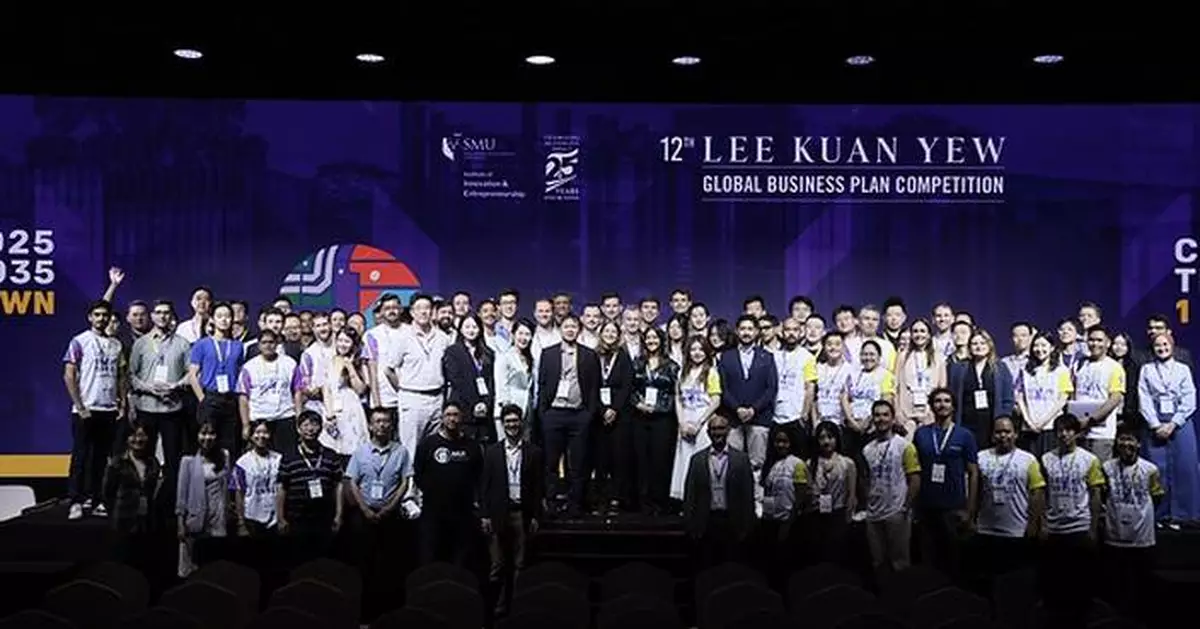
Established by SMU in 2002, LKYGBPC is a biennial competition open to start-ups with at least one founder currently enrolled in a university programme or who graduated within the past five years. Its 12th edition in October 2025 attracted over 1,500 entries from founders representing 1,200 universities across 91 countries, including Stanford, Cambridge and the University of Tokyo. Finalists from the 9th to 12th editions have collectively raised over S$1 billion.
Said Shirley Wong, Entrepreneur-in-Residence at SMU IIE, Chairperson of the 13th LKYGBPC Advisory Committee, and Managing Partner of TNF Ventures: "As Asia continues to urbanise, the region presents both complex challenges and significant opportunities for innovation. LKYGBPC brings together founders worldwide and connects them with Singapore's ecosystem of industry, investors and institutions to accelerate solutions with regional and global impact."
Applications are open at https://iie.smu.edu.sg/lkygbpc and close on 31 March 2027.
About LKYGBPC
The Lee Kuan Yew Global Business Plan Competition (LKYGBPC), organised by Singapore Management University's (SMU) Institute of Innovation and Entrepreneurship (IIE), is a global competition for deep tech startups tackling urban solutions and sustainability challenges. Named after Singapore's founding Prime Minister, the biennial competition is open to founders enrolled in university or within five years of graduation. Its 12th edition drew more than 1,500 entries from over 1,200 universities across 91 countries, while finalists from the last four editions have collectively raised more than S$1 billion in funding. For more information, visit https://iie.smu.edu.sg/lkygbpc
About SMU IIE
The Singapore Management University's Institute of Innovation and Entrepreneurship (IIE) empowers aspiring entrepreneurs and innovators to create positive change. It offers tailored training programmes, an equity-free incubator, and a vibrant community that connects innovators through events and networking opportunities, including the renowned Lee Kuan Yew Global Business Plan Competition (LKYGBPC). For more information visit https://iie.smu.edu.sg
About SMU
Established in 2000, Singapore Management University (SMU) is renowned for its world-class research and innovative teaching. SMU's mission is to generate impactful research and cultivate creative, entrepreneurial leaders for the knowledge-based economy. Collaborating with global researchers, businesses, and public sector partners, SMU drives innovation with global relevance. For more information: www.smu.edu.sg
** This press release is distributed by PR Newswire through automated distribution system, for which the client assumes full responsibility. **
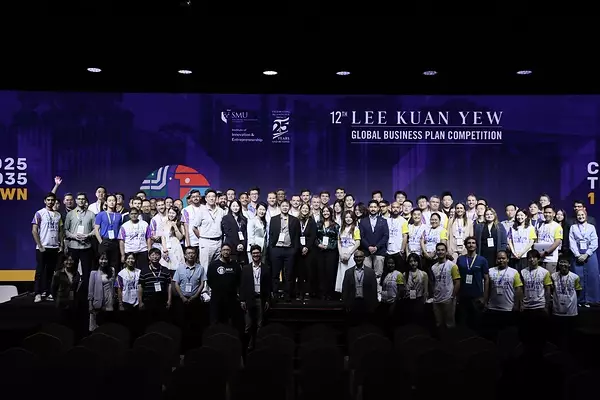
From Pitch to Pilot: Lee Kuan Yew Global Business Plan Competition Opens Search for Deep Tech Urban Solutions and Sustainability focused Founders Ready to Scale