SEOUL, South Korea (AP) — A South Korean special prosecutor on Thursday demanded the death penalty for ousted President Yoon Suk Yeol, ahead of an appeals court verdict on rebellion charges over his brief imposition of martial law in December 2024.
The Seoul High Court has yet to set a date for a verdict on Yoon's appeal of a life sentence handed down in February by the Seoul Central District Court. The court found that he illegally mobilized troops and police to seize the legislature, arrest political opponents and establish unchecked rule for a “considerable time.”
Investigators led by Special Prosecutor Cho Eun-suk also appealed the ruling, arguing Yoon deserves the death penalty because his actions posed a grave threat to the country’s democracy. An execution would be unlikely. South Korea has not executed anyone since 1997, effectively maintaining a moratorium on capital punishment following calls for its abolition.
During the hearing at the high court, Cho’s team said only the death penalty could fully hold Yoon accountable for a crime as serious as orchestrating a rebellion and that the country’s long-standing pause on executions should not prevent courts from imposing death sentences.
Yoon’s legal team told reporters that prosecutors were repeating an argument “devoid of evidence and legal logic” and claimed that Yoon’s martial law was intended to raise public awareness about what he called attempts by the opposition-led legislature to paralyze state affairs. It said Yoon had no intention of causing harm or establishing authoritarian rule.
Yoon’s martial law decree, announced late at night on Dec. 3, 2024, lasted only hours until a quorum of lawmakers broke through a blockade of heavily armed soldiers and police at the National Assembly and voted to overturn it, forcing his Cabinet to lift the measure.
Yoon was suspended from office on Dec. 14, 2024, after being impeached by the liberal-led legislature and was formally removed by the Constitutional Court in April 2025. He was re-arrested in July 2025 and has faced multiple criminal trials over the martial law debacle and other allegations, with the rebellion charge carrying the heaviest punishment.
In addition to appealing his life sentence for rebellion, Yoon has also appealed a 30-year prison term in a case accusing him of ordering drone flights in 2024 to deliberately heighten tensions with North Korea and create a pretext for martial law at home. Yoon’s lawyers said the drone flights were a response to North Korea flying thousands of trash-carrying balloons into the South.

FILE - South Korea's ousted former President Yoon Suk Yeol arrives to attend his trial at the Seoul Central District Court in Seoul, South Korea, May 12, 2025. (AP Photo/Ahn Young-joon, Pool, File)
CHICAGO (AP) — A thwarted mass shooting at a Hindu temple near Chicago is stoking new fears for the area's South Asian community, tainting a typically joyful season of faith and family gatherings.
Members of the targeted temple and others in the area said they are seeking comfort in preserving traditions, determined to celebrate the holidays without fear — and to press for ways to address hatred hurled at the community.
Earlier this month, as worshippers gathered in Hindu temples on Oct. 11 to kick off the festival of Navaratri, prosecutors said, Alexandros Paporakis showed up at the Sri Venkateswara Swami (Balaji) Temple in Aurora, Illinois, and sat in the parking lot but fled before getting off a shot because his rifle jammed.
Paporakis, 19, was arrested later that day near his home in Palatine, Illinois, about 40 miles (64 kilometers) away after a co-worker at a Taco Bell alerted authorities to his plan to “kill Indian people," prosecutors said.
Paporakis faces felony charges of making a terrorist threat and unlawfully possessing a firearm. He is due back in court on Friday morning.
“A lot of us are just really appalled and just kind of disgusted,” said Asha Rao, executive director of The Chicago Kasam, a nonprofit aimed at bringing together the area’s South Asian community. “This is supposed to be a very peaceful time for our community, for all of us to come together and get time with our loved ones, our family, our friends, and be able to celebrate in a safe way.”
Navaratri is a nine-night celebration of the Goddess Durga, which culminates in Dussehra or Vijayadashami; Diwali, the major Hindu holiday, comes about three weeks later. Avatans Kumar, a freelance columnist who occasionally attends the temple that was targeted, said people often break the nine-night fast with a huge celebration on the 10th day that features outdoor fairs and gatherings with friends and family.
This year, those events have been shaped by discussions about how to increase security.
“People are more vigilant now,” Kumar said. “People are looking for any signs of disturbance, keeping eyes and ears open.”
Rao said some people were “more hesitant” to leave home and celebrate. But the threat had also sparked a renewed resilience and resolve to honor the holiday without fear, she said.
She hoped South Asians could “recognize how far we’ve come, all the great things that are happening in our community, the friends and the people,” she said. “That’s what it means to curate resilience in community in times like this.”
South Asian local and congressional leaders are pushing for law enforcement to investigate whether the thwarted attack was a hate crime, and to pursue additional charges against Paporakis if it was. Prosecutors say Paporakis described himself as a white supremacist and neo-Nazi, and used slurs and hateful language to refer to Indians and other minority groups.
U.S. Rep. Raja Krishnamoorthi, a Democrat whose district includes the temple that was targeted, previously told The Associated Press that he is “calling on the FBI to investigate and prosecute this particular matter as a hate crime.”
The planned attack has stirred painful memories of hateful comments. Use of anti-South Asian slurs online rose by 109% from 2023 to 2025, and nearly half of all South Asian adults said they experienced a hate act due to their race, ethnicity, or nationality last year, according to Stop AAPI Hate, which collects reports of hate crimes against Asian Americans and Pacific Islanders.
Illinois’ South Asian population rose from more than 242,000 in 2010 to more than 337,000 in 2020, to comprise around 2.5% of the state’s total population, according to the South Asian American Policy and Research Institute. Some said bullying and race-based harassment were a regular part of life.
After Paporakis’ arrest, authorities said they recovered weapons, ammunition, a gas canister labeled with a slur referring to South Asians and several items depicting Nazi symbols from his home. Officials said Paporakis wrote a lengthy note in which he fantasized about mass murder and expressed his desire to kill as many non-white people as he could.
Rishab Chatty, who leads the Chicago chapter of Hindus for Human Rights, said hatred directed at Hindus and South Asians was once “thought to be something that namely existed in chat rooms and in school lunch cafeterias” but was recently “becoming more and more violent.”
“A lot of folks within my community are really questioning what it means to belong in a country that exercises hate and violence against them,” he added.
Mayes-Osterman is a corps member for The Associated Press/Report for America Statehouse News Initiative. Report for America is a nonprofit national service program that places journalists in local newsrooms to report on undercovered issues.
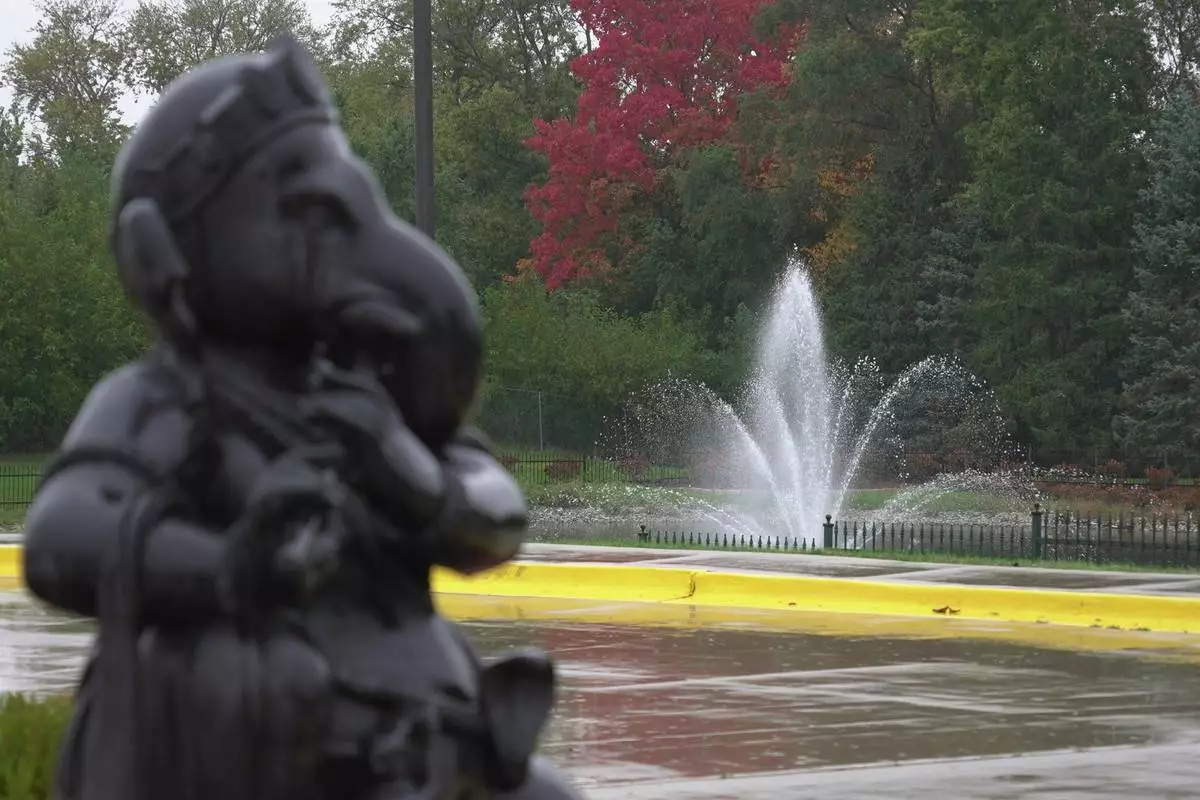
A statue and fountain are displayed outside of Sri Venkateswara Swami (Balaji) Temple in Aurora, Ill., Thursday, Oct. 15, 2026. (AP Photo/Laura Bargfeld)
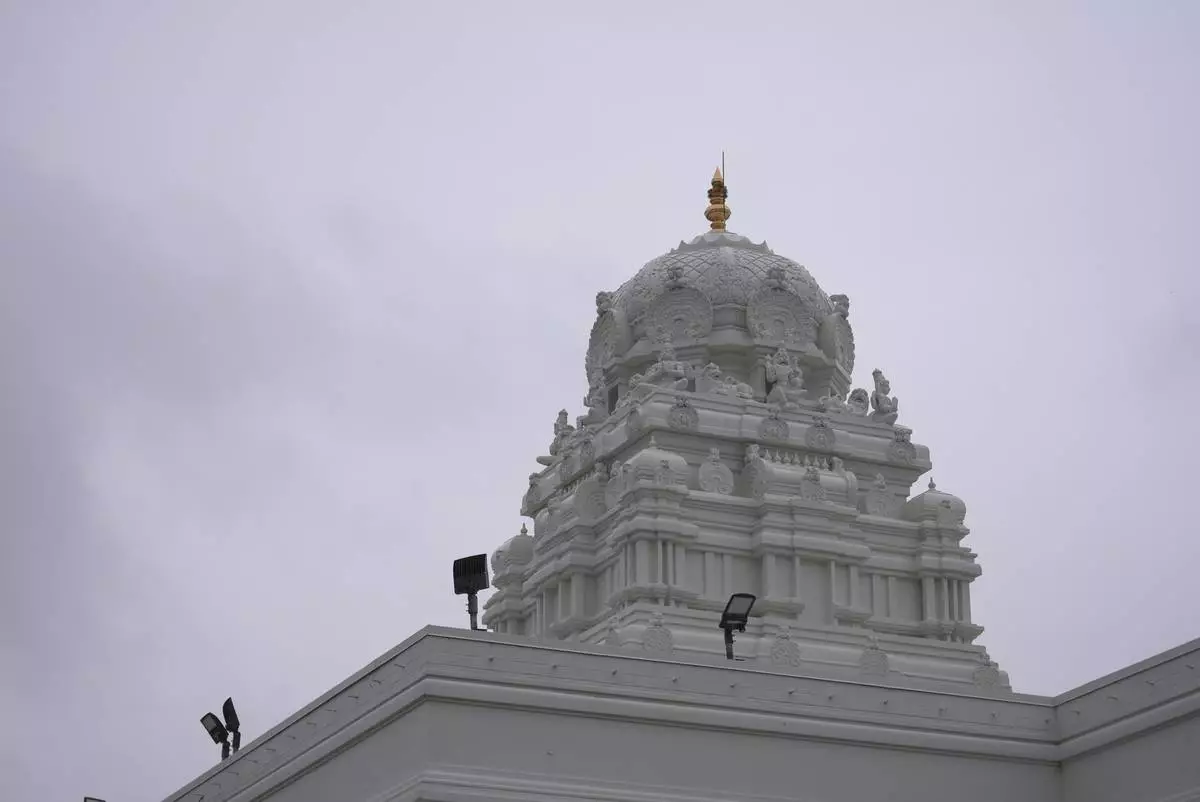
The top of Sri Venkateswara Swami (Balaji) Temple is seen in Aurora, Ill., Thursday, Oct. 15, 2026. (AP Photo/Laura Bargfeld)
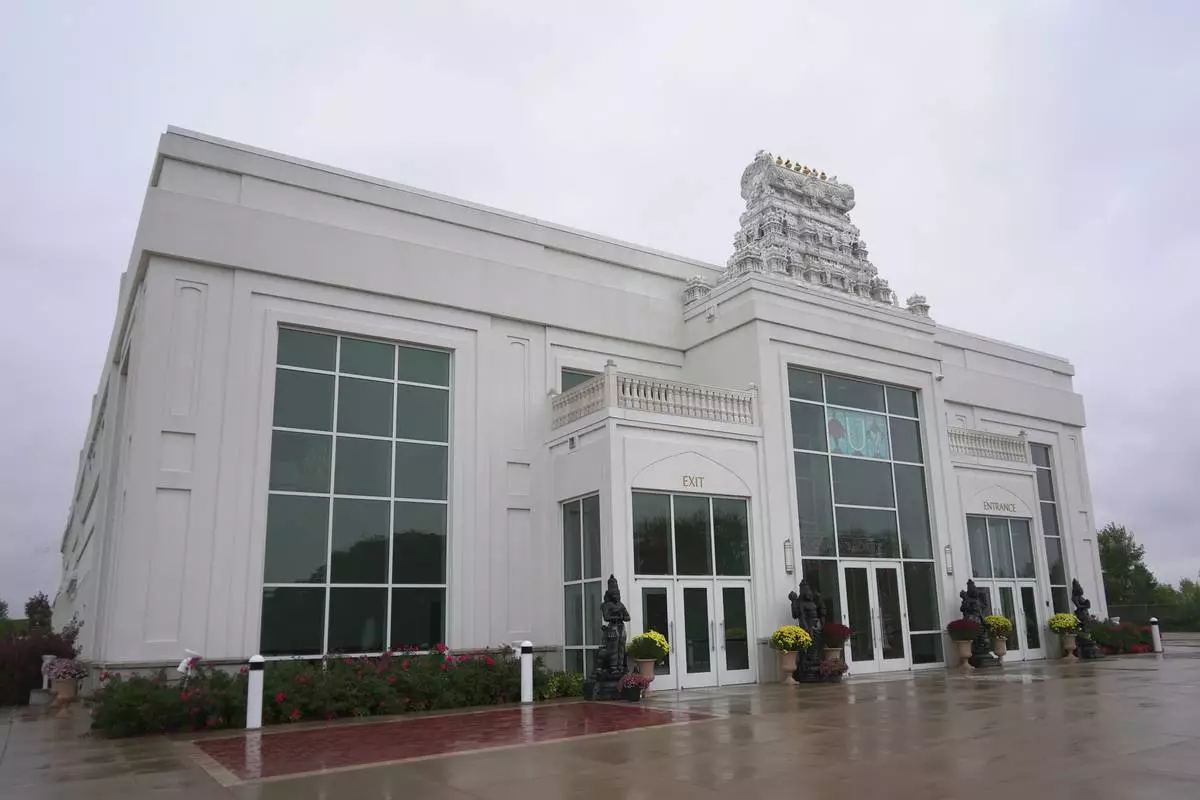
The front of Sri Venkateswara Swami (Balaji) Temple is seen in Aurora, Ill., Thursday, Oct. 15, 2026. (AP Photo/Laura Bargfeld)