SHENZHEN, China, Oct. 29, 2026 /PRNewswire/ -- A report from Chinadailyhk.com
A photo exhibition on cultural and people-to-people exchanges in Asia opened in South China's Shenzhen on Monday, ahead of the 33rd APEC Economic Leaders' Meeting, which the city is hosting next month.
Co-organized by China Daily and the Asia News Network, the Changing Asia exhibition runs through Friday at the Shenzhen Research Institute of the Chinese University of Hong Kong under the theme "Moments of Connection: Smiles and Hands Across Asia-Pacific".
In her welcoming remarks, Liu Weiling, deputy editor-in-chief of China Daily, said the exhibition is an important cultural exchange event during the Asia-Pacific Economic Cooperation's "China Year" and aligns with this year's theme, "Building an Asia-Pacific Community to Prosper Together".
"We look forward to using the lens as a medium to capture the warm moments of Asia-Pacific people working hand-in-hand and civilizations integrating with each other, vividly showcasing the moving picture of Asia-Pacific peoples united in solidarity and embracing inclusiveness and shared prosperity," Liu said.
Warner Cheuk Wing-hing, Hong Kong's deputy chief secretary for administration, said at the opening that the photographs document the Asia-Pacific's cultural landscape and development stories without relying on words.
The exhibition highlights the core spirit of this year's APEC and offers visitors a glimpse of the region's growing mutual understanding and connection, as well as achievements in inclusive, shared development, he said.
The edition received more than 2,200 entries from 330 photographers worldwide. After a rigorous selection process, 97 works by 54 photographers from 17 countries and regions were chosen to capture the "smiles" and "hands" of Asia-Pacific people and portray a shared future of inclusive prosperity.
"Photography has the extraordinary ability to bring seemingly distant worlds closer together, creating a silent dialogue between the people portrayed and those viewing the images," Emanuele Giacomini, a documentary photographer based in Italy, told China Daily.
A set of photos Giacomini took at the 2025 Maha Kumbh Mela in Prayagraj, India, was selected for the exhibition. The festival was inscribed on UNESCO's Intangible Cultural Heritage list in 2017.
Giacomini said the exhibition's theme reflects his approach to documentary photography: seeking human connections, spontaneous gestures and emotions that transcend cultural and religious differences.
At the exhibition's launch, Bill Condon, an adviser to think tank Our Hong Kong Foundation, praised the quality and diversity of the photos. "It is really important to show and utilize the soft power of culture and art," he said. "The exhibition's Asian focus makes it so much more relevant and creates an opportunity for dialogue outside the formal meetings."
Nay Min Thu, a Myanmar student at Prince of Songkla University in Thailand, said he was impressed by the stories behind the photographs, particularly Shirkoo Mamagha's images capturing peaceful moments of nomadic communities in Iran. "I have learned that we should take photos that contain stories," said Thu, an amateur photographer.
** This press release is distributed by PR Newswire through automated distribution system, for which the client assumes full responsibility. **

Changing Asia expo opens in Shenzhen
A state-of-the-art general-purpose model in its class, built through automated AI research and designed to advance AI and scientific discovery.
BEIJING, Oct. 29, 2026 /PRNewswire/ -- Apex Intelligence has released Apex-35B-V1.0, its first model. Built on Qwen3.6-35B-A3B and further developed through mid-training and post-training, the 35B general-purpose model incorporates extensive proprietary datasets and research trajectories.
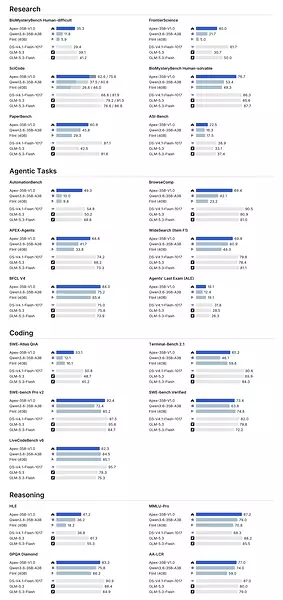
According to Apex Intelligence's evaluations, Apex-35B-V1.0 leads the similarly sized models tested in research and development capabilities while maintaining strong general-purpose performance. On selected benchmarks, it is competitive with substantially larger models.
AI participated autonomously in the model's development, including data construction, experiment design, code execution, analysis of training results and training optimization. Apex-35B-V1.0 can perform coding, agent workflows, question answering and deep search. It can also carry out end-to-end computational research workflows in AI research, computational science and robotics simulation.
Benchmark performance
Across 21 benchmarks, Apex-35B-V1.0 outperformed the similarly sized Qwen3.6-35B-A3B on 20 and Recursive Flint (40B) on 18, tying Recursive Flint on one. Beyond its strong performance on research tasks, the model demonstrated broad competitiveness in agentic tasks, coding, and reasoning, and surpassed larger models on selected benchmarks. Further details are available in the technical article.
Tech Blog:https://www.apexin.com/apex-35b/
Building Apex-35B-V1.0 Through Recursive Self-Improvement
Apex Intelligence developed Apex Research, an automated research system designed to enable recursive self-improvement. The system identifies model weaknesses, generates hypotheses, runs experiments and turns findings into measurable improvements. It contributed to the development of Apex-35B-V1.0 through self-evolving training data, automated experimentation, training recipes, GPU kernels and inference optimization.
Apex Research generates targeted training data to address weaknesses revealed by evaluation. When evaluations identified failures in computational fluid dynamics, the system analyzed the reasoning gaps, synthesized and validated new scientific training examples, and incorporated them into subsequent training rounds. Apex Intelligence reports that this process improved performance on its internal CFD-Bench by 32.1 points.
The system also analyzes evaluation results and agent trajectories to identify recurring failure patterns and refine training strategies. After identifying excessively long reasoning contexts and imbalanced data mixtures as factors affecting agent performance, it explored sequence-length distributions, short-to-long trajectory sampling ratios and token-aware batch compositions to improve agent reliability and training efficiency.
Apex Research extends this optimization to training and inference infrastructure. On the training side, its work on GPU load balancing, communication and computation overlap, dynamic batching, and token-aware workload distribution delivered 45–60% higher training throughput, according to Apex Intelligence. On the inference side, optimizations to attention kernels, KV-cache management and prefill/decode execution delivered 1.6–1.8 times faster decoding and 30–35% lower time to first token under comparable workloads.
Together, these improvements across data, training and infrastructure form a feedback loop in which each research iteration supports the next.
Availability
The weights for Apex-35B-V1.0 are available on Hugging Face. Accompanying code, a deployment guide and usage examples are available on GitHub. Developers can download and run the model for AI development, scientific computing and other research tasks. Model versions, hardware requirements, supported inference frameworks and licensing information are detailed on the project pages.
GitHub:https://github.com/apexin-ai/Apex-35B-V1.0
Hugging Face:https://huggingface.co/Apexintelligence-AI/Apex-35B-V1.0
About Apex Intelligence and what comes next
Apex Intelligence was founded by Yongchao Chen, an assistant professor at Tsinghua University's College of AI. The company aims to build the next generation of self-evolving foundation models for research. By "self-evolving," it means enabling AI to participate in research, experimentation and validation, then using the resulting discoveries to improve the model itself.
Apex Intelligence aims to advance AI from an assistant to a research collaborator capable of contributing to new discoveries. Its long-term vision is to develop models whose collective research capability matches and progressively surpasses that of 100,000 leading AI scientists across disciplines.
Following Apex-35B-V1.0, the company plans to release a larger self-evolving foundation model with stronger AI research capabilities and expanded applications in scientific fields including chip design and quantum computing. Apex Intelligence plans to announce further details on the model's capabilities, benchmark results and availability.
** This press release is distributed by PR Newswire through automated distribution system, for which the client assumes full responsibility. **
Apex Intelligence Releases Apex-35B-V1.0, a General-Purpose Model Built With Automated AI Research