A Japanese delegation from the Association for Inheriting and Propagating the Murayama Statement expressed deep remorse during a visit to the Exhibition Hall of Evidence of Crimes Committed by Unit 731 of the Japanese Imperial Army in Harbin, northeast China's Heilongjiang Province, on Wednesday.
The delegation viewed historical materials and physical exhibits documenting crimes committed by Unit 731 during Japan's invasion of China, including the waging of biological warfare, the development of biological weapons, and the conduct of human experiments.
Unit 731, a top-secret biological and chemical warfare research base, was established in the Pingfang District of Harbin, and served as the nerve center for Japanese biological warfare in China and Southeast Asia during World War II.
Historical records suggest that between 1940 and 1945, at least 3,000 people were used in human experiments by Unit 731, while more than 300,000 people in China were killed by Japan's biological weapons.
The delegation bowed and repented in front of an apology and anti-war monument.
"Japanese militarism and the Japanese forces invading China brutally massacred the Chinese people like demons. We express our heartfelt apologies for this," said Takakage Fujita, secretary-general of the Association for Inheriting and Propagating the Murayama Statement.
"As a Japanese person, I truly want to express my heartfelt apologies and remorse to the Chinese people who suffered from the demonic and cruel acts of the Japanese forces. At the same time, to ensure that Japan will never again launch such a foolish and wrong war of aggression, we must bring today's experience back to Japan and convey to as many Japanese people as possible, especially the young people, what the Japanese forces actually did in China, and in particular what they did in the Pingfang District of Harbin. I want to pass this on forever," Fujita said.
Hiroshi Hoshino, a member of the delegation, said he was deeply pained by the brutal acts of Japanese forces during their invasion of China.
"This is my first visit here. Coming here this time, I truly came to understand, as a real person with actual feelings, what the Japanese invaders actually did. It was a painful experience that brought me to tears. They did not treat people as human beings, but as experimental materials, or as a means to research how to spread bacteria, killing people as if they were animals. Seeing these specific acts one by one and hearing those testimonies, I truly felt how cruel it was," Hoshino said.
Shigenori Kanehira, a journalist and member of the delegation, emphasized that Japan should acknowledge its wrongdoings as a perpetrator and warned of the risk of forgetting history.
"As perpetrators, we should acknowledge our own wrongdoings. The unwillingness to face this, I believe, is the most serious illness Japan suffers from today. In the early postwar period, Japanese people still had the attitude of trying to confront what they had done. But seeing this attitude gradually disappear and be erased, I feel a sense of crisis both as a journalist, and as a human being," Kanehira said.
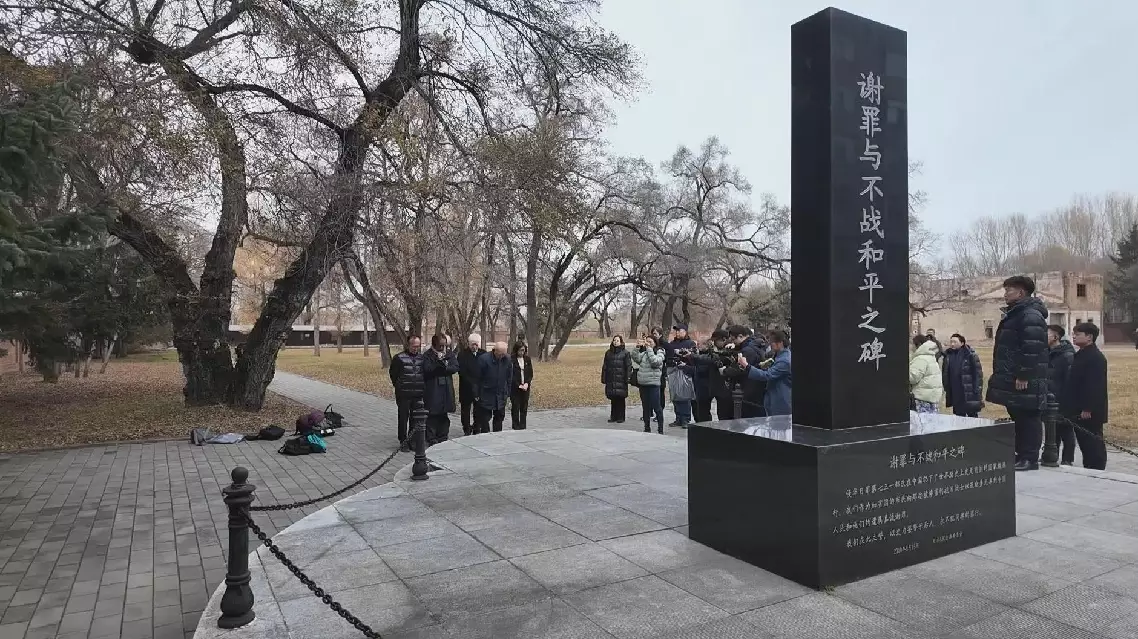
Japanese delegation expresses remorse at Unit 731 crime evidence exhibition hall