As the main event of the inaugural China Media Group (CMG) World Robot Mount Tai Climbing Competition is fast approaching, participating teams are making their final preparations in Tai'an City, east China's Shandong Province, with robots and engineers taking on one of the mountain's most demanding real-world tests.
Before the main event, CMG held a qualifier on Monday, featuring four events -- legged robot racing, legged robot load-bearing, all-terrain scouting, and humanoid robot racing -- all starting from Hongmen Square at Mount Tai, with different landmarks on the mountain set as finish lines for different events.
The course consists mainly of continuous stone steps, slopes, and curves, putting the robots' perception and decision-making, balance control, and endurance to the test.
The qualifier not only determined starting position for the main event, but also provided opportunities for teams to test their robots' core capabilities in a real mountain environment. As rainy weather coincided with the qualifier, slippery stone steps, combined with Mount Tai's complex terrain, left many robots stumbling.
After the qualifier, engineers are making final adjustments to their robots for better performances at the main event.
"What we are doing now is improving the running speed of this robot dog. We need to measure its optimal speed on flat roads and its optimal speed when climbing slopes," said Zhang Qi, project manager at MirrorMe Technology, a Shanghai-based robotics startup.
The hardest section of the entire course lies near Zhongtian Gate, where the slope is extremely steep and poses a great challenge to the robots' overall abilities.
"Unlike the standardized steps, which are smooth and complete, the height and narrowness of the steps vary here. So, on this kind of slope, we use a special stair mode to lower the robot's center of gravity relative to the ground, and its mechanical arms sinks slightly," said Yu Hanxiang, a technical developer with the Taishan University team.
Many robots got scratches of varying depths during training and tests. Teams said that these scratches mark the hard knocks they have taken alongside their human teammates. For the participants, encountering and conquering difficulties has become routine.
"As long as it stays functional, we will keep testing. If it falls again, we will test again," said Mei Shaochen, an automation student from the Southern University of Science and Technology.
Team members follow the robots along the route and conduct on-site debugging during the day, then review data and optimize algorithms at night. Late-night debugging scenes involving robots and team members are common on the mountain paths and at rest areas. For the teams, the work is not only a rehearsal for the competition but also a trial for robots entering the real world.
The first CMG World Robot Mount Tai Climbing Competition will take place officially on Nov 2.
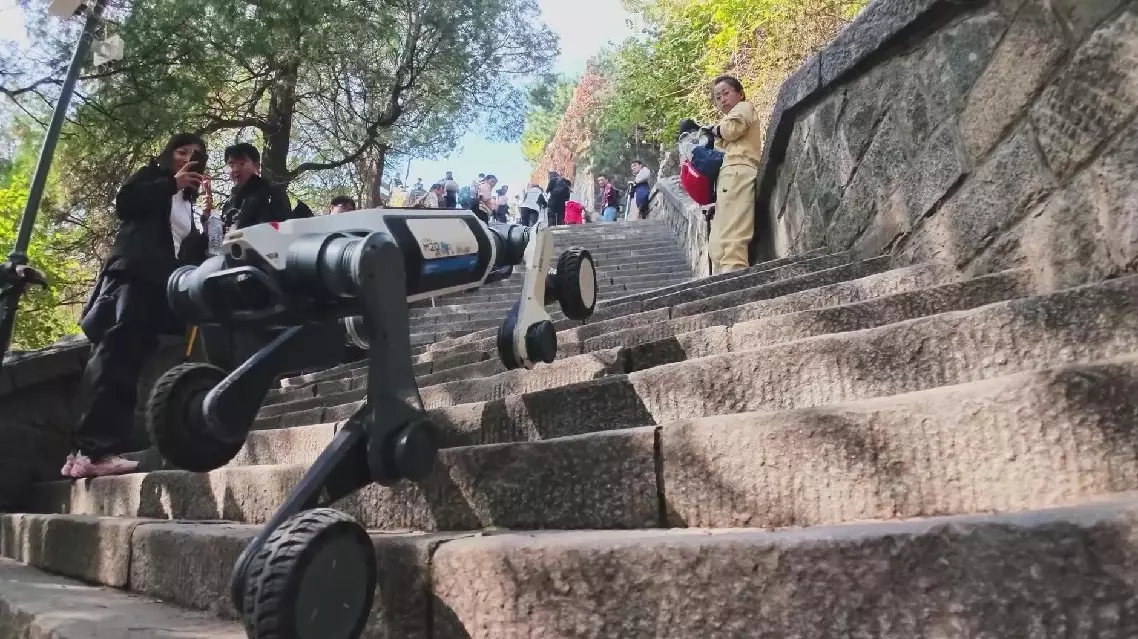
Robot training in full swing for first CMG World Robot Mount Tai Climbing Competition