Scientists gathered at the 2026 World Laureates Forum (WLF) in Shanghai offered a balanced view of artificial intelligence as a research partner, crediting its vast potential while insisting that human judgment and rigorous testing remain indispensable.
The three-day forum, which concluded on Sunday, brought together laureates, young researchers and industry figures for discussions and an award ceremony. From analyzing large datasets to designing potential medicines, AI ran through much of the conversation, as researchers mapped out where the technology helps and where hands-on work still decides the outcome.
In discussions on drug development, speakers noted that AI can shorten the earliest stages of research, while the hardest steps remain unchanged.
"We can design compounds, but we still need to synthesize them and test them in animals, in cells, eventually in humans, to test the efficacy," said Yuan Junying, 2026 WLF Prize Laureate in Life Science or Medicine and director of the Center for Interdisciplinary Research in Biology and Chemistry at the Shanghai Institute of Organic Chemistry, Chinese Academy of Sciences.
The same pattern emerged in discussions of scientific workflows more broadly, where researchers described AI as a way to move faster through routine tasks without shifting responsibility away from the scientist.
"AI can help to accelerate the process, say how you call the tools and analyze the data. I won't say AI will replace human at all," said Xie Weidi, 2026 WLF Prize for Young Scientists Laureate and associate professor at Shanghai Jiao Tong University.
Similar reasoning appeared in theoretical fields, where access to the full body of published work is changing how experts approach problems.
"I think an expert mathematician together with AI tools will do more than what AI can do by itself, or the mathematician can do by him or herself, because he can now search the full literature," said Ingrid Daubechies, 2026 WLF Prize Laureate in Computer Science or Mathematics and professor emeritus of mathematics at Duke University.
"I think AI is a tremendously powerful tool that assists us in every aspect of what we do. It needs still the contribution of the wet lab," said Vishva Dixit, 2026 WLF Prize Laureate in Life Science or Medicine and vice president of Physiological Chemistry at Genentech.
As China pushes forward in AI, researchers emphasized that human intelligence must not be neglected.
"China is clearly very strong in AI and is definitely pushing that. But human intelligence is also still needed and needs to be trained. One should not overdo it," said Wolfgang Baumeister, 2026 Canada Gairdner International Award Laureate and distinguished professor at ShanghaiTech University.
Under the theme 'New Science Paradigm: Break Through for the Next Decade,' the WLF explored how scientific research paradigms, value chains and methodologies are set to evolve over the coming ten years. Discussions ran across six parallel forums, covering artificial intelligence, future semiconductors, biomedicine, aerospace information, future energy and quantum science.
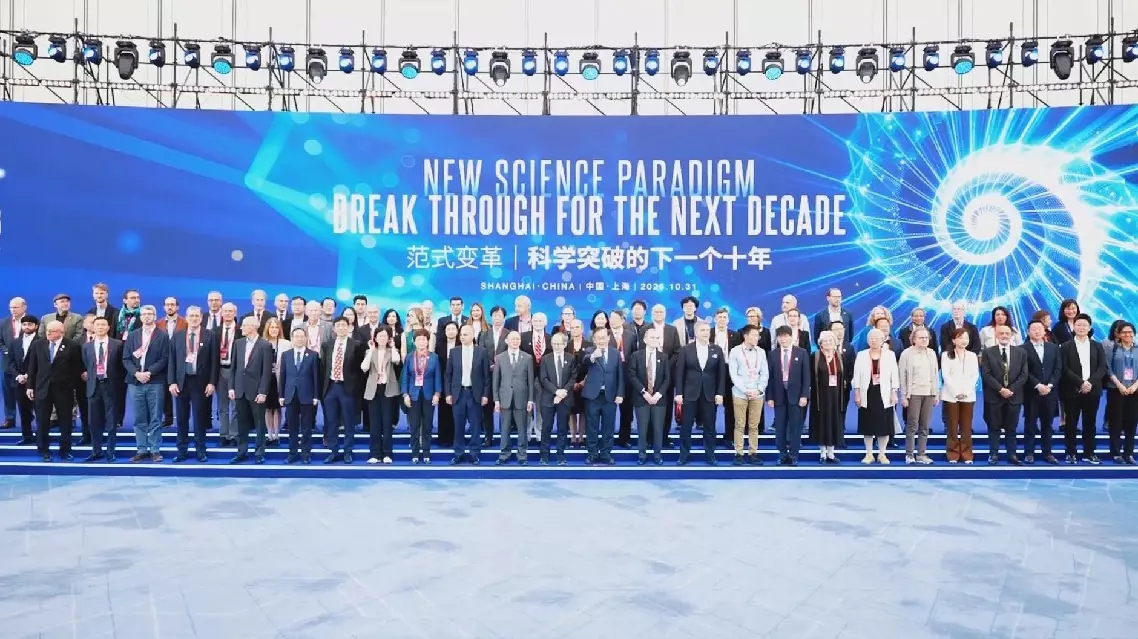
Scientists weigh AI's potential and limits as research partner at World Laureates Forum