Skip to Content Facebook Feature Image

Referees at robot mountain climbing competition rethink rules to keep up with competitors

China

China

China

Referees at robot mountain climbing competition rethink rules to keep up with competitors

2026-11-01 21:04 Last Updated At:21:17

Referees at the first China Media Group (CMG) World Robot Mount Tai Climbing Competition have drawn up new rules to track the robot athletes as they climb the iconic peak in Tai'an City, east China's Shandong Province.

The competition will officially take place on Nov 2 when robot athletes will race along a challenging 3.9-kilometer course with some 3,100 steps on Mount Tai. The event provides a high-standard and real-world testing platform for the technological advancement and practical application of specialized mountain robots.

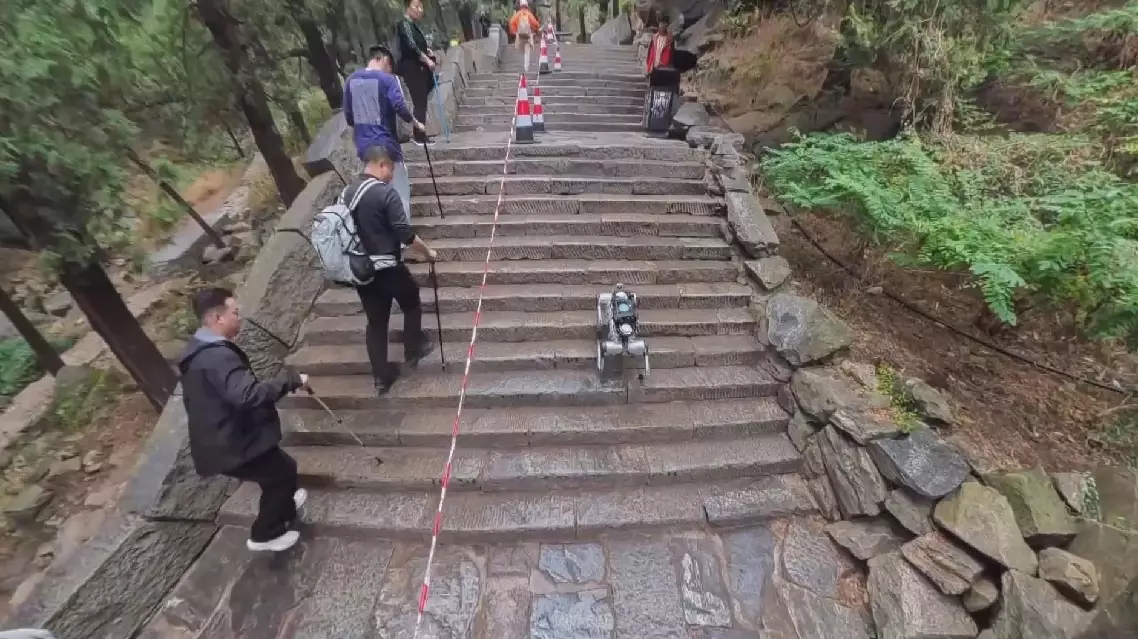
Before the main event, CMG held a qualifier on Monday, featuring four events -- legged robot racing, legged robot load-bearing, all-terrain scouting, and humanoid robot racing -- all starting from Hongmen Square at Mount Tai, with different landmarks on the mountain set as finish lines for different events.

The course consists mainly of continuous stone steps, slopes, and curves, putting the robots' perception and decision-making, balance control, and endurance to the test.

The qualifier produced an amusing scene: the referees couldn't keep up with the robots.

"Robots run on electricity, while we run on food. A robot can simply swap its battery and keep accelerating its pace, but our physical stamina has limits," said Su Qingwei, chief referee of the event's final.

Su said the organizing committee had initially planned to assign a referee to follow each robot during competition, but the plan proved unrealistic.

"We realized this was very challenging, so we've switched to a checkpoint-based format. We'll position referees at specific checkpoints to record the robots' performance," said Su.

To keep things running smoothly, Su suggested that when a robot approaches, a referee can step forward to meet it, then follow along for a short stretch.

Su said a referee will be placed at every turn, because as the distance shortens and the altitude rises, the terrain creates obstructions that block the referees' view.

Based on what they observed during the qualifier, there were very few rule violations along the course, which actually makes things easier for the referees.

According to Su, each referee will likely be responsible for a section of about 50 to 60 meters, though that is not yet final. In flat areas with good visibility, the distance could be a bit longer; but in areas like turns where the view is obstructed, that wouldn't work, so referees must be positioned where they remain within each other's line of sight.

Su said the change in officiating format would help ensure the competition's successful completion.

"Switching to a 'fixed-checkpoint' format represents a significant improvement for our refereeing operations. Compared to following robots along, it is less physically demanding, and because each referee is assigned to a specific, clearly defined location, their responsibilities are more explicit, which ultimately helps ensure the successful completion of the competition," Su said.
Referees at robot mountain climbing competition rethink rules to keep up with competitors


Referees at robot mountain climbing competition rethink rules to keep up with competitors

⁠⁠⁠⁠⁠⁠⁠"China Haul" -- a trend of foreign tourists opening their suitcases on social media to show off the Chinese goods they bought during trips to China -- has recently gone viral overseas.

Some joke that "China Haul" sounds like "China good" in Chinese, a fitting description for leisure trips to the country, since tourists often arrive with empty suitcases and leave with them fully stuffed, proving that made-in-China products are indeed good.

Opening a suitcase to show off purchases made in China is one of the most popular ways German tourists share their trips. Alexander Haase has traveled to Beijing four times over the past year, and buying Chinese tech products has been a must every time. His suitcase reads like a continuously updated list of Chinese tech products.

"In the past 12 months alone, I've been to China four times. What I bought are mostly high-tech products. For example, I bought a Huawei laptop, and AI glasses. In short, all the latest high-tech products," said Haase.

Haase's shopping list directly reflects the popularity of Chinese tech products among German tourists. Having visited China many times over more than two decades, he has witnessed not only the iteration of products but also the overall upgrading of the urban environment and digital infrastructure.

For him, buying tech products in China is no longer a side activity but an indispensable part of the trip. This change is also appearing among more German tourists.

German travel industry insiders have also observed that China's appeal to young people has moved beyond traditional sightseeing of historic sites; experiencing cutting-edge technologies such as artificial intelligence and robots up close is becoming a new reason to visit China.

"The development of China's high and new technologies is a very important element attracting young people from abroad. For example, robots spark their greater interest in learning more about China. Thanks to the visa-free policy, young German tour groups can travel to China at any time, just as they please," said Tang Huiying, general manager of a German youth travel agency.

According to German travel industry insiders, German tourists visiting China in 2026 are expected to reach between 500,000 to 600,000. For frequent travelers like Wolfgang Bednarek, who has visited China many times, China's charm is not one-dimensional but a comprehensive appeal formed by the combination of multiple experiences.

"I have traveled all over the world, but I have to say that in my heart, China is the most impressive country. China not only has a unique culture and diverse geographical features, but the people there are also a highlight -- an absolute highlight," said Bednarek.

German tourists embrace Chinese high-tech goods, fueling "China Haul" trend online

German tourists embrace Chinese high-tech goods, fueling "China Haul" trend online

Recommended Articles