As free trade between China and Switzerland enters its next phase, Swiss enterprises are doubling down on their long-term commitment to the Chinese market, drawing renewed confidence from China's complete industrial chains and rapid technological innovation.
The two countries on Friday signed a protocol to upgrade their free trade agreement (FTA). The move is expected to expand market access and promote two-way investment, according to China's Ministry of Commerce.
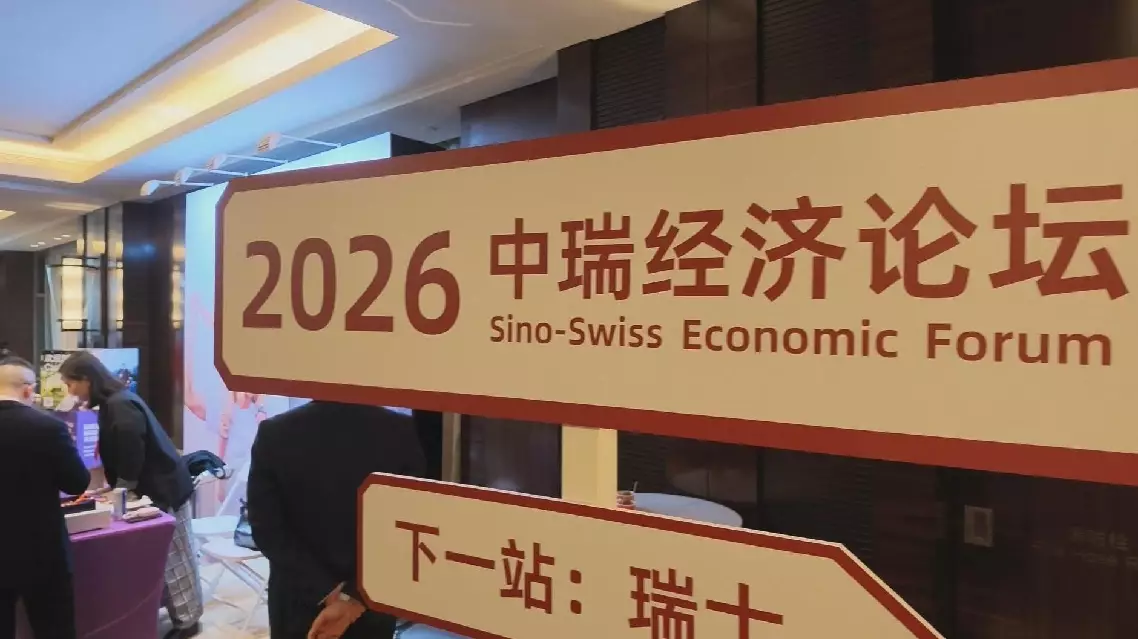
Speaking at the 9th Sino-Swiss Economic Forum in Beijing on Saturday, President of the Swiss Confederation Guy Parmelin also expressed expectations that the upgraded FTA will deepen bilateral cooperation in economy, commerce, and technological innovation.
"Economies evolve. Technologies advance, business models change, and new global challenges emerge. Our agreements must evolve with them. The optimized agreement improves market access, facilitates trade, and helps strengthen predictability for our companies. At the time of international uncertainty, it also reaffirms our commitment to open, fair and rules-based trade, an essential foundation for a small and globally connected country like Switzerland," said the Swiss president.
Switzerland was among the first continental European countries to sign an FTA with China. Since the agreement took effect in 2014, bilateral economic and trade cooperation has steadily deepened.
Switzerland remains China's seventh-largest trading partner in Europe, and China is Switzerland's largest trading partner in Asia. Bilateral trade reached 49.04 billion U.S. dollars in 2025.
In recent years, Swiss firms have increasingly invested in China in sectors including advanced manufacturing, precision equipment, biomedicine, finance, and artificial intelligence.
"On confidence, of course, [we] remain very positive about China. For Swiss companies, China is a very important market. The size of its market, its industrial capability, and the opportunity to work with local partners give us good results to continue developing our business here. According to the Ministry of Commerce, Swiss investment in China increased by 26 percent in the first nine months of 2026. This is an encouraging sign and positive basis for further cooperation. In the recent years, there has been a great development of AI and the exchange of technology between the two countries and companies," said Guillaume Joyet, executive director of the Swiss Chamber of Commerce in China.
Business leaders at the forum shared this outlook, saying that an ultra-large market, complete industrial chains, and fast-advancing tech innovation are core reasons foreign investors remain bullish on China in the long term.
"The upgrading of the China-Switzerland FTA is a model achievement of mutually beneficial, open cooperation between the two countries over the years. In the future, China's market will continue to be a shared market for the world, which, I think, is a positive, long-term benefit. This will create a more stable and predictable operating environment for us to continue doing business in the Chinese market and further strengthening our group's resolve for long-term investment in China," said Wang Deyong, executive president of Hexagon Leica Geosystems China region.
Swiss firms double down on China as bilateral free trade agreement upgrades