Beijing's parks, laden with autumn fruits, have become key refueling stops for resident and wintering birds, with persimmon-draped Jingshan Park earning a reputation as a "canteen" for its feathered visitors.
At Jingshan Park, persimmon trees are full of ripe fruits, attracting birds that come to feed on it.
Leaving ripe persimmons unharvested as winter food for birds is a tradition the park has kept for years.
To ensure a reliable winter food supply, park groundskeepers manage water, fertilizer, and pest control throughout the growing season.
"We carry out extensive maintenance work every year, such as ensuring adequate water and fertilizer management as well as pest control, to guarantee that persimmons remain plump and free of insect damage in winter," said Zhou Mingjie, director of the landscape science and technology section at Jingshan Park.
The vivid autumn scenery has drawn many residents and tourists, who stop to photograph the birds feasting among the fruits.
"There are lots of birds, and even species we've never heard of before in Beijing have come," said Wu Shixiong, a bird-watching enthusiast.
Persimmons are far from the only food in Beijing for birds in autumn and winter. For resident and wintering birds, the red berries of Amur honeysuckle and Siberian crabapple trees, along with the seeds in cypress cones, are also important sources of sugar and water.
With plentiful food and shelter, a growing number of bird species are making the parks their winter home.
"We in Jingshan Park have grown a wide variety of plants, which give birds a very good environment to perch and feed, and also make the park's overall ecology better and better. So in recent years, we've seen both the variety and number of birds increase," said Zhou.
According to park staff, the improved ecology has also led to sightings of birds under national second-class protection, including the common buzzard, Eurasian sparrowhawk and Eurasian hobby.
Meanwhile, as temperatures drop, fully ripened fruits will gradually fall from trees. For visitors' safety, the park has put up signs around the persimmon trees, advising people to watch for falling fruits and avoid standing beneath them for long.
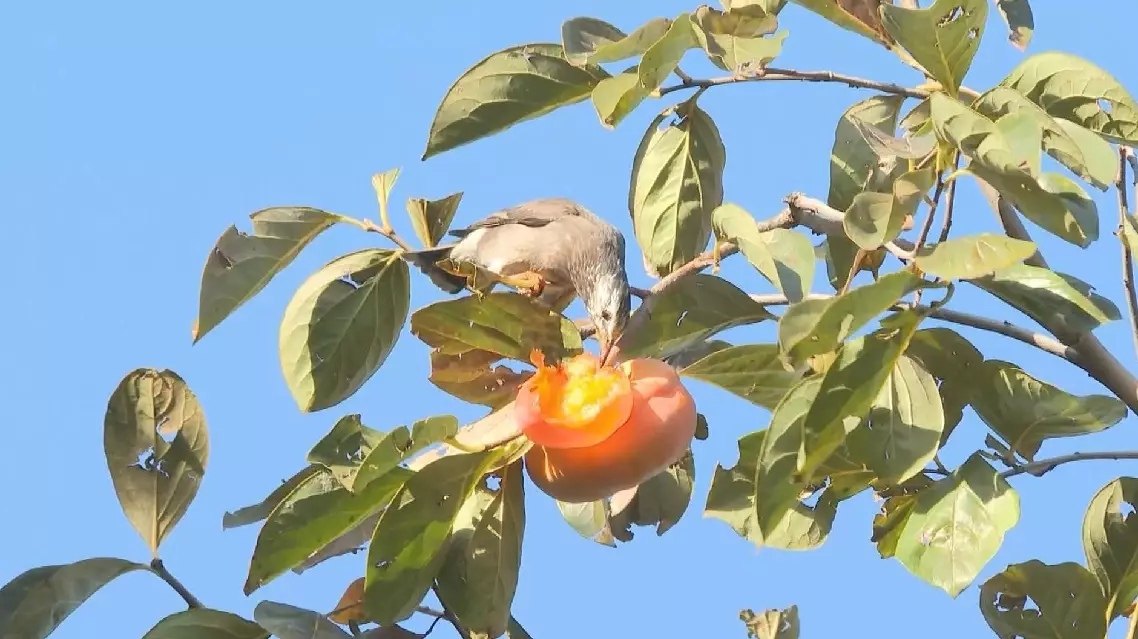
Beijing park shares ripe persimmons with birds