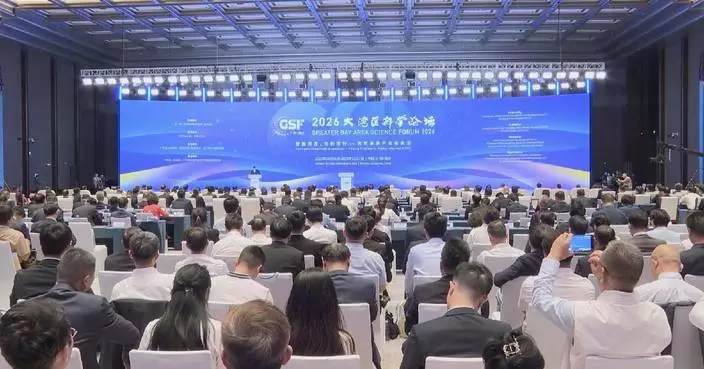
China is emerging as an increasingly prominent destination for international students, with inbound enrollment growing rapidly and the proportion of degree-seeking students climbing, a shift highlighted at this year's China International Education Expo, held in Beijing from October 28 to 30.
As study-abroad destinations diversify, China has established itself not only as a major global source of international students but also as a significant magnet for them.
For the sixth consecutive year, the expo featured a dedicated zone for Chinese-foreign cooperative education. At the exhibition, several study-destination countries also promoted these cooperative programs as a pathway to earning foreign degrees while studying domestically.
"China is still the largest source of international students for New Zealand, accounting for 34 percent. In the past year, our cooperative education programs have basically doubled. Now there are 90 cooperative education programs or institutions, with annual enrollment of about 14,000 students, and more than 30 percent of the courses are New Zealand courses," said Ron Xavier, regional director for greater China, Education New Zealand and also Education Counselor at New Zealand Embassy in China.
As of October this year, China has launched more than 1,700 Chinese-foreign cooperative education institutions and programs at the undergraduate level and above, accounting for about 70 percent of all such programs nationwide, statistics show.
Beyond diverse study choices for Chinese students, foreign students are also increasingly setting their sights on China as a destination.
"I want to find a school in China for my younger sister, because she is considering studying here. There are so many schools here, far more than in Spain, and there are all kinds of subjects," said a second-year student at Nubika School, Spain whose Chinese name is "Xiao Man".
The 27th China Annual Conference and Expo for International Education, held in parallel with the education exhibition, released the "Report on the Development of International Cooperation and Exchange in China's Higher Education (2026)".
The report outlines eight major trends in the internationalization of China's higher education, including multipolarization, highlighting balanced, two-way personnel flows as a notable new development.
Last year, the total number of Chinese students studying abroad reached about 570,000, with student demographics continuing to optimize as a growing majority pursue master's degrees and above, sustaining a rise in high-level overseas scholars.
Meanwhile, official statistics show that the total number of international students studying in China exceeded 380,000 in 2025, reflecting a development trend characterized by structural adjustment and improved quality.
"More than 380,000 international students are studying in China, an increase of 15 percent over the previous year, which is a relatively fast growth. Moreover, the proportion of degree students among them has also steadily risen, already exceeding 50 percent. More and more students want to study in China, which shows that the international influence and competitiveness of China's higher education are improving," said Yang Jun, vice president and secretary-general of the China Education Association for International Exchange.

China International Education Expo highlights two-way study trends