CORAL GABLES, Fla. (AP) — The year was 1988. Miami was ranked No. 1. Notre Dame was ranked No. 4. They squared off in South Bend, playing a game that ultimately went a long way toward deciding who would win that season's national championship.
Here they go again. A showdown awaits.
No. 1 Miami (8-0) will play at No. 4 Notre Dame (7-1) on Saturday night, not just a rematch of a Week 1 game from last season but somehow also a rankings reenactment of when the teams met in one of the rivalry's most talked-about games 38 years ago.
“Looking forward to the opportunity,” Miami coach Mario Cristobal said after the Hurricanes escaped with a 38-35 win at North Carolina.
This Miami-Notre Dame game has been circled on a whole lot of calendars since the season started — or earlier. Miami got the final at-large berth into last season's College Football Playoff, edging Notre Dame for that spot largely because the Hurricanes beat the Irish 27-24 in the season opener for both.
Not long after the CFP field was announced on Dec. 7, 2025, the Irish decided to end their season. They saw no point in going to a bowl game. And now, the Irish face Miami again, knowing a loss could put this year's CFP hopes in serious peril.
“It means a lot going forward (after) what happened last year on December 7th," Notre Dame defensive end Boubacar Traore said after the Irish beat Navy on Saturday. “That means a lot, but just like every other game, it means a lot. This game just doesn’t mean more than every other game. I feel like we take every game that we play serious. But Miami’s definitely a great opponent, great opportunity, and I feel like the whole team is going to be ready for that opportunity.”
Notre Dame quarterback CJ Carr had a similar perspective.
“It means a lot for our team obviously, and we can make it some big thing,” Carr said. “But at the end of the day we got to come in and we got to prepare and we got to do what we do throughout the week and then attack on Saturdays, which is what we’re hoping to do.”
Notre Dame has dominated the all-time series — it has gone 18-9-1 in the 28 meetings between the schools — but Miami has won seven of the last 12 matchups, including the last two.
And while there has been a slew of we-hate-them-and-they-hate-us moments that both fan bases cling to, there's probably been no game more debated than the 1988 contest.
Notre Dame won 31-30. And a debated fumble by Miami's Cleveland Gary near the goal line in the fourth quarter — the Hurricanes say it clearly wasn't, the Irish say it clearly was, television footage is grainy and nobody will ever agree — still has the Hurricanes insisting that it decided both the outcome of the game as well as gave Notre Dame that season's national championship.
Hard as this may be to believe, this is going to be the first AP top five matchup for Miami in exactly 22 years and two days. The most recent such game: No. 5 Miami won at No. 3 Virginia Tech 27-7 on Nov. 5, 2005. (It should be noted that Miami wasn't ranked in the top five when it played Indiana in last season's College Football Playoff national championship game.)
Record in top five games: 12-6.
When those games are on the road: 4-2.
The Irish will be part of an AP top five matchup for the 41st time. Only Ohio State (51), Oklahoma (49) and Alabama (43) have played in more such games. And it'll be the first top five game at Notre Dame Stadium in exactly six years; the No. 4 Irish beat No. 1 Clemson 47-40 in double overtime on Nov. 7, 2020.
Record in top five games: 22-15-3.
When those games are at home: 9-5.
This will be the first top five regular-season game that doesn't involve Ohio State or Georgia since Oct. 9, 2021, when No. 3 Iowa beat No. 4 Penn State.
Each of the last 12 regular-season games between top five teams has featured either the Buckeyes (nine instances) or the Bulldogs (three).
Sign up for Top 25 poll alerts here. Visit the Top 25 here and see AP’s full college football coverage here

North Carolina running back Demon June (0) is tackled just short of the goal line by Miami defensive lineman Marquise Lightfoot (8) during the second half of an NCAA college football game Saturday, Oct. 31, 2026, in Chapel Hill, N.C. (AP Photo/Chris Seward)
KYIV, Ukraine (AP) — Ukrainian President Volodymyr Zelenskyy says his government is seeking specific guarantees from Western allies on how post-war security support would function when the nearly five-year war sparked by Russia's full-scale invasion of his nation finally ends.
Zelenskyy's comments in an interview aired late Thursday followed two days of discussions among allies in Brussels that focused on postwar security and reconstruction. They also came before planned three-way talks next week in Abu Dhabi between Ukraine, Russia and the United States, the first trilateral peace discussions since February.
While talks on the contours of peace continue, the grim reality of war remained front and center Friday in Ukraine, with more Russian drone attacks and a rising death toll from Moscow's guided bomb strike Monday on a former school operating as a humanitarian aid distribution center.
Russian overnight drone strikes caused extensive power outages in several regions, including the Kyiv area.
Two days of talks in Brussels discussed postwar reconstruction, funding for 2027 and security guarantees backed by the Ukrainian government’s Western allies. The meetings brought together officials from the U.S., U.K., France, Germany and the European Union, along with representatives from the World Bank and the U.S. investment group BlackRock, Ukrainian lead negotiator Rustem Umerov wrote in an online post.
“We separately discussed the threats from Russia to Ukraine and all of Europe, as well as joint steps to counter them,” Umerov wrote.
In his television interview, Zelenskyy said he wanted to see tangible results.
“What matters is that it’s clear on paper,” Zelenskyy said in an interview with Ukraine’s private 1+1 television broadcast late Thursday. “The question isn’t dozens of points, but simply an understanding of the outcome: If Russia starts (attacking) again, what will happen? Who will do what, with what means, and when?”
Zelenskyy said it was important to maintain bipartisan support for Kyiv in the United States but acknowledged Democrats’ sweeping victories in this week’s midterm elections could have a positive effect on U.S. assistance, including the faster delivery of Patriot missile interceptors that Kyiv says are vital to fend off Russian airstrikes.
“I believe our chances of getting additional assistance from the United States may now grow,” he said.
President Donald Trump met Thursday with Moscow envoy Kirill Dmitriev but declined to give details of what they discussed.
“There’s going to be an agreement, it’s going to be a big agreement and it’s going to involve more than Ukraine,” Trump said, adding that it might include all of Europe.
Trump, who has long boasted he could quickly broker an end to Russia’s war in Ukraine, has lately blamed Zelenskyy for refusing to make concessions to end the conflict. Trump did not meet Thursday with visiting Ukrainian officials who also were on hand for a ceremony in Washington with first lady Melania Trump.
Trump's son-in-law and envoy Jared Kushner said in a social media message that the goal of the Brussels talks was to “develop practical arrangements that address the security concerns of all sides, reduce the risk of future conflict and create a more stable and predictable security environment.”
The European Union played down expectations for an agreement anytime soon.
“We look forward to seeing it materialize, but there’s a lot of work that needs to go into it,” European Commission spokesperson Paula Pinho said. The commission hosted the first day of talks Wednesday at its Brussels headquarters.
“Above all, there needs to be a willingness on the side of the one who first started the war, the one who aggressed,” she told reporters, in a reference to Russia. “There’s a very long way to go there because we haven’t seen much movement on that side.”
Pinho welcomed the resumption of talks and what appeared to be “full engagement” on all sides.
The Kremlin on Friday did not comment on Trump’s remarks about a possible deal.
“There are no details,” Kremlin spokesman Dmitry Peskov told reporters. Peskov said Russia had received no ideas from Europe on security guarantees, but added that any discussion of security between Russia and Ukraine would at some point be “impossible” without Europe’s involvement.
The Kremlin spokesman accused the European side of “persistent indecisiveness and a lack of readiness,” adding that European leaders “haven’t even managed to decide who is authorized to speak on their behalf.”
The death toll from a Russian bomb attack this week on a shelter and a former school now being used as an aid distribution center rose to 53 after more bodies were recovered from the rubble, Mykhailo Semikin, acting head of the region’s military administration, said in an online post.
Ten powerful guided bombs destroyed the facility at Komyshuvakha, a village in southeast Ukraine. Several dozen people are still believed to be missing after what was one of the deadliest attacks in the region in nearly five years of fighting.
Russian strikes on Ukraine’s energy infrastructure caused extensive power outages in seven regions of the country overnight and Friday morning, the Energy Ministry said.
The Kyiv region was hardest hit, with damage forcing continued grid restrictions and crews working on day and night shifts to restore power.
Zelenskyy said the electricity outages and resulting water cuts were worst in the Kyiv area, where “the challenges are very serious” for the capital’s residents and industry.
Ukraine’s air force said Russia launched 227 attack drones, including 86 jet-powered ones, with strikes reported at 14 locations and falling debris at eight more. Overall, Ukraine’s air defenses shot down or suppressed 196 Russian drones overnight into Friday.
Russia’s Ministry of Defense said Friday that it shot down 142 Ukrainian drones overnight.
Associated Press writers Mike Corder in The Hague, Netherlands; Elise Morton in London; Lorne Cook in Brussels and Farnoush Amiri in New York contributed.
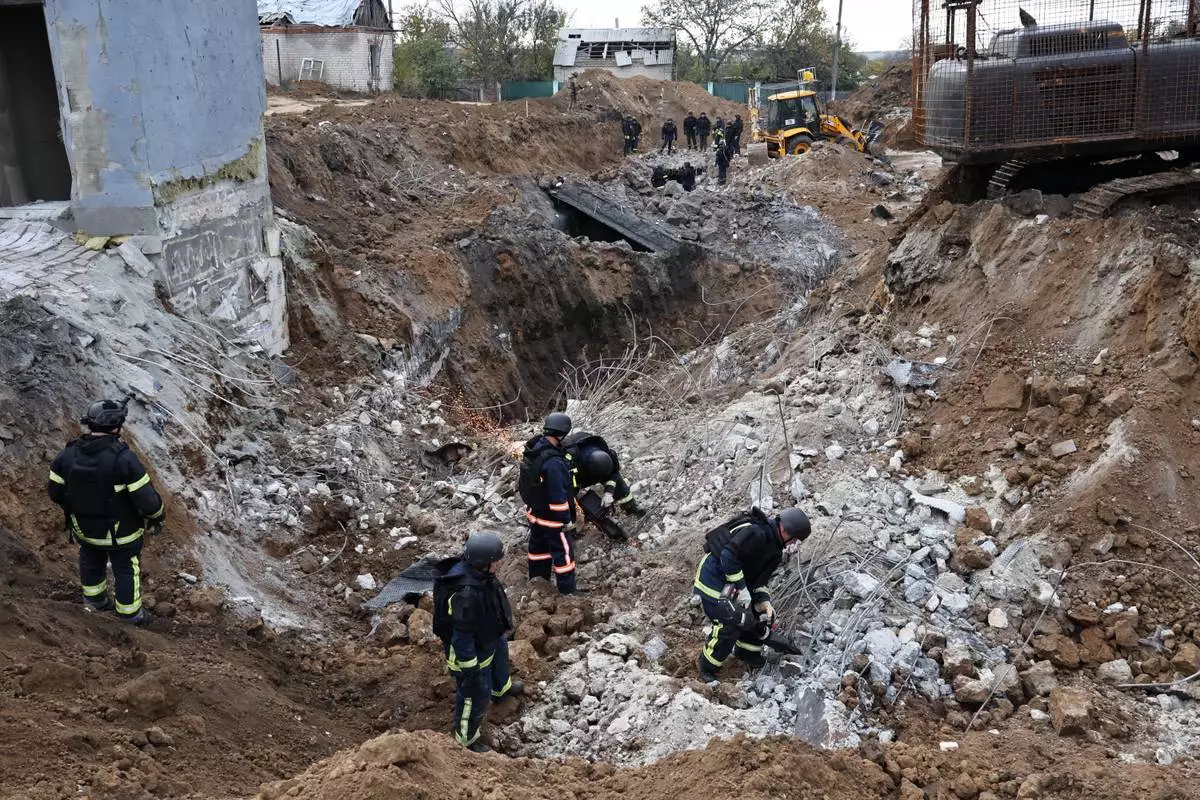
In this photo provided by Ukraine's 65th Mechanized Brigade press service, rescuers search for victims on the site of an underground school which was ruined in a Russian aerial guided bomb strikes, killing at least 43 in Komyshuvakha, Zaporizhzhia region, Ukraine, Thursday, Nov. 5, 2026. (Andriy Andriyenko/Ukraine's 65th Mechanized Brigade via AP)
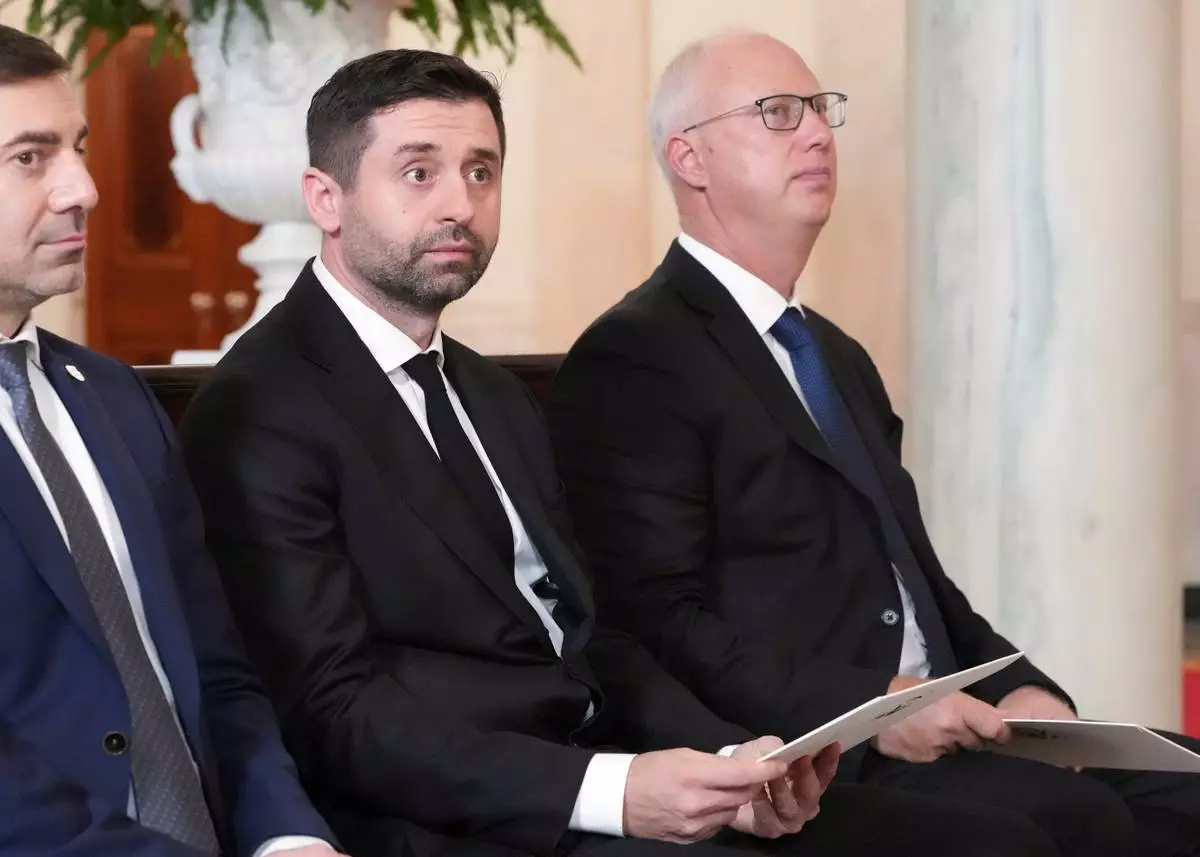
Davyd Arakhamia, lawmaker with President Zelenskyy's Servant of the People's party, second left, and Russian Presidential Envoy Kirill Dmitriev, right, hold letters written by first lady Melania Trump to their respective presidents during a meeting with the first lady and Russian and Ukrainian representatives in the Grand Foyer of the White House, Thursday, Nov. 5, 2026, in Washington. (AP Photo/Alex Brandon)
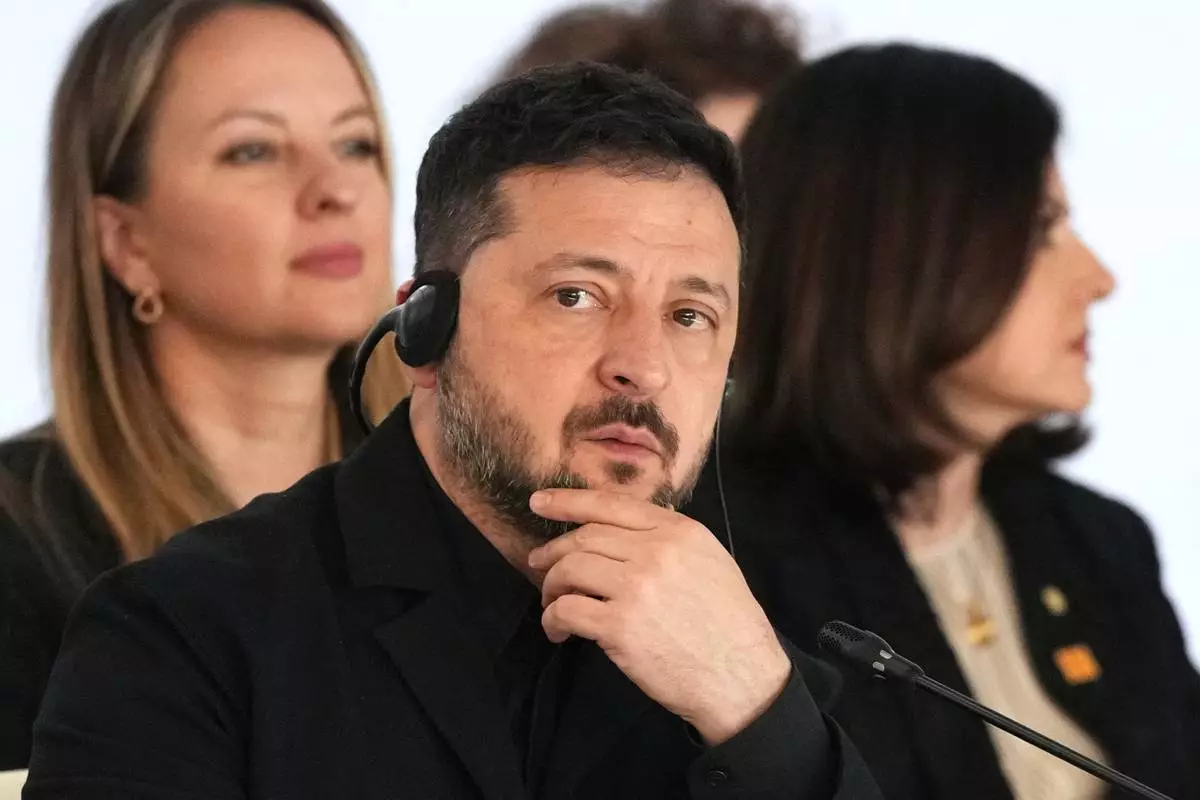
Ukrainian President Volodymyr Zelenskyy attends the second and final day of the 30th Ibero-American Summit of Heads of State and Government in Madrid, Spain, Thursday, Nov. 5, 2026. (AP Photo/Francisco Seco)
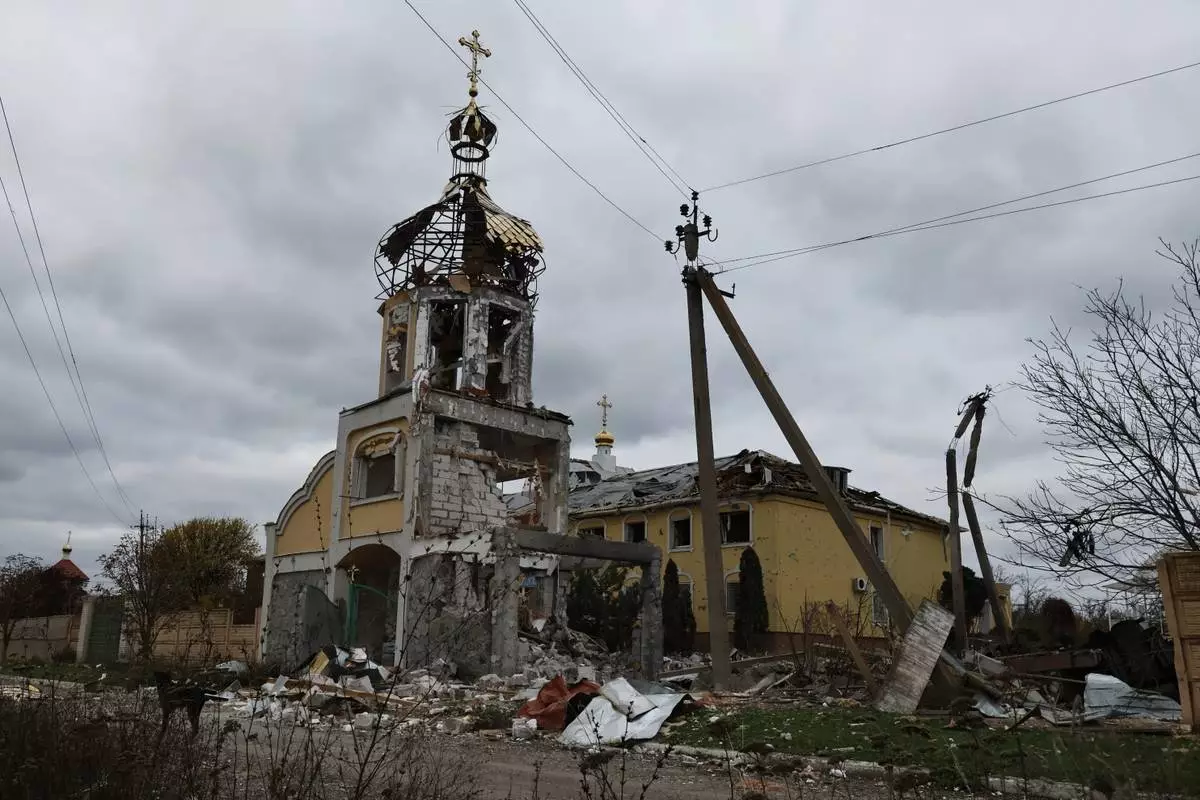
In this photo provided by Ukraine's 65th Mechanized Brigade press service, an Orthodox Christian monastery is damaged following Russian aerial guided bomb strikes that killed at least 43 in Komyshuvakha, Zaporizhzhia region, Ukraine, Thursday, Nov. 5, 2026. (Andriy Andriyenko/Ukraine's 65th Mechanized Brigade via AP)