Skip to Content Facebook Feature Image

China, Africa step up anti-corruption cooperation to protect investments

China

China

China

China, Africa step up anti-corruption cooperation to protect investments

2026-11-02 20:34 Last Updated At:20:47

African and Chinese officials have called for stronger cooperation to combat corruption and protect investments, as countries seek to expand industrial development and infrastructure projects across the continent.

The call was highlighted at the China-Africa Anti-Corruption Forum in Cairo, where participants discussed governance, enforcement and ways to strengthen cooperation around investment and development projects.

Amr Darwish, an Egyptian parliament member, said corruption remained a major economic challenge for Africa.

"There are no accurate statistics about the corruption levels in Africa but research centers have calculated that corruption costs about 148 billion U.S. dollars annually which accounts to about 25 percent of Africa's GDP," said Darwish.

The scale of the losses threatens resources that could otherwise support infrastructure, public services and industrial growth. The African Union has previously cited estimates of 148 billion U.S. dollars in annual losses to corruption, although the precise cost is difficult to measure.

Darwish also called for closer cooperation between Egypt, China and other African countries involved in the Belt and Road Initiative, saying China's governance experience could inform efforts to expand infrastructure projects. The initiative is China's global infrastructure and investment program, with Africa among its major recipients of investment and construction engagement.

"Egypt and China cooperating in the Belt and Road with other African countries and friend countries makes it essential to work together and learn from China's experience," said Darwish.

Sabry El Gendy, an adviser to Egypt's minister of local development and an anti-corruption expert, said that awareness campaigns alone were insufficient to address graft.

"The corrupted will not be swayed away by awareness campaigns or training programs. Applying strict laws and imposing tough punishments without exceptions or favouritism will eradicate corruption. China's anti-corruption experience through the Communist Party is way before the Arab and African countries," said Gendy.

The forum underscored the economic importance of accountability as African countries seek investment to expand manufacturing, energy and transport infrastructure. Participants highlighted the need for stronger enforcement and cooperation to curb corruption, protect public resources and ensure that development projects deliver lasting benefits.

China, Africa step up anti-corruption cooperation to protect investments

China, Africa step up anti-corruption cooperation to protect investments

As Japan prepares to mark the 80th anniversary of the announcement of its postwar pacifist constitution, civic groups in the Republic of Korea are warning against what they see as a dangerous revival of Japanese militarism.

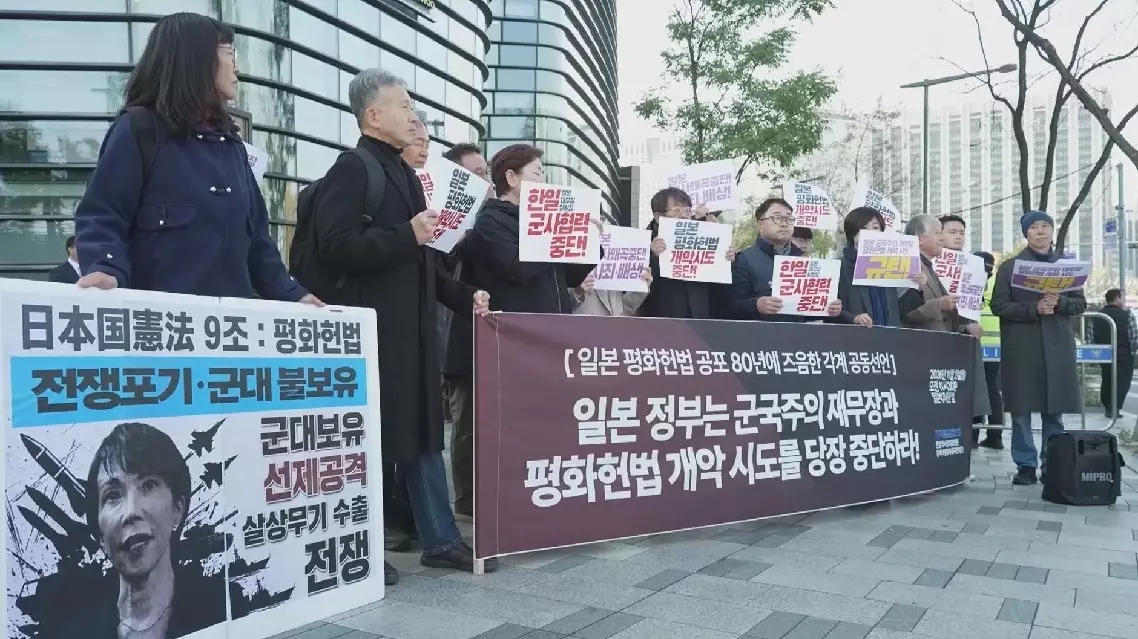
Outside the Japanese Embassy in Seoul, protesters gathered on Monday with a message for Tokyo: don't abandon the principles that have guided Japan since the end of WWII.

The rally comes ahead of the 80th anniversary of Japan's Peace Constitution, which was officially announced on November 3, 1946. Japan renounced war and declared that Japan would not maintain military forces or the right to wage war. But civic groups here say that commitment is increasingly under threat.

They accuse Japan's government of moving away from its postwar pacifist principles by expanding its military capabilities and pushing to revise Article 9 of the constitution, which renounces war.

"By refusing to take responsibility for its wartime atrocities and colonial rule, and instead turning the blame around and denying these historical facts, Japan is completely undermining the trust of neighboring countries," Han Kyong-Hee, Chairperson of the Korean Council for Justice and Remembrance of Military Sexual Slavery by Japan.

The debate, though, goes well beyond the constitution's wording.

Under Prime Minister Sanae Takaichi, Japan is seeking to further strengthen its defense capabilities, including acquiring long-range counterstrike capabilities. It's also pledged to review its national security and defense policies by the end of this year.

Japan argues these measures are necessary to respond to an increasingly challenging regional security environment.

But in the ROK, memories of Japan's colonial rule remain deeply contentious. Any expansion of Japanese military power carries added historical and political weight.

Disputes over wartime history, including forced labor and Japan's military sexual slavery system, continue to complicate bilateral ties.

Whether Japan ultimately succeeds in revising its constitution remains uncertain. But as it reconsiders the limits of its postwar military role, the debate is likely to resonate far beyond Japan's borders, raising fundamental questions about the future security order in East Asia.

ROK civic groups warn against revival of Japanese militarism ahead of constitution anniversary

ROK civic groups warn against revival of Japanese militarism ahead of constitution anniversary

Recommended Articles