ROME (AP) — Next year’s Giro d’Italia will start in Trieste, cross briefly into Slovenia, and climb up three iconic mountains in the final week before the mostly ceremonial finish in Rome.
The route for the 110th Giro, scheduled for May 8-30, was presented in Rome on Monday.
The 21 stages will be made up of: two time trials, six sprint stages, eight medium mountain legs and five in the high mountains on a total route of 3,418.9 kilometers (2,124.4 miles).
The Giro will open with a 172-kilometer stage that starts and finishes in Trieste, crossing the nearby border briefly into Slovenia. The second stage is entirely in Slovenia before crossing back into Italy for the rest of the race.
The peloton then travels down the Adriatic coast before heading across to Naples — the southernmost point of next year’s Giro — and back up through the center of Italy.
As ever, the final week is set to be the most daunting.
The toughest leg, known as the queen stage, is slated to be Stage 16 from Sondrio to Aprica and comes immediately after the race’s second — and final — rest day.
The 192-kilometer (119-mile) route packs in nearly 6,000 meters (20,000 feet) of elevation gain as it takes the riders over a double ascent of the feared Mortirolo pass, either side of the legendary Gavia climb — which marks the “Cima Coppi” as the race’s highest point at 2,618 meters (8,589 feet).
The Gavia has not been climbed on the Giro since 2014.
Monte Zoncolan also returns for the first time since 2021 and should decide the winner of the Giro as it is the finish of a brutal penultimate stage before the long transfer down south and the largely processional ride through Rome the following day.
It is the first time the three daunting climbs of the Mortirolo, Gavia and Monte Zoncolan have been taken on in the same edition of the Giro.
There are seven summit finishes in total, ranging in difficulty across the Apennines and Alps, with the standings also set to be shaken up by two time trials — on the seventh and 15th stages.
The first is almost entirely uphill, while the second is a much flatter route that starts at Monza’s famous Formula 1 circuit.
The Giro also takes in two other motorsports race tracks, as Stage 4 finishes at the Autodromo Marco Simoncelli in Misano, while another MotoGP circuit, Autodromo Mugello, is the finish of Stage 11.
The nine-stage Women’s Giro will start in Viareggio on May 29 and finish on the Italian side of Western Europe’s highest mountain, Mont Blanc, on June 6.
As well as the tough final day in the Alps, the route includes two mountain top finishes as well as a mountain time trial on the penultimate day.
Jonas Vingegaard and Demi Vollering won the Giro this year.
See AP’s full sports coverage here

Moreno Moser Elena Cecchini Luca Guercilena during the presentation of the 2027 Giro d'Italia and Giro d'Italia Women in Rome, Italy, Tuesday, Nov. 3, 2026 (Massimo Paolone/LaPresse via AP)

Paolo Bellino during the presentation of the 2027 Giro d'Italia and Giro d'Italia Women in Rome, Italy, Tuesday, Nov. 3, 2026 (Massimo Paolone/LaPresse via AP)

Stefano Garzelli, Urbano Cairo and Ivan Basso with trophy during the presentation of the 2027 Giro d'Italia and Giro d'Italia Women in Rome, Italy, Tuesday, Nov. 3, 2026 (Massimo Paolone/LaPresse via AP)
WASHINGTON (AP) — The United States will stop providing $4 billion in aid each year to Israel in 2027 but will sell arms to its closest ally in the Middle East, President Donald Trump said on Tuesday.
The Republican president told Fox News Channel during a phone call on Election Day for the midterms that Israeli Prime Minister Benjamin Netanyahu had approached him about the idea and that they have been talking about it for a couple of years.
Trump said Israel doesn’t need the aid and it’s a lot of money for the U.S. to spend. But Trump also said that U.S. aid to Israel has become a Democratic talking point for candidates such as Michigan Senate candidate Abdul El-Sayed, a vocal critic of Israel.
“You can consider it barter. You can consider military aid or cash,” Trump said. “Look, we give them $4 billion of things and money, and they don’t need it. And I was approached by Bibi Netanyahu, and we’ve been talking about it for a couple of years because it’s a lot of money.”
There was no immediate comment from Netanyahu’s office.
The United States has sent tens of billions of dollars in military aid to Israel over the last few years.
In 2016, President Barack Obama, a Democrat, signed an unprecedented security agreement with Israel to give its military $38 billion over 10 years, amounting to $3.8 billion a year. Under the agreement, Israel’s ability to spend part of the funds on Israeli military products was to be phased out and eventually all of the money would be spent on American military industries.
Netanyahu has talked about the need to wean Israel off the aid in the past and has said that the American aid would end at some point.
He told The Economist in January that he wanted to “taper off” U.S. military aid in the next 10 years and that such a change was “in the works.”
But the optics of the aid had also become an issue, according to Trump, who singled out El-Sayed for using it as a talking point.
“The left uses the $4 billion payment — that everybody knows about, it’s no secret — as a signal of unfairness,” Trump said Tuesday on Fox. “And we can’t allow that to happen. I don’t like that, because it’s too easy. It’s almost too easy a target. And Bibi and I have been talking, and we’ve agreed. He was very understanding of it.”
Phasing out direct military and economic aid to Israel has long been a subject of debate in both countries and has gained traction in the last several years.
There are several issues that complicate it, though, not least of which are obligations the U.S. has to Israel under the terms of the Camp David peace accords with Egypt, which require the United States to support Israel and Egypt with security assistance.
In addition, much of the assistance the U.S. provides Israel comes in the form of foreign military financing, or FMF, that gives Israel the money but requires it to spend the money on American-produced weaponry, meaning the funds are plowed back into the U.S. economy.
Unless Israel plans to spend the same amount on purchasing American materiel, U.S. defense contractors may see an impact.
An academic study published last year showed the U.S. under the administrations of President Joe Biden, a Democrat, and Trump provided at least $21.7 billion in military assistance to Israel after the start of the Gaza war in 2023. The study was published on the second anniversary of the Oct. 7, 2023, Hamas attacks in Israel that provoked the conflict.
Another study, also published last year by the Costs of War project at Brown University’s Watson School of International and Public Affairs, said the U.S. had spent roughly $10 billion more on security aid and operations in the broader Middle East in the previous two years.
While the reports relied on open source material for most of their findings, they offered some of the most comprehensive accountings of U.S. military aid to close ally Israel and estimated costs of direct American military involvement in the Middle East.
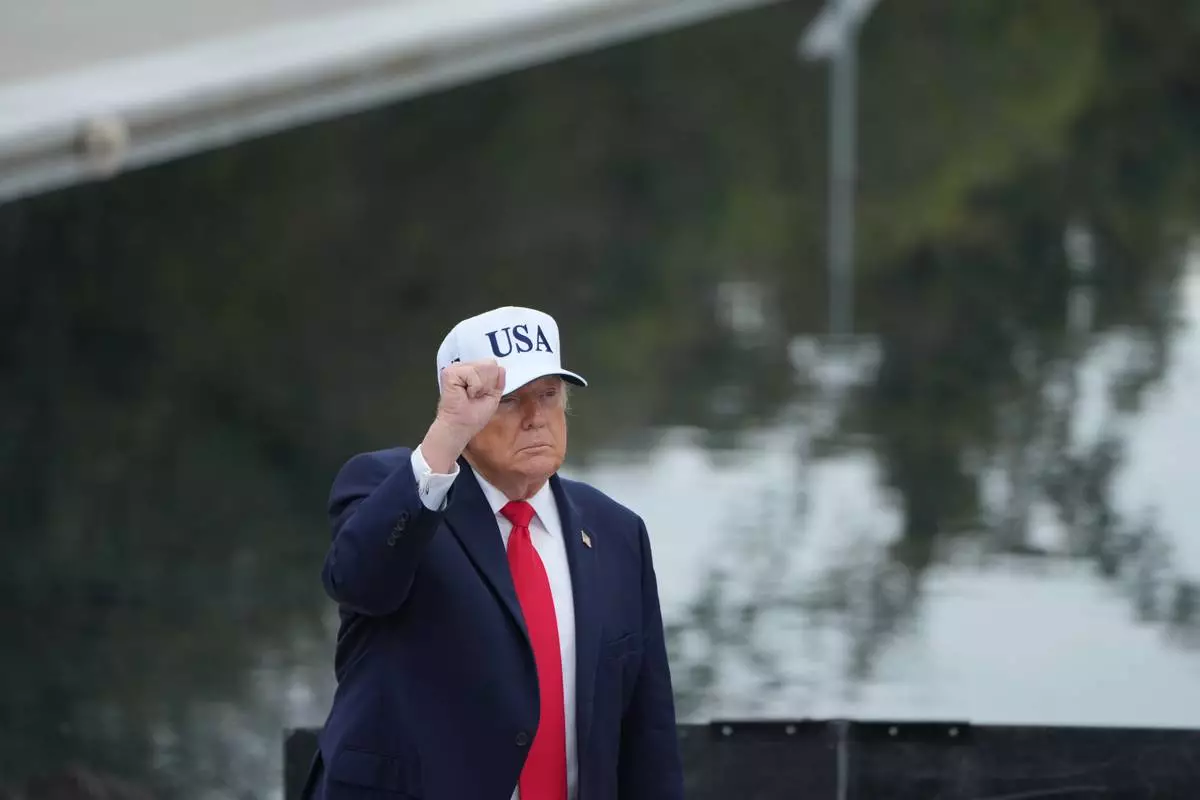
President Donald Trump after speaking in front of the Lincoln Memorial Reflecting Pool, Monday, Nov. 2, 2026, in Washington. (AP Photo/Mark Schiefelbein)