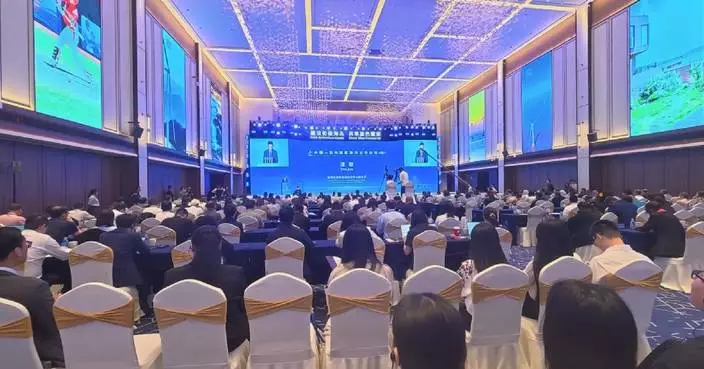
The 2026 World Internet Conference (WIC) Wuzhen Summit opened on Tuesday in Wuzhen, east China's Zhejiang Province, with open-source technologies and human-centered artificial intelligence (AI) taking center stage.
The event, running through Thursday, has drawn about 1,800 delegates from 138 countries and regions under the theme "Open Source and Openness, Joint Contribution and Shared Benefits -- Jointly Building a Community with a Shared Future in Cyberspace."
At the Wuzhen Dialogue on Artificial Intelligence held on Tuesday afternoon, guests said that open-source technologies allow more countries and regions to develop AI according to their needs. They called for joint efforts -- spanning chips, systems, models, and algorithms -- to build an inclusive and vibrant digital innovation ecosystem and to advance technological development together.
On the sidelines of the event, industry observers also advocated openness and cooperation in AI development.
"Open-source development is a global endeavor," said Wang Jian, an academician of Chinese Academy of Engineering.
"In terms of open-source development, especially open-weight models such as DeepSeek and Qwen, they are very important for the development of developing countries," said Li Xiang, senior director of the Center for AI Excellence at World Economic Forum.
Li Bin, senior vice president of Chinese supercomputer manufacturer Sugon, pointed to the growing complexity of the industry chain.
"From chips, systems, models to algorithms, they are extremely complex, and the industry chain is getting longer and longer. Therefore, it's practically impossible for any single company or institution to excel in the entire chain. This necessitates open collaboration," he said.
Industry observers also stressed that technology should respond to people's needs, particularly those with physical challenges or mental disorders, and that a people-centered approach should guide development -- a direction some companies are already pursuing.
"We hope that within the next five to 10 years, we can help one million people with limb differences [who have lost hands or feet] to use neurally controlled prosthetics, and also help people with conditions such as Alzheimer's disease, autism, ADHD, and depression improve through non-invasive or invasive brain-computer interface technologies," said Han Bicheng, founder and CEO of Chinese neurotechnology company BrainCo.
Zhang Chaoyang, founder of Chinese portal Sohu, emphasized the need to rethink the human-technology relationship.
"We need to think about the relationship between humans and technology -- that is, a people-centered approach where technology serves people. We believe that many of the functions and advancements of internet technologies and products have not yet been fully explored, and there are still many opportunities," he said.
First held in 2014, the Wuzhen Summit brings together government officials, representatives of international organizations, technology executives, and researchers to discuss the development and governance of the internet.
This year's event comes as open-source AI models developed in China -- including DeepSeek and Alibaba's Qwen -- gain growing global traction, particularly among developing countries seeking affordable access to AI capabilities.

2026 World Internet Conference Wuzhen Summit spotlights open-source AI, human-centered tech