LAUSANNE, Switzerland (AP) — Romanian gymnast Ana Bărbosu, who won a controversial bronze medal at the 2024 Olympics, has had a two-year ban confirmed for “whereabouts” failures on anti-doping tests.
The Court of Arbitration for Sport said Wednesday it had “partially upheld” World Gymnastics’ request for disciplinary proceedings against Bărbosu after the International Testing Agency recorded three whereabouts failures against the athlete between September and December 2025.
Bărbosu was given the standard provisional two-year ban effective from May 5, 2026 and had her competitive results since December 2025 disqualified, but she appealed the decision to CAS.
CAS confirmed the ban, with credit for the suspension already served, but ruled in Bărbosu's favor regarding her competitive results — they still stand.
CAS is also arbitrating a separate case over Bărbosu‘s medal from the 2024 Olympics. That medal was first awarded to U.S. gymnast Jordan Chiles but later revoked. The hearing is not expected before May 2027.
AP Olympics at https://apnews.com/hub/2024-paris-olympic-games

FILE - Romanian gymnast Ana Bărbosu poses with the bronze medal for her women's artistic gymnastics individual floor performance at the Paris 2024 Olympics, after receiving it during a ceremony at the Romanian Olympic and Sports Committee, in Bucharest, Romania, Aug. 16, 2024. (AP Photo/Vadim Ghirda, File)
LONDON (AP) — The Bank of England raised interest rates for the first time in more than three years Thursday in a bid to tackle an inflation shock stoked by the Iran war, and held out the option of further increases if the conflict escalates once again.
The decision to lift the bank’s main interest rate to 4% from 3.75% was widely expected given a recent surge in prices, though the fact that all nine members of the Monetary Policy Committee voted for a hike was a surprise. One of the nine backed an even bigger increase, to 4.25%.
The increase was the first since August 2023.
The pressure on the bank to act has grown steadily in recent months. When inflation hit an 11-month high of 3.5% in September — well above the bank's 2% target — it cemented market expectations of a rate hike this month, with potentially more to come in 2027.
The main cause of the spike in inflation this year has been the sharp rise in fuel costs as a result of the Iran war and the ensuing bottlenecks in the Strait of Hormuz, which have squeezed global oil and gas supplies.
“There is now enough inflationary pressure in the pipeline caused by the rise in energy prices that an increase in Bank rate is warranted," Governor Andrew Bailey said.
The bank’s quarterly economic projections were also published Thursday, but they are highly uncertain — perhaps even more so than usual — because the economic outlook hinges hugely on what happens in the Iran war.
The heavy losses suffered by the Republican Party in the U.S. midterm elections have resulted in a sharp fall in energy prices with many believing that it's now less likely that U.S. President Donald Trump will launch fresh strikes on Iran given the new constraints he faces from a Democratic-controlled Congress. Many Republicans, including Vice President JD Vance on Wednesday, have blamed the war for the party's poor performance at the ballot box.
Though Brent crude is down around $15 a barrel this week, trading at $96, that is still more than $30 more expensive than it was at this time last year.
If the decline in oil and gas prices is sustained over the coming weeks, then the expected peak in inflation next summer — anticipated by the bank to reach 5% — could be lower, which could temper expectations of further rate hikes, not just by the Bank of England.
Bailey said the hike “shouldn’t be seen as the first in an inevitable long sequence of hikes” but stressed that the outlook depends on what happens in the war with Iran.
“Unless the conflict in the Middle East is resolved, neither does it seem likely to be the last increase," he said.
Others, including the U.S. Federal Reserve and the European Central Bank, have raised rates recently in response to the higher inflation stoked by the Iran war, and forecasts for their interest rate strategies are largely contingent on what happens to energy prices.
Interest rates in the U.K. had been trending downward from a 15-year high of 5.25% until the U.S. and Israel attacked Iran.
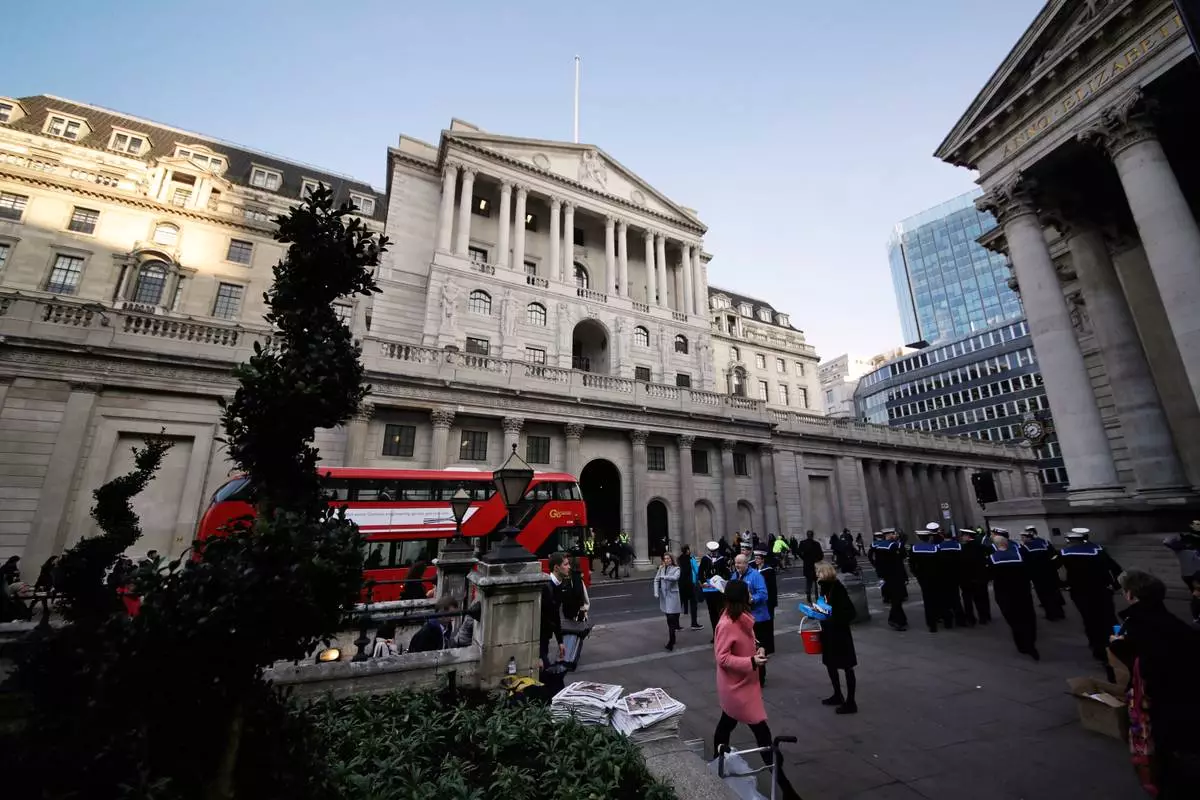
FILE - The facade of the Bank of England is seen in th London on Nov. 2, 2017. (AP Photo/Matt Dunham, File)