SANTA CRUZ, Calif.--(BUSINESS WIRE)--Nov 4, 2026--
Joby Aviation, Inc. (NYSE:JOBY), a company developing electric air taxis for commercial passenger service, today issued its Third Quarter 2026 Shareholder Letter detailing the company’s operational and financial results for the quarter ending September 30, 2026. The company will host a live audio webcast of its conference call to discuss the results at 2:00 p.m. PT (5:00 p.m. ET) today.
This press release features multimedia. View the full release here: https://www.businesswire.com/news/home/20261104420012/en/
Highlights include:
Commenting on Joby’s third quarter results, JoeBen Bevirt, founder and CEO, said:
“This quarter, we made important progress on the fifth and final stage of certification, completing a wide range of ‘for credit’ testing with the FAA. We significantly increased manufacturing output while improving efficiency, and demonstrated our electric air taxi in key early U.S. markets through the White House-backed eIPP program. Our J208 aircraft also completed what we believe to be the first fully autonomous flight of a civilian aircraft across the United States, and this morning we announced an expansion of our autonomy-focused contracts with the U.S. Air Force to nearly $37 million.”
“Our core mission is - and always has been - to bring electric vertical flight to passengers around the world. We designed our aircraft from the ground up for that mission, and our engineering, manufacturing and certification efforts are focused on bringing it to market. The progress we’re making gives me every confidence that Joby will continue to lead the way.”
Outlook
Joby’s current outlook incorporates investment toward certification of our eVTOL aircraft, expansion of manufacturing, and advancement of commercial preparations including participation in the U.S. eVTOL Integration Pilot Program. The company increased its full year 2026 total revenue outlook to a range of $135 million to $140 million. For the second half of 2026, Joby anticipates use of cash, cash equivalents and short-term investments to be between $385 million and $415 million.
Third Quarter 2026 Financial Results Webcast Details
What: Joby Aviation Third Quarter 2026 Financial Results Webcast
When: Wednesday, November 4, 2026
Time: 2:00 p.m. PT (5:00 p.m. ET)
Webcast:Upcoming Events section of the company website.
If unable to attend the webcast, to listen by phone, please dial 1-877-407-9719 or 1-201-378-4906. A replay of the webcast will be available on the company website following the event.
About Joby Aviation
Joby Aviation, Inc. (NYSE: JOBY) is a next-generation aviation company based in California. Its aircraft, propulsion and autonomy technologies span both commercial aviation and defense applications. Joby also operates Blade, a leading urban air mobility business providing passenger transportation services in the United States and Europe. Joby intends to operate its fast, quiet and convenient air taxi service in cities around the world and sell its aircraft to other operators and partners. To learn more, visit www.jobyaviation.com.
Forward-Looking Statements
This release contains “forward-looking statements” within the meaning of the “safe harbor” provisions of the Private Securities Litigation Reform Act of 1995, including but not limited to, statements regarding the development and performance of our aircraft, the growth of our manufacturing capabilities, our regulatory outlook, progress and timing; our planned operations with the Department of Defense, including benefits we expect to receive from our contracts with the US Air Force; expected benefits of and operations under the eIPP, including the potential for the eIPP to accelerate our path to commercial operations ; the timing and expected benefits of our planned acquisition of Resonant Sciences, including the potential for revenue growth and additional defense opportunities; our business plan, objectives, goals and market opportunity; and our current expectations relating to our business, financial condition, results of operations, prospects, capital needs and growth of our operations, including our use of cash and revenue guidance for 2026. You can identify forward-looking statements by the fact that they do not relate strictly to historical or current facts. These statements may include words such as “anticipate”, “estimate”, “expect”, “project”, “plan”, “intend”, “believe”, “may”, “will”, “should”, “can have”, “likely” and other words and terms of similar meaning in connection with any discussion of the timing or nature of future operating or financial performance or other events. All forward looking statements are subject to risks and uncertainties that may cause actual results to differ materially, including: our ability to launch our air taxi service and the growth of the urban air mobility market generally; our ability to produce aircraft that meet our performance expectations in the volumes and on the timelines that we project; contracts with the U.S. Air Force may be subject to government funding and appropriations constraints; participation in eIPP projects is subject to, among other things, the finalization of OTA contracts; our ability to satisfy any remaining closing conditions for the acquisition of Resonant Sciences; our ability to integrate Resonant Sciences’ business and team into our operations and to retain key personnel; our ability to realize anticipated benefits of any combined operations; risks of unanticipated costs of acquiring or integrating Resonant Sciences’ business; the competitive environment in which we operate; our future capital needs; our ability to adequately protect and enforce our intellectual property rights; our ability to effectively respond to evolving regulations and standards relating to our aircraft; our reliance on third-party suppliers and service partners; uncertainties related to our estimates of the size of the market for our service and future revenue opportunities; and other important factors discussed in the section titled “Risk Factors” in our Annual Report on Form 10-K, filed with the Securities and Exchange Commission (the “SEC”) on February 27, 2026, our Quarterly Report on Form 10-Q, filed with the SEC on May 6, 2026, and in future filings and other reports we file with or furnish to the SEC. Any such forward-looking statements represent management’s estimates and beliefs as of the date of this release. While we may elect to update such forward-looking statements at some point in the future, we disclaim any obligation to do so, even if subsequent events cause our views to change.

Joby’s all- electric, vertical take-off and landing air taxi flies over Tampa, Florida, on Oct. 29 during the state’s first eIPP flights. (Photo: Joby Aviation)
WASHINGTON (AP) — At the urging of President Donald Trump, Republicans in eight states redrew the boundaries of dozens of congressional districts over the past year while angling for an edge that could help them hold onto a slim House majority in a tough midterm election.
Ultimately, it didn't work.
Republicans lost most of the Democratic-held seats they had targeted to flip, lost others they had banked on retaining and got swept out of power by a Democratic surge fueled by voter dissatisfaction with Trump, the economy and the war with Iran.
The Republican redistricting plan fell flat in Alabama, Florida and Texas. It got scuttled by courts in Missouri and then firmly defeated by its voters Tuesday. And it got offset in California, where a retaliatory Democratic redistricting flipped all five of the Republican-held seats it targeted.
“This is a catastrophic rebuke of Donald Trump’s failed effort to gerrymander the country into oblivion to save the U.S. House of Representatives for himself," John Bisognano, president of the National Democratic Redistricting Committee, said Wednesday.
Congressional voting districts typically are redrawn after a census at the start of each decade to account for population changes. But Trump spurred an unusual mid-decade redistricting battle last year when he urged Texas Republicans to reshape U.S. House districts to give the GOP a shot at winning five additional seats in the midterm election.
A cascade of redistricting followed, spurred along in the South by a Supreme Court ruling that weakened federal Voting Rights Act protections for majority Black districts. Republicans hoped their redistricting could net as many as four more seats in Florida, two in Ohio and one each in Alabama, Louisiana, North Carolina and Tennessee.
In all but one of those revamped districts, Trump would have carried over 54% of the vote had they been in place for the 2024 election, according to Associated Press estimates.
“In normal times, that sort of district is relatively safe,” said Justin Levitt, a professor at the Loyola Law School in Los Angeles who runs the “All About Redistricting” website.
But the presumed Republican districts got undercut by shifting viewpoints of Trump. The AP Voter Poll found about 6 in 10 disapprove of how Trump is handling the presidency. Views of Trump’s priorities also were mostly negative.
“If we look across the country, that entire mid-decade redistricting gambit was a complete bust for Republicans,” said Mark Jones, a political science professor at Rice University in Houston.
In Texas, Republicans won just one of the five seats they had targeted to flip. But Democrats flipped two Republican-held districts, putting the GOP at a net loss.
Republicans reconfigured three heavily Latino districts in the Rio Grande Valley, which had shifted toward Trump in 2024, to try to boost their chances of unseating Democratic Reps. Henry Cuellar and Vicente Gonzalez. But both won reelection Tuesday. And Democrats instead unseated Republican Rep. Monica De La Cruz, whose district is sandwiched between theirs.
Though De La Cruz's new district retained the same percentage of Trump-inclined voters as the 2024 version, about 3 in 5 voting-age residents were new — making it harder for her to compete against Democratic challenger Bobby Pulido, a well-known Latin Grammy award winner.
The AP Voter Poll indicates a substantial shift in Hispanics moving away from Republicans compared with Trump’s victory just two years ago. Nationally about one-third of Hispanics say they backed the Republican in their local U.S. House race, while roughly 4 in 10 voted for Trump two years ago.
The new Texas districts were drawn by Adam Kincaid, executive director of the National Republican Redistricting Trust.
“Trying to pick up five seats in Texas, without putting anything else in serious jeopardy, it was a Herculean task,” Kincaid said Wednesday. He added: “It required the trends that we had been seeing over the past several years to continue, and that did not happen.”
Had Republicans not redrawn the Texas districts, however, they likely would have lost even more seats, Kincaid said.
Republicans in Florida tried to tilt four more House seats to the GOP in Trump’s adopted home state. Democratic Rep. Jared Moskowitz was among their targets, but he decided to run anyway in one of the redrawn districts. He won reelection Tuesday.
“I’ve worked across the aisle. I’ve delivered results for my community, and they spent $26 million trying to beat me,” Moskowitz said after his victory in Florida’s 25th Congressional District. “They lit that money on fire tonight.”
He said voters in his new district, like those nationwide, were most concerned about the economy and their ability to afford a good quality of life. But he said that redistricting angered voters, too.
After redistricting, about two-thirds of voting-age residents were new to the district represented by Democratic Rep. Kathy Castor. But she also won reelection. Democrat Pia Dandiya won yet another district -- an open seat in southern Florida — that Republicans had reshaped for an advantage.
In Alabama, a Supreme Court ruling allowed the Republican-led Legislature to revert to what the GOP considered to be a friendlier map. But Democratic Rep. Shomari Figures won reelection anyway, defying Republicans' plans.
Republicans redrew two congressional districts in eastern North Carolina with a goal of unseating Democratic Rep. Don Davis in the 1st Congressional District, which has sent a Black member to Congress for more than 30 years. They made Davis' district a bit more Republican by bringing in thousands of voters from the 3rd Congressional District, held by Republican Rep. Greg Murphy. In exchange, they reassigned thousands of voters in Democratic-leaning areas to Murphy's district.
The ensuing advertising battle for Davis' seat cost well over $50 million, according to the ad-tracking firm AdImpact, ranking among the most expensive House races nationally.
Davis held a slight lead Wednesday, and the race between Murphy and Democratic challenger Raymond Smith was particularly close.
What started as a Republican redistricting effort could become a Democratic redistricting movement ahead of the presidential election.
Maryland voters on Tuesday approved a constitutional amendment that will make it easier for the state's Democratic-led General Assembly to redraw districts to the party's advantage. Democratic proponents, backed by former President Barack Obama, have touted it as a way to “stop Trump.”
Democrats who made gains in numerous state legislatures Tuesday also could use that power for redistricting — most notably in Wisconsin, where districts were tilted toward Republicans. And Democratic lawmakers in New York already have taken an initial step toward congressional redistricting before the 2028 elections.
But the recent midterm redistricting revealed it can be difficult to anticipate voter behavior when trying to gerrymander districts for partisan advantage. That could particularly be the case for the next presidential election, which would be the first in a dozen years without Trump's name atop the ballot, making it hard to know how his supporters would realign behind new candidates.
The midterm election "shows districts aren’t destiny – that if voters actually show up, they can overcome district lines,” Levitt said.
Associated Press writer Bill Barrow contributed to this report.
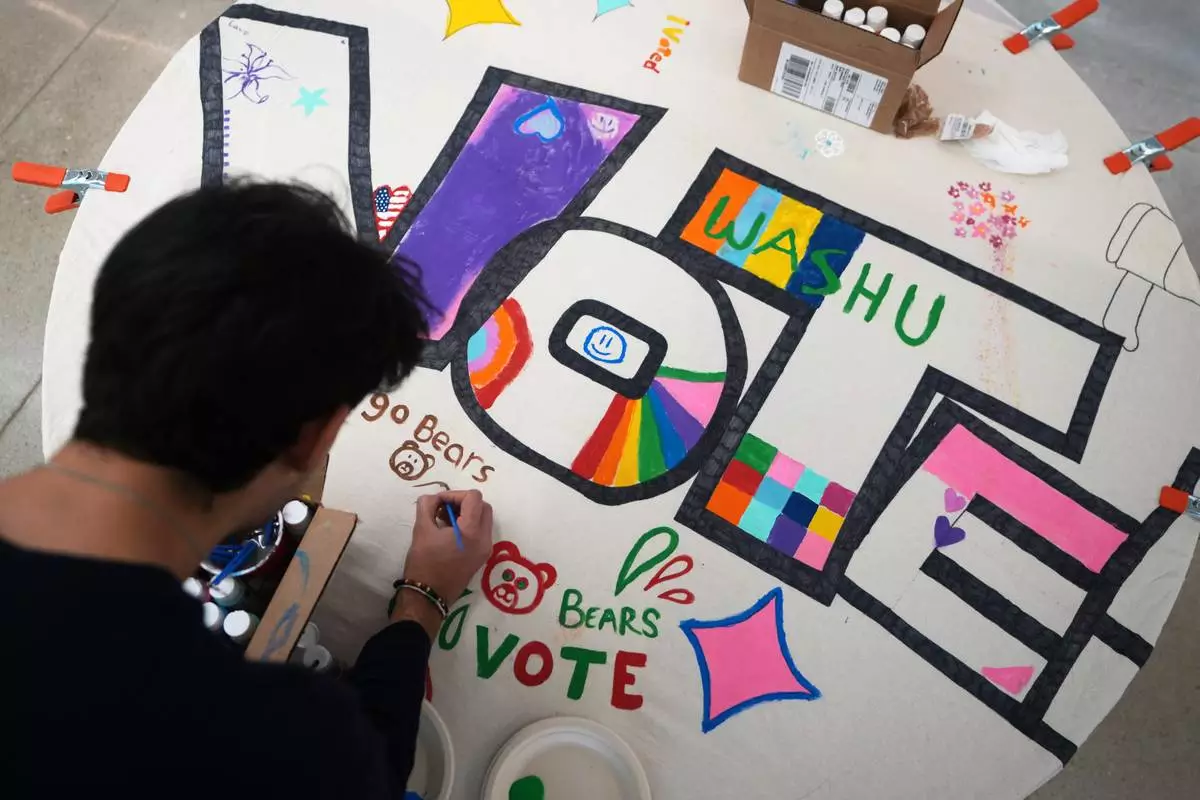
Santiago Rivera paints on a sign outside a polling place after casting his ballot on Election Day during the midterm election Tuesday, Nov. 3, 2026, in Clayton, Mo. (AP Photo/Jeff Roberson)
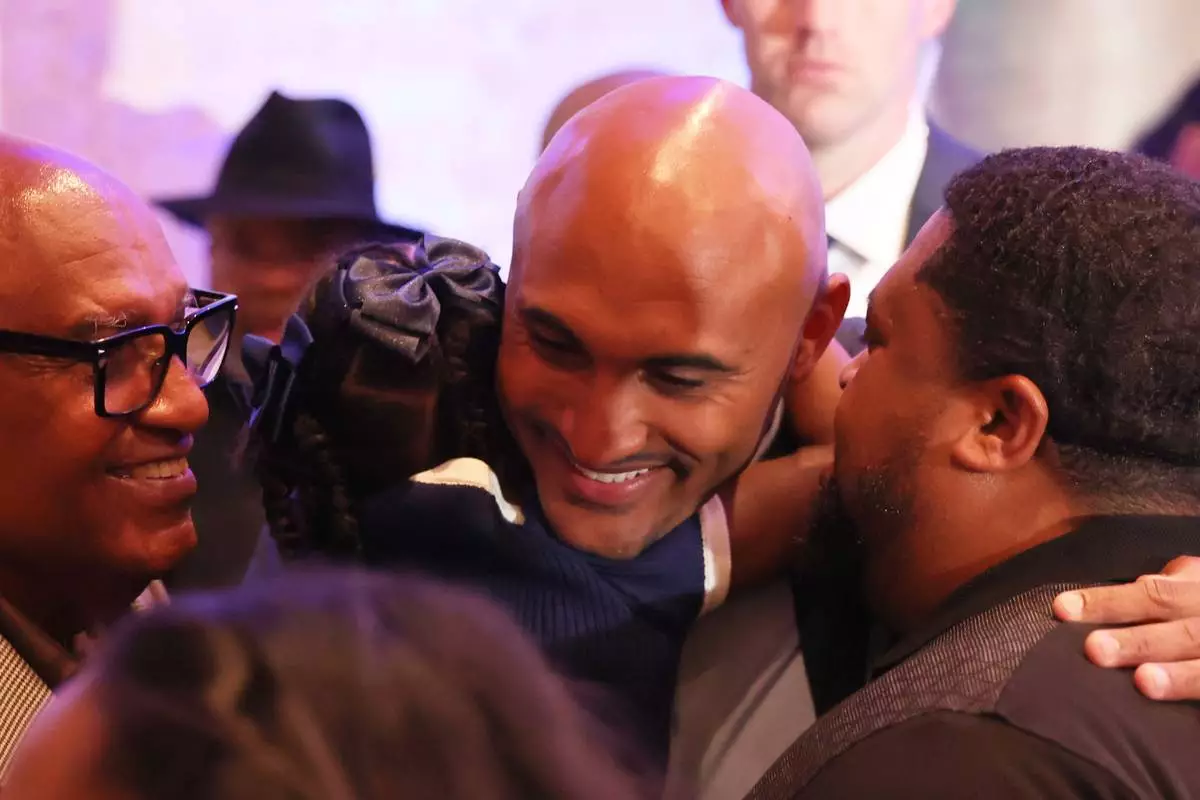
Rep. Shomari Figures, D-Ala., mingles with supporters at an election night event, Tuesday, Nov. 3, 2026, in Montgomery, Ala. (AP Photo/Vasha Hunt)
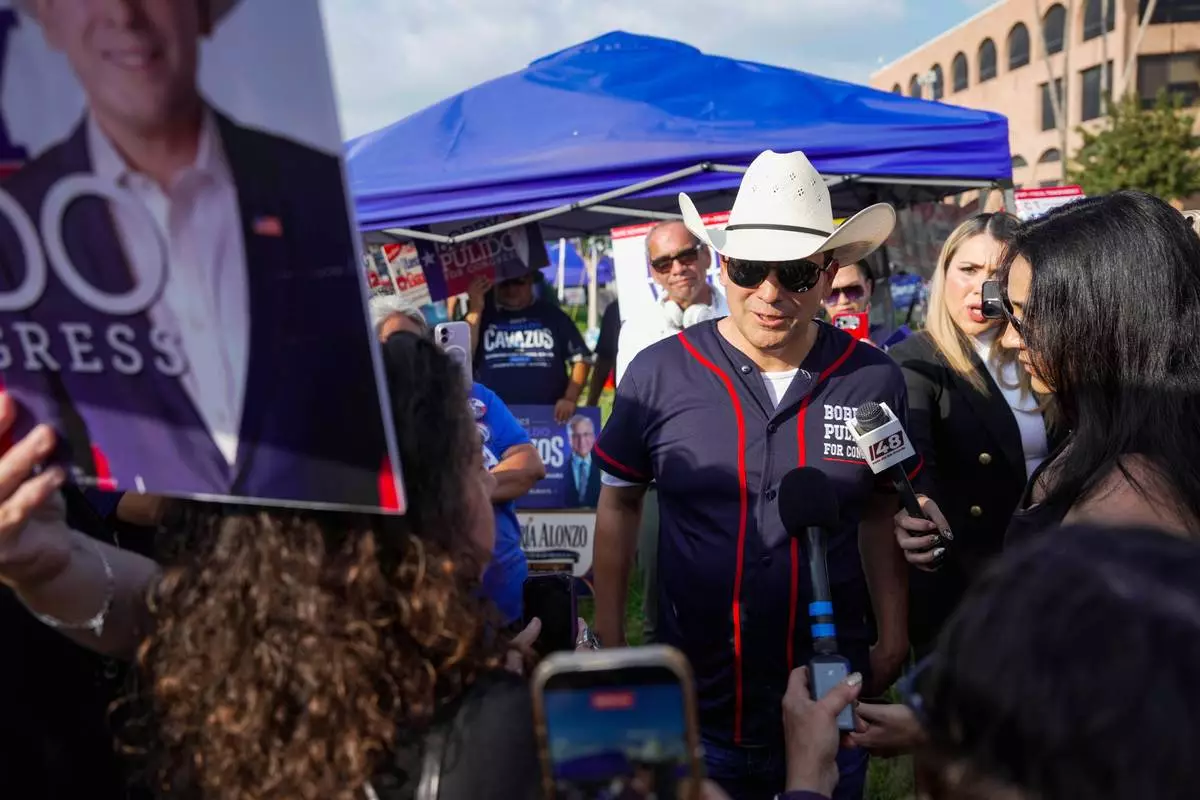
Democratic House candidate Bobby Pulido arrives at a polling location at the University of Texas Rio Grande Valley's Student Academic Center on Election Day, Tuesday, Nov. 3, 2026, in Edinburg, Texas. (Raquel Natalicchio/Houston Chronicle via AP)