China's moon shot just got real. Officials have confirmed the plan: Chinese astronauts will set foot on the lunar surface before 2030.
Three Astronauts, One Big Goal
Click to Gallery
China plans first crewed Moon landing before 2030
Wang Xiang, chief designer of lunar exploration
China's lunar exploration enters new development stage
Lunar landing work advances toward 2030 goal
Mission uses two Long March 10 rockets
The first crewed lunar mission will fly with three astronauts. Two will descend to the surface to carry out scientific surveys and technical tests. The third will stay aboard the spacecraft in lunar orbit, coordinating and supporting the landing.

China plans first crewed Moon landing before 2030
The details emerged on October 31, when 7th Manned Space Symposium convened at Beihang University in Beijing. More than 800 experts and scholars from human spaceflight fields gathered to discuss how digital and intelligent technologies can drive the high-quality development of crewed spaceflight.
Wang Xiang, deputy chief designer of the China Manned Space Program and chief designer of the lunar exploration project, laid out the mission profile at the conference. China's first crewed lunar mission will adopt a "two launches, one landing" approach, completing the entire mission through a lunar-orbit rendezvous and docking.

Wang Xiang, chief designer of lunar exploration
How the Mission Works
The flight plan is a two-rocket job. According to the plan announced so far, the mission calls for two Long March 10 carrier rockets, launched separately. The first rocket carries the lunar lander into lunar orbit. Then a second rocket sends the crewed spacecraft into space, where it rendezvouses and docks with the waiting lander.
Once docking is complete, the astronauts move from the crewed spacecraft into the lunar lander and separate. Riding the lander, they descend to the lunar surface to carry out scientific exploration and related technical tests.
The crew is expected to number three. Two of them make the actual descent to the surface. The third stays behind in the spacecraft, keeping operations in sync with the astronauts on the ground.
Getting home means running the sequence in reverse. After their work is done, the two lunar astronauts lift off from the surface aboard the lander, climb back to lunar orbit, and dock a second time with the crewed spacecraft that held station. Once the astronauts transfer back aboard, the spacecraft heads for Earth, closing out the crewed lunar landing mission.

China's lunar exploration enters new development stage
Beyond the Landing
China's lunar program just leveled up. The Chinese Lunar Exploration Program has completed integration and formally entered a new phase of development. Work on the lunar landing stage is moving steadily ahead, with one clear target: putting the first Chinese astronauts on the Moon before 2030.
But landing is only the beginning. The mission will also run lunar scientific surveys and related technical tests. The goal is to master the hard stuff: crewed Earth-Moon round trips, short stays on the lunar surface, and joint human-machine exploration. It must check off a full list of tasks, from landing and roving to sampling, research and return. Step by step, China is building the ability to explore the Moon on its own terms.

Lunar landing work advances toward 2030 goal
Meanwhile, China's space station is hitting its stride. The outpost has entered a phase of routine operations and high-quality development, and it is running stably in orbit. More than 200 science and application projects are already under way, spanning space life sciences, space materials science, microgravity fundamental physics, and microgravity fluid and combustion science.
And the station is about to open its doors wider. Its first foreign astronaut is on the way, along with visits from a low-cost cargo transportation system.

Mission uses two Long March 10 rockets
A Milestone in Sight
China's crewed lunar landing program is moving out of the lab and onto the launch pad.
The Long March 10 launch vehicle, the lunar lander and the crewed spacecraft are all pushing ahead in development. Put them together, and a first Chinese landing on the Moon before 2030 will stand as a major milestone in the country's space ambitions.
Mao Paishou
** 博客文章文責自負,不代表本公司立場 **
Bloomberg reported on October 14 local time that the EU is negotiating with China. Brussels hopes Beijing will lift sanctions on the small German company Sindlhauser Materials GmbH. That small firm supplies the Dutch ASML, the world's most important chip equipment manufacturer. The sanctions now threaten its survival.
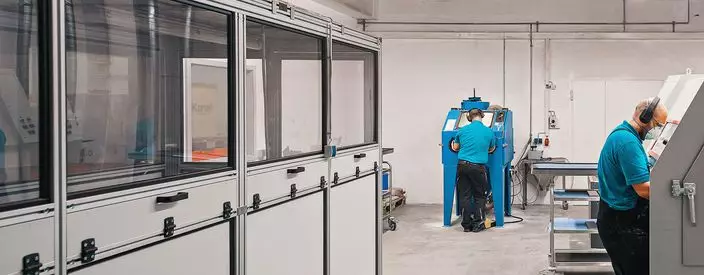
EU seeks China deal to free ASML supplier Sindlhauser.
The Deal on the Table
Bloomberg cited people in the know as saying the EU will remove trade restrictions on an unnamed Chinese company in exchange. That company is accused of assisting Russia in launching war against Ukraine.
In July this year, China imposed sanctions on Sindlhauser and 13 other European companies. The move retaliated for the EU's 21st round of sanctions against Russia. Sindlhauser is a small German company specializing in precision manufacturing and advanced coating technology for semiconductors and other industries.
In that round of sanctions, the EU listed several Chinese entities as sanctions targets. The EU said they were suspected of providing Russia with key components that could be used to manufacture weapons. Companies placed on the relevant EU and Chinese lists are subject to export controls.
People familiar with the matter said Sindlhauser relies on Chinese supplies of rare earths and critical minerals. If China's sanctions continue, the company will face the risk of bankruptcy within the coming months. It was also said this German company is part of ASML's supply chain.

ASML, Dutch semiconductor equipment giant.
Berlin and Brussels Race to Rescue Sindlhauser
Bloomberg sees a message in China's choice of target. Imposing controls on such an obscure company, the report argues, shows China knows exactly where Europe's economic bottlenecks sit.
An EU official says the European Union has begun discussions with China on whether each side would remove the entities from its own list. That means China's export control framework on one side, and the entities the EU has listed under its own regulations on the other.
The official added that any removal decision on the EU side would require unanimous support from all member states.
The trouble began in July when China's Ministry of Commerce put Sindlhauser on its export control list, and the company's first reaction was panic.
For weeks after the announcement, Sindlhauser had no clear view of whether, or how, it could keep operating.
Help came quickly. According to the people who knows what’s happening, the German government and the Bavarian state government, where Sindlhauser is headquartered, stepped in immediately to help the company find alternative suppliers wherever possible.
The two governments also explored other workarounds, such as recycling existing materials and seeking whatever financial support was available.
Brussels was watching too. Some officials there understood the company's plight and raised the matter with the Chinese side for several weeks.
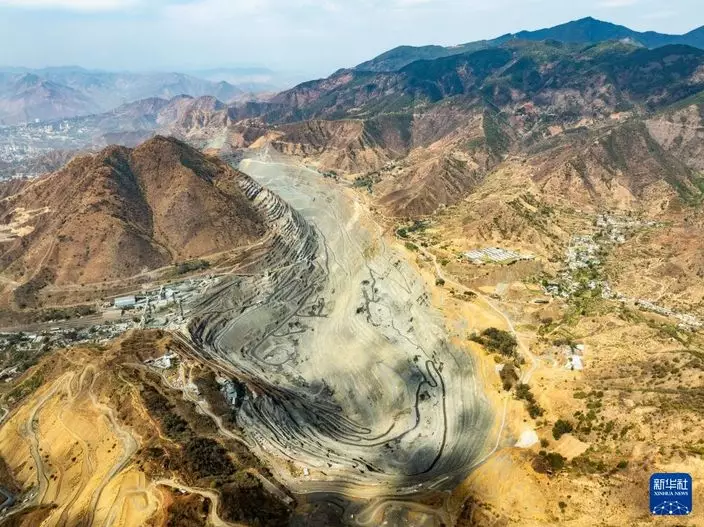
Sindlhauser's rare earth supply nearly all Chinese.
A Policy Dilemma, an Intelligence Blind Spot
Sindlhauser sits squarely inside China's rare earth grip. According to the report, the company relies almost entirely on Chinese rare earths, and its placement on the export control list dealt a direct blow to its supply chain.
The company had previously taken almost no measures to diversify its supply sources or reduce its dependence on Chinese raw materials.
Some officials see a problem with the rescue. Removing companies such as Sindlhauser from the sanctions list, they worry, could once again weaken the urgency for these European companies to build supply chain networks outside China.
That leaves the German government and EU officials in a bind. Deciding through negotiations which companies go onto or come off trade restriction lists could set a bad precedent for other companies also hoping for sanctions exemptions. It would also mean the EU must make concessions on the question of certain Chinese entities.
But officials involved in handling the matter see a deeper problem. The situation behind the case, they argue, is more concerning, though not surprising.
The explanation: over the past year and a half, China has been collecting information on global supply chains as much as it possibly can. That is how China identified a small company in Bavaria as a supplier to the world's most important chip equipment manufacturer.
Beijing's map of global supply chains runs remarkably deep. The report credits that insight to the licensing system China has built for exports of critical minerals and rare earths.
The system requires foreign companies to submit detailed information, including their customers, how and where Chinese raw materials are used, and photos of the final products.
Germany shows the cost. Some companies have been leaking business secrets to China, while the German government remained completely unaware and unable to obtain the same or even similar information.
More important, the German government still has not formulated any strategy to address its shortcomings in economic intelligence.
A Possible Template, and China's Stated Position
The talks went straight to the top. According to the report, EU Trade Commissioner Maroš Šefčovič visited Beijing last week and met with Chinese Commerce Minister Wang Wentao. The two sides discussed lifting restrictions on Sindlhauser in exchange for relief for a Chinese company.
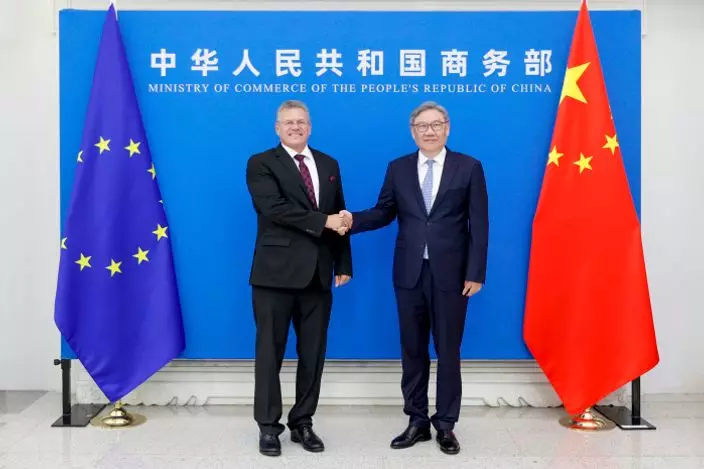
EU trade chief Šefčovič met Wang Wentao in Beijing.
The backdrop is stark. The EU is hunting for a fix to a massive trade deficit that exceeds $1 billion every single day.
People familiar with the matter say the two sides agreed in Beijing to strengthen information sharing and to give each other advance notice of export restriction measures.
The "one-for-one" arrangement around Sindlhauser, in which each side takes the other's company off its restriction list, could become a template for similar moves in the future. The EU is expected to act first. Only then would China lift its restrictions on the German company.
China's message has stayed consistent. The Chinese side has repeatedly stressed that China holds an objective and impartial position on the Ukraine crisis, stays committed to promoting peace talks, and plays a constructive role in advancing a political resolution of the crisis.
The opposition is just as firm. China firmly rejects the EU's blame-shifting, smears and denigration over the Ukraine crisis. It equally and firmly opposes the EU's unjustified listing and sanctions against Chinese companies and citizens.