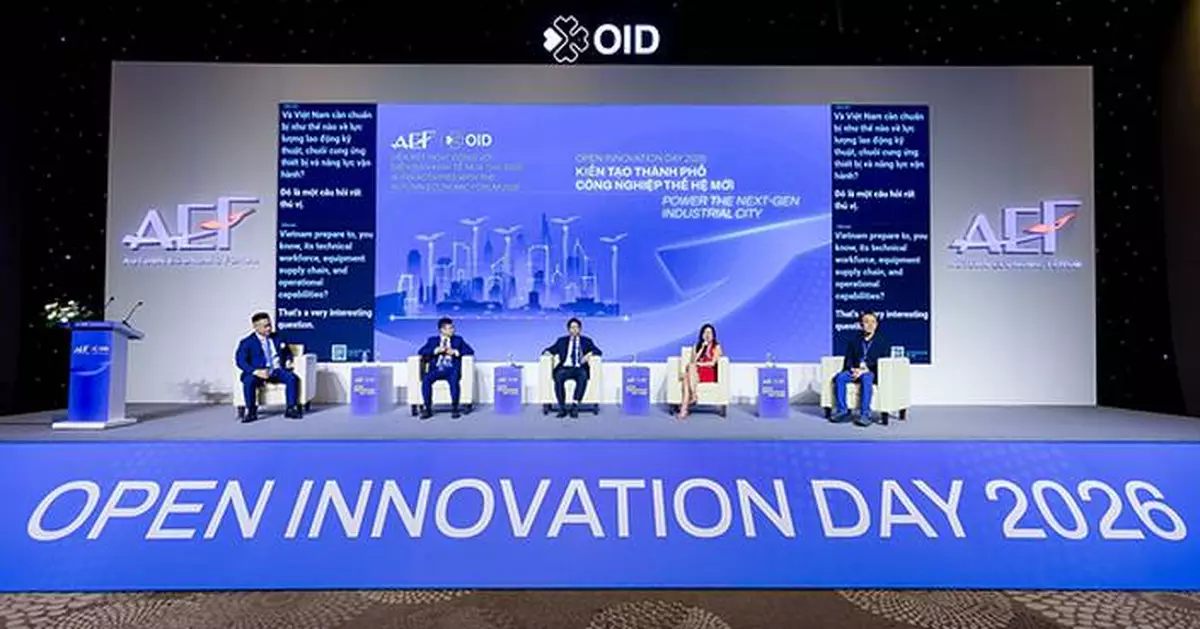
HO CHI MINH CITY, Vietnam, Nov. 5, 2026 /PRNewswire/ -- Open Innovation Day 2026 (OID 2026), themed "Power the Next-Gen Industrial City," took place in Ho Chi Minh City, bringing together policymakers, businesses, investors and technology partners from Viet Nam and abroad. Spanning AI infrastructure, green energy and the low-altitude economy, the event focused on the conditions needed to turn technological potential into industrial capacity and real-world market opportunities.
OID 2026 kicked off the Autumn Economic Forum 2026 (AEF 2026). Led by SoiHub – Open Innovation Hub, it was jointly organized with the Open Innovation and Technopreneur Institute (OITI); the National Academy for Advanced Technology and Innovation (NACENTECH) under the Ministry of Science and Technology of Viet Nam; Saigon Telecommunication & Technologies Corporation (SAIGONTEL); and the Viet Nam Centre for the Fourth Industrial Revolution in Ho Chi Minh City (HCMC C4IR), together with other co-organizers and partners.
From Policy Direction to Technological Capabilities
Speaking at the event, Mr. Truong Minh Huy Vu, Vice Chairman of the Ho Chi Minh City People's Committee, said the city is laying the groundwork for next-generation industries, from spatial planning for high-tech industry and energy infrastructure to innovation support mechanisms. Notably, the city has rolled out policies to bridge the gap between research and commercialization, including a VND 500 billion venture capital fund. He noted that developing next-generation industries requires not only infrastructure investment but also an ecosystem capable of bringing ideas and technologies to market.
At the national level, Mr. Nguyen Khac Lich, Director General of the Department of Digital Technology and Artificial Intelligence, under the Ministry of Science and Technology of Viet Nam, stressed the need to strengthen Viet Nam's capacity to master strategic technologies such as AI, semiconductors and unmanned aerial vehicles (UAVs). He said Viet Nam needs to deepen its involvement in research, design and manufacturing while developing regulatory sandboxes to validate new technologies and support their progressive commercialization.
OID 2026 Highlights: Strategic Partnerships Geared Toward Real-World Deployment
Ms. Bui Thanh Hang, Director of SoiHub and Head of the OID 2026 Organizing Committee, said SoiHub has connected and co-developed 50 domestic and international technologies, received 15 technology orders from the market and established 20 strategic cooperation agreements. At OID 2026, partnerships with MobiFone, MOBY Robotics, TADI Global, NACENTECH and CITARES further expanded SoiHub's network across smart cities, deep-sea robotics, technology transfer and technical workforce development. According to Ms. Hang, these results show that open innovation can deliver tangible value when research and technology are directly linked to the needs of businesses and the market.
AI Infrastructure: Competitiveness Goes Beyond Technology
The morning session, "Foundations of Next-Generation Industry in the AI Era," examined the factors that will determine Viet Nam's ability to attract investment in AI infrastructure. Mr. Samuel Ang, Senior Advisor to the Asian Development Bank (ADB), highlighted a shift in site selection criteria for AI data centers: power availability and grid capacity are becoming the top priorities, ahead of location and cost. He said countries that align their digital infrastructure ambitions with energy planning and grid modernization will be better positioned to attract international capital.
Discussions further addressed requirements for data security, computing capacity, clean energy and storage systems. On the workforce front, Ms. Sinwon Park, Director of the International Labour Organization (ILO) Country Office for Viet Nam, discussed AI's impact on jobs and the need to upskill workers, underscoring that industrial development in the AI era demands coordinated preparation in both infrastructure and human capital.
Low-Altitude Economy: From Technology Testing to Market Development
The afternoon session, "Low-Altitude Economy – Creating New Engines of Growth," focused on what it takes to scale UAVs and autonomous systems from standalone applications to large-scale industrial development. Drawing on experience from test sites in Japan and the United States, Mr. Joe Felter, CEO of Pickaxe Technologies, emphasized: "Start with the use case, not the equipment." He said Viet Nam needs to develop a network of test sites integrated with research, training, manufacturing and operational standards, rather than invest in standalone testing facilities.
During the panel discussion, representatives from Viettel High Tech, the Viet Nam Aerospace Association (VASA), SoiHub and EHang further explored commercial viability, regulatory sandboxes and supply chain development. Mr. Bui Trung Hieu, representing SoiHub, raised a pivotal question: once a pilot succeeds, who will be the next customer? The question underscores that building a low-altitude economy requires not only technological capability but also a sufficiently large market and scalable business models.
From the partnership commitments announced to the challenges surrounding AI infrastructure, energy and autonomous technologies, OID 2026 pointed to a shared approach: next-generation industrial development must start from market demand, be underpinned by enabling infrastructure and policies, and involve meaningful participation from businesses, research institutions and investors.
PR Newswire is the official media partner of Open Innovation Day 2026.
Event information: https://oid.openinnovationhub.vn/
SoiHub Organizing Committee Representative: Ms. Trinh Thi Lan Huong, Email: huong.trinh@soihub.vn
Open Innovation and Technopreneur Institute (OITI) Organizing Committee Representative: Ms. Hoang Ngoc Mai, Email: mai.hoang@oiti.vn
** This press release is distributed by PR Newswire through automated distribution system, for which the client assumes full responsibility. **
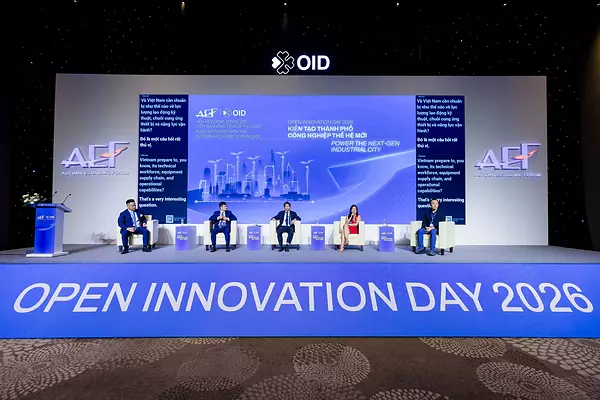
OID 2026: Advancing Technology Partnerships to Power the Next-Gen Industrial City