ASUNCIÓN, Paraguay (AP) — Paraguay’s lower house voted unanimously Thursday to impeach President Santiago Peña just minutes after he announced his resignation, as the collapse of a major digital bank tied to his government froze millions of people’s savings, sent protesters surging into the streets and turned his own party against him.
The 78-0 vote marked a stunning repudiation of Peña by lawmakers from his long-ruling Colorado Party, who joined the opposition in backing his impeachment after three days of demonstrations rocked the capital, Asunción. The vote sends the charges to the Senate, where a two-thirds majority is required to convict the president and formally remove him from office.
Click to Gallery
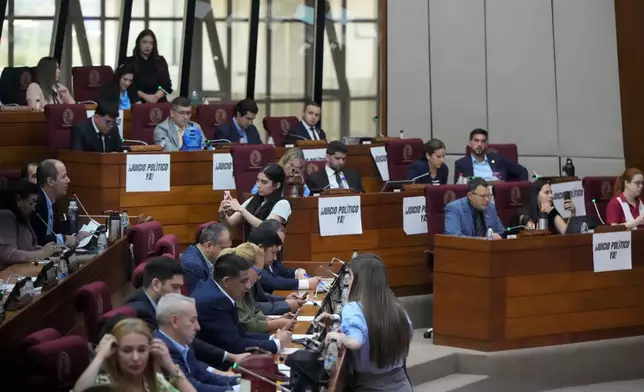
Deputy Carlos Pereira speaks during a discussion on the impeachment of President Santiago Peña in Paraguay's lower house of Congress, as banners reading "Impeachment Now" are displayed on opposition lawmakers' desks in Asuncion, Paraguay, Thursday, Nov. 5, 2026. (AP Photo/Jorge Saenz)
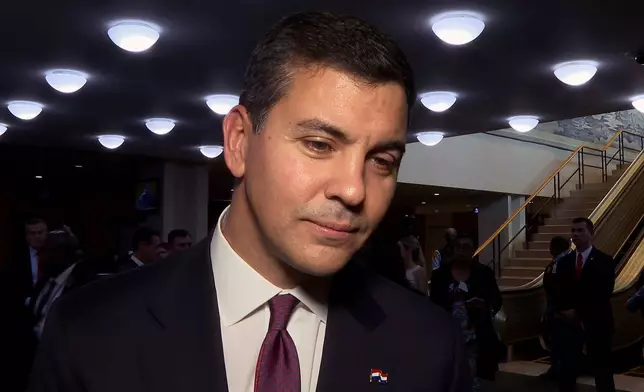
FILE - Paraguay President Santiago Peña speaks to the media at United Nations headquarters, Sept. 19, 2023. (AP Photo/Ted Shaffrey, File)
People protest in front of police against the government and Ueno Bank, which Paraguay's central bank seized amid a solvency crisis, in Asuncion, Paraguay, Wednesday, Nov. 4, 2026. (AP Photo/Jorge Saenz)
A demonstrator holds a mock U.S. dollar bill depicting Paraguayan President Santiago Peña during a protest against the government and Ueno Bank, which Paraguay's central bank seized amid a solvency crisis, in Asuncion, Paraguay, Wednesday, Nov. 4, 2026. (AP Photo/Jorge Saenz)
People protest against the government and Ueno bank, which Paraguay's central bank has seized amid a solvency crisis in Asuncion, Paraguay, Wednesday, Nov. 4, 2026. (AP Photo/Jorge Saenz)
People protest against the government and Ueno bank, which Paraguay's central bank has seized amid a solvency crisis in Asuncion, Paraguay, Wednesday, Nov. 4, 2026. (AP Photo/Jorge Saenz)
Executives of Ueno Bank, taken over by Paraguay's central bank amid a solvency crisis, arrive in custody at the anti-corruption prosecutor's office in Asuncion, Paraguay, Wednesday, Nov. 4, 2026. (AP Photo/Jorge Saenz)
People protest against the government and Ueno bank, which Paraguay's central bank has seized amid a solvency crisis, in Asuncion, Paraguay, Wednesday, Nov. 4, 2026. (AP Photo/Jorge Saenz)
Executives of Ueno Bank, taken over by Paraguay's central bank amid a solvency crisis, arrive in custody at the anti-corruption prosecutor's office in Asuncion, Paraguay, Wednesday, Nov. 4, 2026 (AP Photo/Jorge Saenz)
The impeachment came as thousands protested for a third day, as they attempt to recoup lost savings, wages and pensions from Ueno Bank, a major digital lender.
Peña, a close ally of U.S. President Donald Trump, announced his decision in a video posted to X as lawmakers debated his impeachment, saying he was stepping down in the interest of “the stability of our country, social peace and the need to preserve our democratic institutions.”
The president, who until last year held a stake in a company related to Ueno Bank, expressed contrition but stopped short of accepting responsibility for the banking crisis that has plunged a South American nation long prized by foreign investors for its stability into financial and political turmoil.
“I also want to apologize to the people if I have failed them at any point,” he said. “It was never my intention to betray the trust they placed in me."
The extraordinary turn of events set the stage for a transfer of power later Thursday. Congress was expected to formally accept Peña’s resignation at 5 p.m., clearing the way for Vice President Pedro Alliana to be sworn in as president an hour later. Alliana would serve out Peña’s term through August 2028, with lawmakers expected to choose a new vice president.
Ueno Bank, which exploded from an obscure finance company to a household name in less than five years, claimed more than 60% of Paraguay’s adults as customers. They are now left scrambling to recoup their savings, government pensions, and, for 7,000 employees impacted by the bank's closure, unpaid wages.
Many Paraguayans are left asking how a bank linked to the president, who until last year had a stake in Ueno’s holding company, could grow so rapidly in size and importance despite repeated warnings about its dubious lending practices.
The answer lies in the uncomfortable proximity of Peña’s long-ruling Colorado Party to the country’s regulators and business elite, a weakness that has endured even as steady economic management and rapid growth made Paraguay a darling of international investors in recent years.
“Santiago Peña and the Colorado Party have stolen all our savings,” said Luis Pineda, one of the protesters marching to Congress on Wednesday. “We are fed up with 70 years of plunder.”
Soon after winning its banking license in 2023, Ueno seemed to be everywhere in Paraguay. The digital lender, a rebranded version of a decades-old finance company, lured customers with generous cash-back offers on groceries, grew to more than 70 locations, sponsored Paraguay's national soccer team and plastered its name on the country's main stadium.
Government money poured into Ueno’s coffers under Peña. He also appointed Carlos Carvallo, president of Financiera Ueno, the predecessor to Ueno Bank, to run the central bank, the agency charged with supervising the digital lender.
As of last month, Ueno reported holding roughly $800 million in public deposits, about a quarter of its total, including money from the state pension and health fund and the operators of Paraguay’s giant hydroelectric dams.
Even as retirees’ savings and other public money piled up at Ueno, worries were escalating inside the central bank. In June, its inspectors found a pattern of risky lending to insiders, reported ABC Color, a leading Paraguayan newspaper. Ueno had extended large sums to companies tied to its owners, beyond what the law allows and without enough collateral to cover the debts if they went bad. On a single day in September 2025, nearly $39 million had gone to three such companies.
Peña repeatedly brushed off the warnings. As recently as last month, he defended Ueno and the central bank’s oversight, dismissing the concerns as a smear campaign that was spooking the public.
But on Monday, it all came crashing down. Regulators investigating Ueno’s loans to companies linked to its owners found poorly documented lending, the central bank said, as well as expenses the bank had wrongly counted as assets.
Once the books were corrected, Ueno’s capital, the cushion banks must keep to absorb losses, fell to less than half the legal minimum. The central bank seized the lender Tuesday and announced plans to move customers’ accounts, along with whatever assets still hold value, to other banks before liquidating what’s left.
Ueno’s app, cards and transfers went dark and its branches locked their doors, leaving desperate depositors lined up outside with no way to cash out their savings. On Wednesday, a rush to open new accounts elsewhere crashed other banks’ mobile apps, fueling public panic.
Officials appealed for calm and said they had begun repaying depositors, opening new accounts elsewhere for about 280,000 who had banked only with Ueno.
“The banking system is sound,” insisted Pedro Acosta Bernal, appointed interim central bank president Wednesday after Carvallo resigned at Peña’s request.
Authorities have detained eight senior Ueno executives, including founder Miguel Vázquez and bank President Juan Manuel Gustale. Prosecutors also charged 27 bank officials and business associates with offenses including breach of trust and attempted fraud. Lawyers for several of the detained said they needed time to review the allegations before they could comment.
Hundreds of employees of Ueno Bank and other companies belonging to Grupo Vázquez, the bank’s parent conglomerate, protested outside the Labor Ministry on Thursday, demanding severance and unpaid wages with their jobs in limbo and their salaries trapped at the failed bank. A day earlier, hundreds of retirees, depositors, university students and workers flooded the streets of Asunción, the capital.
“We want your head, Peña!” they shouted. Their signs demanded Peña’s impeachment, called him “the enemy of savers” and pleaded “Give us back our money.” Riot police fired pepper spray and rubber pellets to push back the crowds.
Many demonstrators saw Ueno’s collapse not just as the result of risky banking but as a case study in official corruption. Only Venezuela ranks worse in South America on the latest index of perceived corruption from Transparency International, a global watchdog.
“This is yet another assault on honest, hard-working citizens, people whose small savings are the fruit of years of labor,” said protester Belarmino Balbuena.
At the national stadium that once bore Ueno’s name, the bank’s logo had already been scrubbed away. But across the capital, fresh graffiti denounced politicians as thieves.
Jorge Sáenz contributed to this story. DeBre reported from Buenos Aires, Argentina.
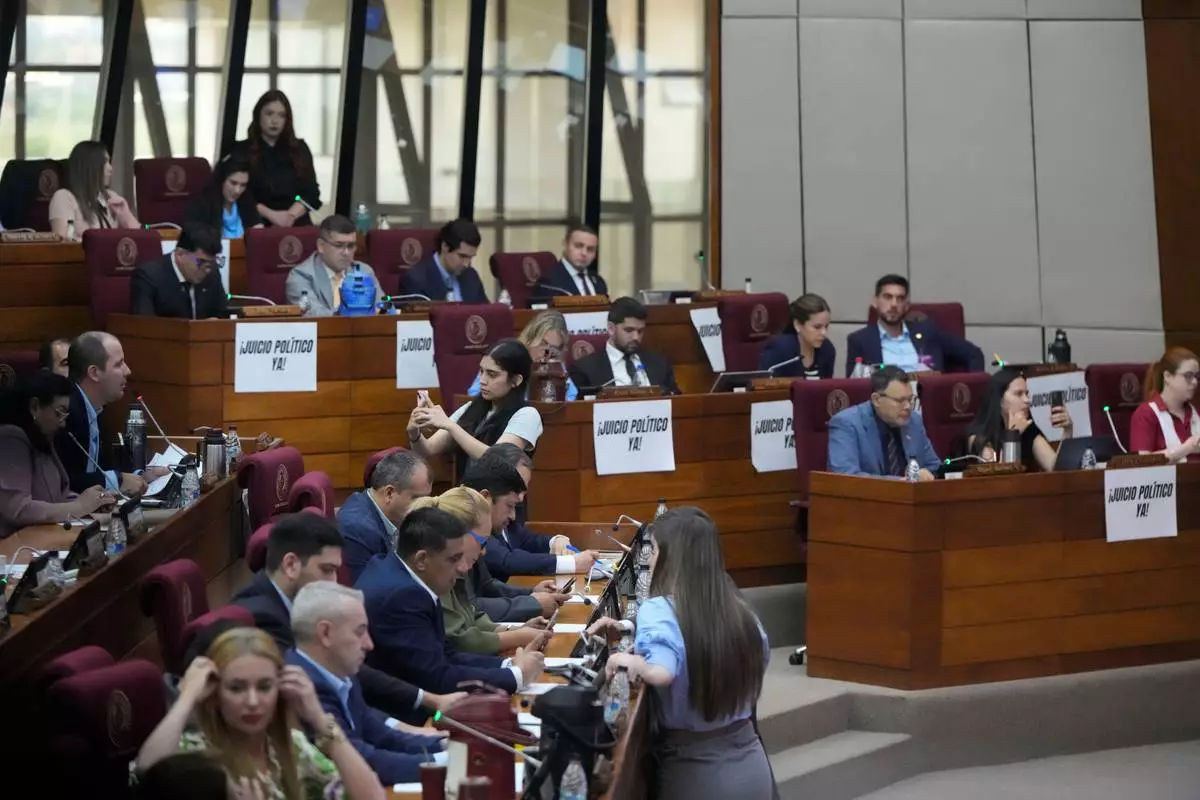
Deputy Carlos Pereira speaks during a discussion on the impeachment of President Santiago Peña in Paraguay's lower house of Congress, as banners reading "Impeachment Now" are displayed on opposition lawmakers' desks in Asuncion, Paraguay, Thursday, Nov. 5, 2026. (AP Photo/Jorge Saenz)
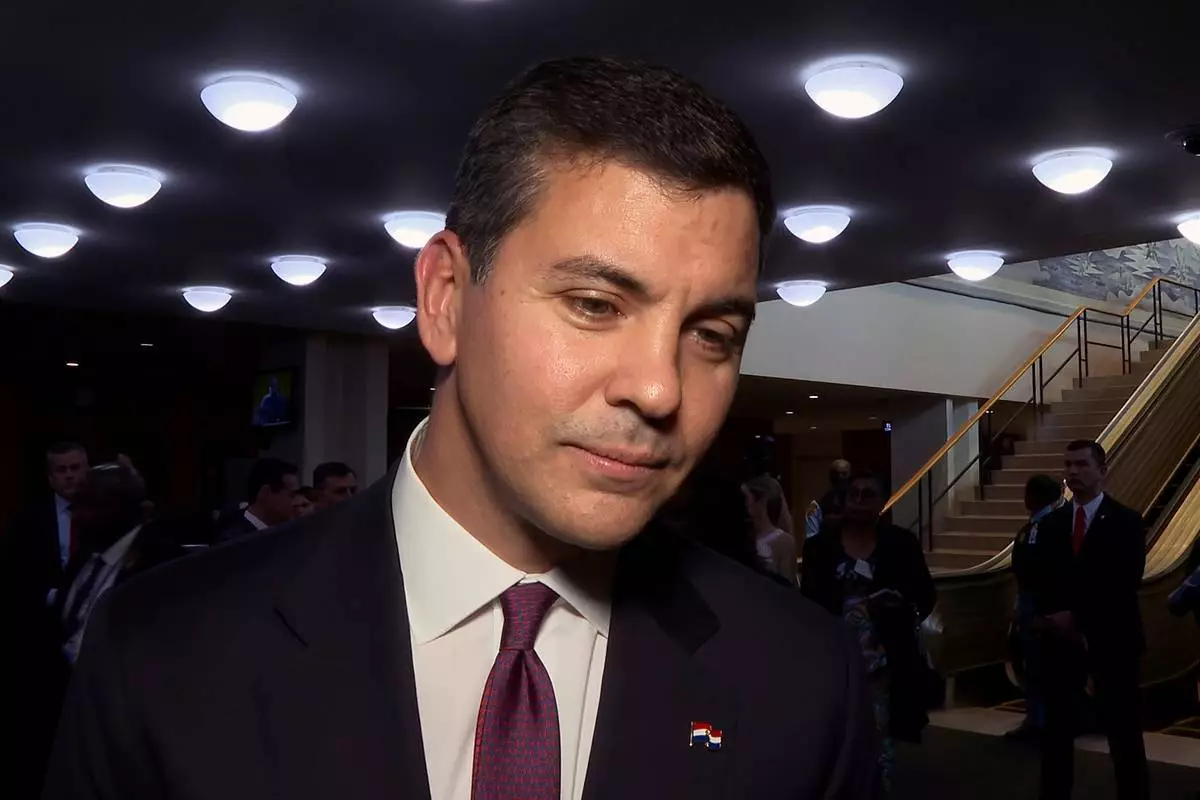
FILE - Paraguay President Santiago Peña speaks to the media at United Nations headquarters, Sept. 19, 2023. (AP Photo/Ted Shaffrey, File)

People protest in front of police against the government and Ueno Bank, which Paraguay's central bank seized amid a solvency crisis, in Asuncion, Paraguay, Wednesday, Nov. 4, 2026. (AP Photo/Jorge Saenz)

A demonstrator holds a mock U.S. dollar bill depicting Paraguayan President Santiago Peña during a protest against the government and Ueno Bank, which Paraguay's central bank seized amid a solvency crisis, in Asuncion, Paraguay, Wednesday, Nov. 4, 2026. (AP Photo/Jorge Saenz)

People protest against the government and Ueno bank, which Paraguay's central bank has seized amid a solvency crisis in Asuncion, Paraguay, Wednesday, Nov. 4, 2026. (AP Photo/Jorge Saenz)
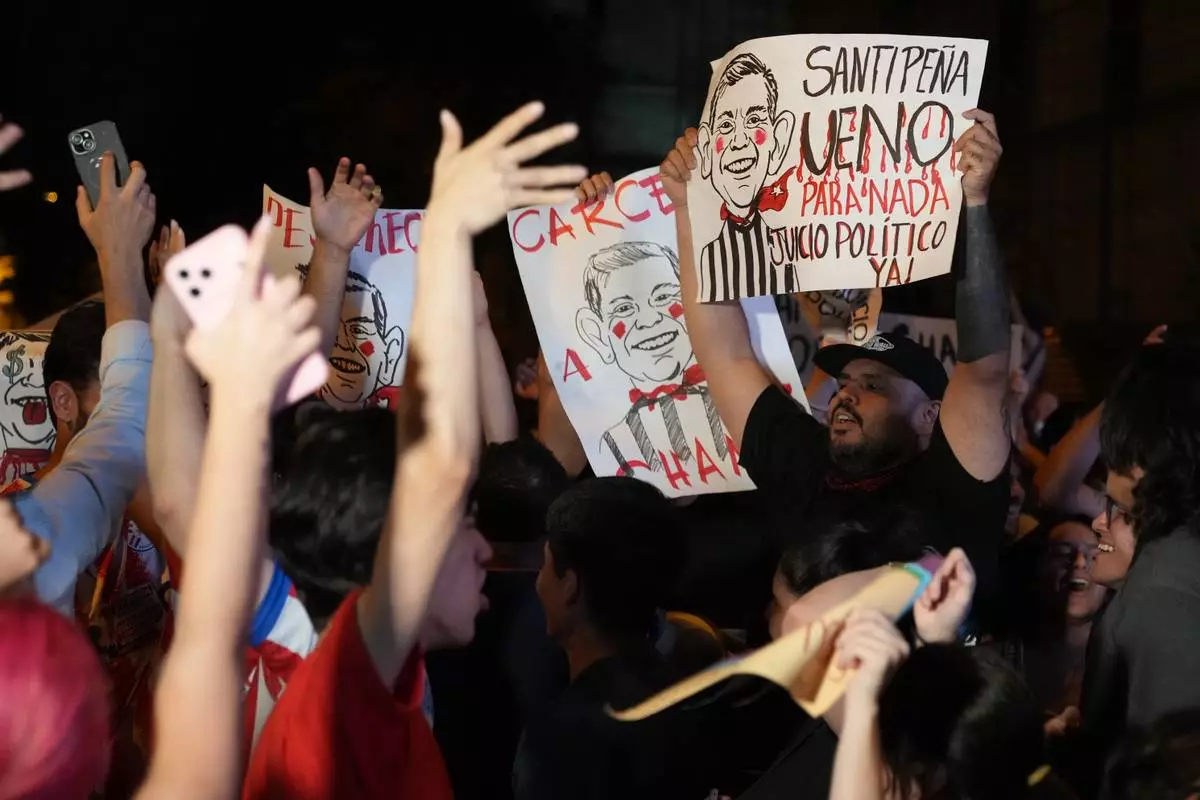
People protest against the government and Ueno bank, which Paraguay's central bank has seized amid a solvency crisis in Asuncion, Paraguay, Wednesday, Nov. 4, 2026. (AP Photo/Jorge Saenz)

Executives of Ueno Bank, taken over by Paraguay's central bank amid a solvency crisis, arrive in custody at the anti-corruption prosecutor's office in Asuncion, Paraguay, Wednesday, Nov. 4, 2026. (AP Photo/Jorge Saenz)

People protest against the government and Ueno bank, which Paraguay's central bank has seized amid a solvency crisis, in Asuncion, Paraguay, Wednesday, Nov. 4, 2026. (AP Photo/Jorge Saenz)

Executives of Ueno Bank, taken over by Paraguay's central bank amid a solvency crisis, arrive in custody at the anti-corruption prosecutor's office in Asuncion, Paraguay, Wednesday, Nov. 4, 2026 (AP Photo/Jorge Saenz)
Alaskans are awaiting more results from key races on the general election ballot, including a bitterly fought U.S. Senate campaign and an open seat for governor. A ballot measure seeking to repeal Alaska’s unique system of open primaries and ranked vote general elections was also too early to call.
The midterm election blowout has ushered in a new era in Washington, with Democrats eager to meet voter demands for change as Republicans watched their congressional majorities evaporate in a revolt against President Donald Trump’s policies. Democrats triumphed in several surprise upsets, marking a decisive rejection of unified GOP control of the House and Senate. See the full election results.
Trump acknowledged the Iran war affected the midterms, suggesting voters were frustrated by surging gas prices that have been a byproduct of the more than 8-month-old conflict. He struck a conciliatory tone earlier, suggesting he could work with the Democrats, only to later threaten to use his veto power to strike down their agenda.
The fallout for Republicans is only beginning. Vice President JD Vance, a 2028 presidential contender, blamed the war in Iran for Republicans’ midterm wipeout. And Mike Johnson of Louisiana will not seek reelection as House speaker, according to two people familiar with the matter.
Here's the latest:
The likely income majority leader said the battle over Democratic Party identity is a distraction and that any governing majority requires a coalition of “different voices.”
“Populism and moderation are not mutually exclusive,” Schumer said, arguing that all victorious Democrats on Tuesday agreed on the fundamental tasks of lowering costs, stopping the Iran war, standing up to Trump and addressing corruption.
“Unity does not mean blind fealty to a party line,” Schumer said. “Just look at what that’s done to the GOP. Unity means linking arms with people you will not agree with on every issue so that you can make progress on the more important areas where you agree.”
Schumer said Democrats flipped so many Senate seats by having “candidates who fit their states, who ran the gamut from proud progressives to lifelong moderates, all united by one simple mission: make the government work for the people.”
A Democratic candidate has conceded in a U.S. House race in Maine that was slated to go to ranked choice voting.
The Associated Press has not yet called the race between Republican Paul LePage and Democrat Matt Dunlap in the Maine 2nd Congressional District. State officials said Thursday the race would proceed to a ranked count because neither candidate broke 50% of the popular vote.
Dunlap’s campaign said Thursday that it does not “currently believe that ranked choice voting will change the results of this race.” LePage said in a statement that he was confident he had won.
A win by LePage would be a rare blue seat that flipped red this year. Democratic Rep. Jared Golden did not seek reelection.
LePage is a former governor of the state and an ally of President Donald Trump. Dunlap is a former Maine Secretary of State
The New York Democrat and likely Senate majority leader and said Thursday that the new Congress will work to answer voters’ concerns on “costs, chaos and corruption” regardless of whether Trump plays along.
“Will Trump sign all of it into law? Knowing Trump’s and Republicans’ intransigence, of course not,” Schumer said at the Center for American Progress.
Schumer said Democrats will try to curb Trump’s tariffs, the Iran war, ban federal elected officials from stock trades, and limit consumer costs from data center expansion.
Schumer said Republicans have to choose whether to participate or ensure another drubbing at the polls.
“If Donald Trump does spend the next year vetoing common sense legislation to lower costs and end corruption, this election,” Schumer said, “this absolute Republican catastrophe on election night 2026 will look like a good day compared to what will come down on Republicans in the 2028 election.”
A Maine race in which Republicans have a rare chance to flip a blue seat this year is headed to a ranked choice count, the state announced.
Republican Paul LePage and Democrat Matt Dunlap ran against each other to fill the seat that Democratic Rep. Jared Golden is vacating. The 2nd Congressional District covers much of rural Maine and is typically very competitive.
The secretary of state’s office said Thursday that neither candidate broke 50% of the vote, so the ranked second choices will come into play. There were only two candidates on the ballot, but use of write-in candidates allowed voters to pick second choices.
LePage declared victory in the race Wednesday. Dunlap’s campaign has said it is awaiting full results.
Ohio Gov. Mike DeWine says “a mighty wind” was responsible for sweeping so many fellow Republicans out of office Tuesday, brushing aside whether GOP gubernatorial nominee Vivek Ramaswamy’s controversial attack ad against Democratic Gov.-elect Amy Acton played a role.
The 79-year-old DeWine joked during the Impact Ohio postelection conference that “the elephant in the room” was now “the donkey in the room.”
When people didn’t laugh or applaud, he nudged the room, “Oh, c’mon.”
DeWine predicted that Acton, who previously served in his cabinet, would uphold Ohio’s tradition of governing from the middle. He said Ohio has a history of moderate Republican and moderate Democratic governors and he expects Acton to be one, too.
On Tuesday, Acton became the first Democrat in 20 years to win Ohio’s governor’s office and the first woman elected to the post.
Another wipeout for stocks tied to the build-out of AI data centers is overwhelming Wall Street and erasing gains from the day before, which marked the stock market’s best day in three months.
The S&P 500 fell 3.2% Thursday and is on track for its worst loss since President Donald Trump shook markets worldwide in 2025 with his “Liberation Day” tariffs. The Dow Jones Industrial Average dropped 1,079 points, and the Nasdaq composite tumbled 4.9%.
Stock markets worldwide felt pressure from continued drops for AI stocks as worries rose about possible moratoriums on further data centers following Democratic victories in the U.S. midterm elections.
Texas will send 14 Democrats to the U.S. House, a net gain of one seat that squashed Republicans’ hopes of gaining five seats through redistricting. Each congressional district voted more Democratic than its estimated 2024 presidential margin under the new boundaries, with shifts of more than 30 percentage points in the 9th, 15th and 28th Districts.
Curtis Hertel, chair of the state’s Democratic Party, said narratives about divisions among voters were false and that consistent messaging about affordability contributed to a “blue tsunami.”
“I don’t know how you could watch the election results and say that there are rifts,” Hertel told reporters during a virtual news conference.
Michigan Democratic Sen.-elect Abdul El-Sayed’s race was widely seen as a referendum on whether a progressive candidate could win a national seat. His campaign was driven in part by dissatisfaction with the political establishment.
Hertel said Democratic candidates in Michigan don’t have to be “one size fits all.”
“The difference for people is not which part of the party you come from. The difference is, are you going to fight for my family?” Hertel said.
More drops for AI chip stocks are dragging the U.S. market lower, even as much of Wall Street rises following strong profit reports from AppLovin, Tapestry and other companies.
The S&P 500 fell 1.8% Thursday and erased all of its gain from the prior day, which was its best in three months.
The Dow Jones Industrial Average dropped 403 points, and the Nasdaq composite fell 3%. AI-related stocks worldwide felt pressure from worries that Tuesday’s U.S. midterm elections could mean moratoriums for data centers in some areas, and South Korea’s Kospi index tumbled 5.3%.
In other markets, though, the initial knee-jerk reaction to the midterms faded. Oil prices recovered some of their sharp slides.
The Bank of England indicated Thursday that the sharp decline in energy prices after the U.S. midterm elections — if sustained — could limit the prospect of further interest rate hikes in the coming months.
After raising its main interest rate for the first time in more than three years to 4% from 3.75%, the bank said the outlook for U.K. borrowing costs largely hinges on what happens with the Iran war.
The heavy losses suffered by the Republican Party in the midterm elections have been followed by a sharp drop in energy prices. Many believe it’s now less likely Trump will launch fresh strikes on Iran, with Democrats gaining control of Congress early next year after their big wins this week. Many Republicans, including Vice President JD Vance on Wednesday, blamed the war for the party’s poor performance at the ballot box.
▶ Read more
__
This post has been updated to clarify that it's the first interest hike in three years, not nearly three years.
After President Donald Trump said he would accept the results of his party’s midterm rout, many of his loyalists followed suit even though they, too, are always a hair trigger away from branding a losing election rigged.
Across the country, great numbers of defeated Republican candidates conceded, congratulated their Democratic opponents in moments of grace and bowed to their fate.
Misinformation experts have multiple theories about why election denial claims have not spread as widely this time. One is the scale of the Democrats’ success.
People see “a lot of enthusiasm on the left,” said Jen Golbeck, a professor at the University of Maryland who studies conspiracy theories. “They see all of these races moving that way across the country in places that you never would have expected.” And it’s “really hard to say every single place cheated.”
It’s also possible Trump’s acceptance of the results set the tone for others.
▶ Read more
A preliminary count released by the clerk of the New Hampshire House shows Democrats achieving a supermajority in the nation’s largest state legislative body. The Associated Press has not yet made calls in many of the races.
Heading into Tuesday’s elections, Republicans had a 41-member advantage in the House and a veto-proof 16-8 majority in the Senate. Preliminary numbers released by the House clerk show the new total as 292 Democrats, 107 Republicans and one Independent in the House. Democrats have a majority in the state Senate, according to AP race calls.
Further complicating the path for Republican Gov. Kelly Ayotte, the secretary of state’s totals also show Democrats won all five seats on the Executive Council, an obscure but powerful panel that approves state contracts and key appointments.
Correction: A previous version of this post preemptively stated that the Democrats had flipped both chambers of the New Hampshire legislature. While preliminary data from the state House clerk show a Democratic majority in the state House, The Associated Press has not yet called enough races to determine control of the chamber.
World shares were mostly higher Thursday, though heavy selling of artificial intelligence-related stocks offset gains for some markets following the U.S. midterm elections.
South Korea’s Kospi sank more than 5% and the Nikkei 225 in Tokyo lost nearly 2%. Oil prices were mixed after the Dow Jones Industrial Average jumped more than 3% on Wednesday after Republicans lost control of the U.S. Congress.
In early European trading, the German DAX rose 0.6% to 26,598.03, while the CAC 40 in Paris surged 1.2% to 8,276.55. The United Kingdom’s FTSE 100 gained 1% to 10,935.08.
The future for the S&P 500 was nearly unchanged, while that for the Dow Jones Industrial Average was up 0.4%. On Wednesday, the S&P 500 jumped 1.6%. The Dow Jones Industrial Average surged more than 1,500 points, and the Nasdaq composite rose 1.4%.
U.S. stocks usually climb following midterms. But technology shares have taken a hit as investors mull the potential impact on the artificial intelligence boom from a Democratic-led Congress next year.
▶ Read more
Corruption topped the list of concerns for voters who ousted Republicans and handed Democrats control of Congress in the midterm elections. Now, the newly empowered Democratic Party is putting the issue front and center as its leaders chart their course for investigations and policymaking.
Senior Democrats in both chambers of Congress have vowed to marshal the subpoena powers and larger investigative staffs that come with their soon-to-be majorities to probe what they say is the self-enrichment that President Donald Trump and people in his orbit have done at the public’s expense. The Republican president and his White House have long denied any wrongdoing.
House Democrats are preparing a vast oversight agenda to look at how Trump and his family have become wealthier since he returned to office — and Democratic leader Hakeem Jeffries of New York, who’s in line to become House speaker, has not ruled out trying to impeach Trump for a third time.
▶ Read more
Campaigning across Michigan, Abdul El-Sayed didn’t highlight the possibility that he could become the first Muslim elected to the U.S. Senate. But with victory in hand, he savored his triumph over the vitriol aimed at him and his fellow Muslim Americans.
“They tried to demonize people because of how they pray,” he told The Associated Press on Wednesday. “And Michigan — the whole Michigan — clapped back. People don’t want that. They’re sick of it.”
Twenty-five years after the Sept. 11 attacks and their aftermath yanked anti-Muslim sentiment into the forefront of American life, those emotions are shared by many Muslim Americans.
They saw a surge of anti-Muslim rhetoric after Zohran Mamdani was elected New York City mayor, and they saw the attacks intensify as El-Sayed became the new prime target. But after El-Sayed’s defeat of GOP rival Mike Rogers, there is a pervasive sense that a broader victory is at hand.
▶ Read more
Trump was publicly humbled by inflation in Tuesday’s midterm elections, as rising prices provoked a blistering set of losses for Republicans in House, Senate and gubernatorial races.
Most voters said that Trump’s own policies had smothered growth and driven costs even higher, according to The AP Voter Poll, a survey of roughly 100,000 midterm voters. The president’s message that the fault lay with his predecessor, Democrat Joe Biden, didn’t land. Americans saw prices start to climb with Trump’s chaotic rash of tariffs last year, and energy costs spiked after he launched a war with Iran in February.
About two-thirds of voters said Trump’s own policies had fueled inflation. By contrast, only about half of 2022 midterm voters said this about Biden’s policies, according to AP VoteCast.
The election results matched what voters had been telling pollsters for months, but Trump had campaigned with a decidedly deaf ear.
“I’ve done a great job,” Trump said at one of his final midterm rallies in Iowa.
▶ Read more
At the urging of President Donald Trump, Republicans in eight states redrew the boundaries of dozens of congressional districts over the past year while angling for an edge that could help them hold onto a slim House majority in a tough midterm election.
Ultimately, it didn’t work.
Republicans lost most of the Democratic-held seats they had targeted to flip, lost others they had banked on retaining and got swept out of power by a Democratic surge fueled by voter dissatisfaction with Trump, the economy and the war with Iran.
The Republican redistricting plan fell flat in Alabama, Florida and Texas. It got scuttled by courts in Missouri and then firmly defeated by its voters Tuesday. And it got offset in California, where a retaliatory Democratic redistricting flipped all five of the Republican-held seats it targeted.
“This is a catastrophic rebuke of Donald Trump’s failed effort to gerrymander the country into oblivion to save the U.S. House of Representatives for himself,” John Bisognano, president of the National Democratic Redistricting Committee, said Wednesday.
▶ Read more
The final midterm votes are still being counted, but make no mistake: The next election season has already begun.
Presidential prospects in both parties jockeyed for position on Wednesday, even as the political world was digesting the impact of the Democratic wave that crashed over American politics the night before. Democrats celebrated their party’s stunning success — and began promoting themselves — while dejected Republicans scrambled to distance themselves from Trump’s wreckage.
The Republican with the most at stake was likely Vice President JD Vance, who entered Tuesday night as the GOP’s leading presidential prospect and woke up on Wednesday far more vulnerable — like any Republican who is close to Trump.
Voters still processing an extraordinary midterm campaign may not welcome an immediate pivot to 2028. But for would-be candidates, there is real urgency to move toward a White House bid in what is expected to be a wide-open contest in both parties.
▶ Read more
As he takes stock of his Republican Party’s midterm drubbing, Trump now faces the difficult question of what to do about his unpopular 8-month-old war against Iran.
For weeks, Trump has threatened to return to a full-scale bombardment of Iran once the U.S. elections were in the rearview mirror if Tehran did not come to a settlement under terms acceptable to him.
In his first comments on Wednesday after Democrats’ resounding election victory — a wave powered in part by the American electorate’s dissatisfaction with the war — Trump largely agreed with Vice President JD Vance, who publicly ruminated on the war being a catastrophe for Republicans.
The strikes, and counterstrikes, have caused tens of billions of dollars of damage in the region. And the conflict has reached into the pocketbooks of families around the globe with elevated gas prices and rising costs in just about every sector.
Now, as Trump ponders his next move, the stakes couldn’t be higher for Iran, the Middle East and the global economy writ large.
▶ Read more
Alaskans settled in Wednesday to await more results from key races on the general election ballot, including a bitterly fought U.S. Senate campaign and an open seat for governor.
A ballot measure seeking to repeal Alaska’s unique system of open primaries and ranked vote general elections was also too early to call.
If no candidate wins more than 50% of first-choice votes, rankings will come into play. Alaska accepts ballots from overseas voters for up to 15 days after the election, making Nov. 18 the date targeted by state elections officials to tabulate under the ranked vote system.
The major candidates in the Senate race are two-term Republican Sen. Dan Sullivan and Democratic former Rep. Mary Peltola.
In the governor’s race, former state lawmaker Jonathan Kreiss-Tomkins is trying to become the first Democrat elected to the office in a generation. He faces three other Republicans, including business owner Bernadette Wilson, who was endorsed by President Donald Trump.
▶ Read more
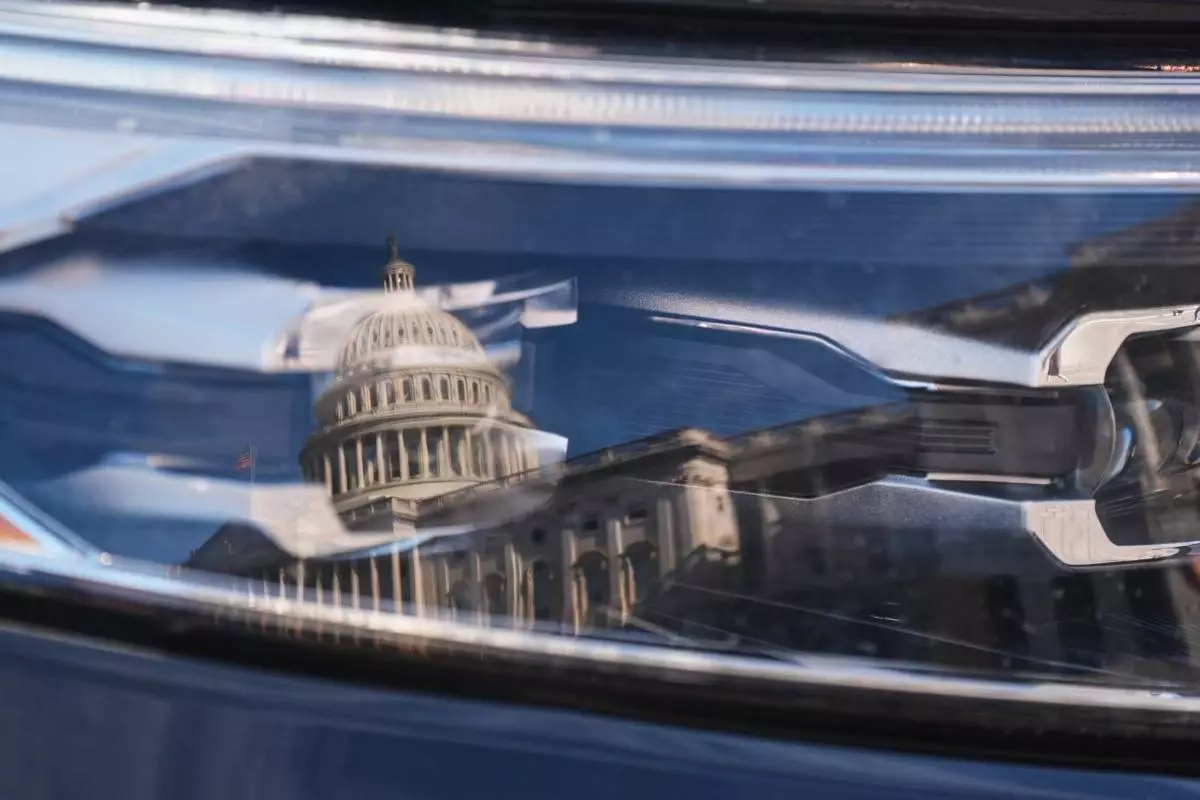
The U.S. Capitol dome is reflected in the body of a parked car, Wednesday Nov. 4, 2026, in Washington. (AP Photo/Mariam Zuhaib)
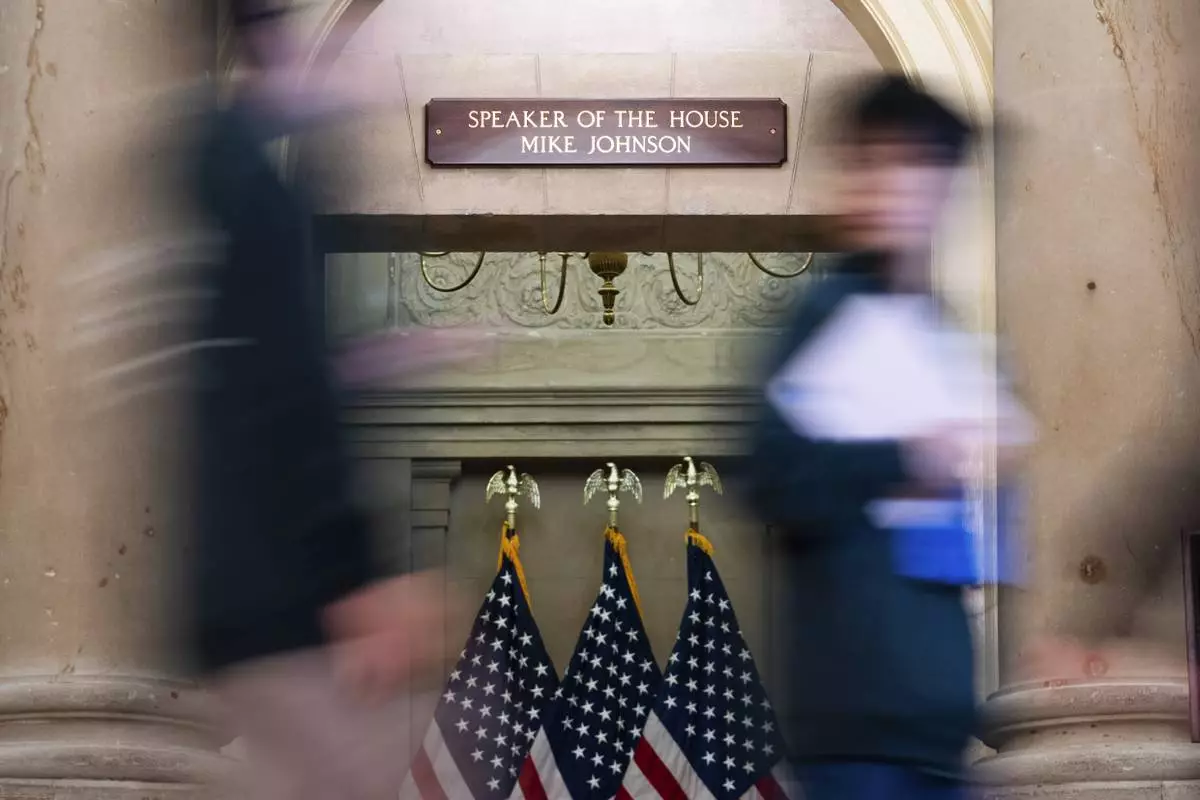
Scenes outside the office of House Speaker Mike Johnson, R-La., at the Capitol, Wednesday, Nov. 4, 2026, in Washington. (AP Photo/Allison Robbert)