WASHINGTON (AP) — President Donald Trump's administration held secret talks with Iran on deporting Iranians even as the war there dragged on, court documents obtained by The Associated Press show.
The court documents unsealed Thursday show the Republican administration as recently as mid-October said it had plans to deport the Iranians through an unnamed third country, although it was unclear when it intended to do so. The judge in the case ordered the government to give the court 24-hour notice of any finalized plans to deport Iranians to Iran or to any other country and five days' written notice before any such deportation is carried out.
“We are at war with a country where the President of the United States has said, as recently as two or three days ago, if not yesterday, that it is essentially lawless ... A country that is an enemy of the United States, according to the current president. A country that, according to our president, murdered tens of thousands of protestors,” Judge Ana Reyes said according to the Oct. 15 transcript.
“And what you’re telling me is that the United States of America is going to send individuals back to that region, facing what you and I and everyone who would ever look at this would know would be, at a minimum, a serious threat of certain death.”
“Yes, your honor,” Justice Department attorney Dimitar Georgiev-Remmel said. “The government is executing lawful orders of removal.”
Georgiev-Remmel told the court there was no specific date set to carry out any removals. A legal group representing Iranians held by Immigration and Customs Enforcement said a dozen Iranian detainees had been given notice over the past week that they would be deported to Iran. The legal group, the Iranian American Legal Defense Fund, brought the lawsuit in which the transcript was released.
The court documents show that the administration maintained contacts with Iranian officials during the war over the removals, specifically for submitting travel documents and figuring out “possible avenues for removal.”
The Department of Homeland Security and the State Department did not immediately respond to a request for comment.
The development emerged from an ongoing lawsuit that alleges the Trump administration’s immigration agencies have been sharing confidential information about Iranian asylum seekers with the Iranian government, violating national immigration regulations and endangering countless Iranians, court filings argue.
The Iranian American Legal Defense Fund said Thursday at least 12 Iranian detainees have been contacted by the Iranian Interest Section, an Iranian representative office in the Pakistani Embassy in Washington that handles consular affairs, in the past week and notified of an upcoming deportation flight to Iran through Pakistan. The group did not say when the deportation would occur.
One of those detainees attempted suicide once he learned he might be returned to Iran, according to Yasmine Chubin, the executive director of the organization. He was one of two people who were subsequently moved across state lines to a detention center in Texas, where detainees are often relocated immediately preceding a removal.
None of the detainees who have been contacted have been provided any information in writing from immigration authorities, the legal group said.
Activists abroad have expressed concern about deportees returning to Iran, whose theocracy has been cracking down on intellectuals and where the government vociferously cracks down on any dissent.
The lawsuit depicts a coordinated campaign between the U.S. and Iranian governments to identify Iranians in ICE custody and pressure them to return to Iran — a marked departure from decades of diplomatic hostility between the two governments. DHS has denied that it is sharing asylum application records with the Iranian government.
Hundreds of emails exchanged between U.S. immigration officials exposed how the two countries worked together to arrange for more than 100 Iranians to be flown back to Iran on three immigration flights in September and December 2025 and January 2026.
During the Oct. 15 hearing, Reyes warned government attorneys that she would initiate contempt proceedings if the administration violated her order to give the court advance notice of any planned deportation flights.
“We are talking about sending individuals in our care and custody to a country that we have bombed and we may continue bombing, and is a declared enemy of this country,” Reyes said.
In a court filing Wednesday, the Justice Department said the judge’s order effectively served as an injunction against the government “given the possibility of sanctions and contempt dangling overhead.”
Deportations of Iranians back to their home country are historically rare, owing to the lack of diplomatic relations between the U.S. and Iran and the possible persecution they could face if they were sent to Iran.
But under the Trump administration, which is carrying out a broad immigration crackdown, ICE has aggressively pushed to deport people even from countries that have typically been reluctant to take people back or with whom the U.S. has had icy or no diplomatic relations.
Sometimes that has meant sending people back to their home country, but it has also meant deporting people to other countries they have no connection with.
The Trump administration has deported people, including Iranians, to countries other than their own in an attempt to circumvent diplomatic hurdles with governments that won’t take their people back. During Trump’s second term, countries including El Salvador, Costa Rica and Panama have accepted noncitizens from the U.S.
In June, an Iranian woman was among two dozen migrants the U.S. deported to the Central African Republic.
Riddle reported from Los Angeles. Follow the AP's coverage of the Iran war at https://apnews.com/hub/iran.

FILE - U.S. Department of Homeland Security sign, is seen during a news conference at ICE Headquarters, Oct. 9, 2026, in Washington. (AP Photo/Jacquelyn Martin, File)
ASUNCIÓN, Paraguay (AP) — Paraguayan President Santiago Peña announced his resignation Thursday after the collapse of a major digital bank tied to his government triggered widespread protests, froze millions of people’s savings and cost him the support of his own party.
The crisis at Ueno Bank turned Peña’s long-ruling Colorado Party against him, a stunning reversal for the former International Monetary Fund economist who had enjoyed the backing of the country's most powerful politicians and was welcomed in Washington just weeks ago as a key ally of the Trump administration.
Minutes after Peña’s announcement, the lower house voted 78-0 to impeach him, sending the charges to the Senate. Congressional leaders were expected to accept his resignation later Thursday, clearing the way for Vice President Pedro Alliana to be sworn in without waiting for a Senate trial.
As lawmakers debated his impeachment, Peña said in a video posted to X that he was stepping down in the interest of “the stability of our country, social peace and the need to preserve our democratic institutions.”
Even Peña’s mentor, Colorado Party leader and former President Horacio Cartes, backed impeachment, saying the party would not side with “the plundering of public and private funds and pensioners’ money.” The United States Treasury sanctioned Cartes in 2023 over bribery allegations that the Trump administration lifted last year.
Peña, who until last year held a stake in a company linked to Ueno, expressed contrition. But he stopped short of accepting responsibility for the turmoil, which has left millions of depositors, retirees and workers scrambling to recoup their frozen savings and unpaid wages.
“I want to apologize to the people if I have failed them at any point,” he said. “It was never my intention to betray the trust they placed in me."
Ueno Bank, which exploded from an obscure finance company to a household name in less than five years, claimed more than 60% of Paraguay’s adults as customers. Many Paraguayans are left asking how a bank linked to the president could grow so rapidly in size and importance despite repeated warnings about its lending practices.
The answer lies in the uncomfortable proximity of Peña’s Colorado Party to the country’s regulators and business elite, a weakness that has endured even as steady economic management and rapid growth recently earned Paraguay coveted investment-grade credit ratings.
“Santiago Peña and the Colorado Party have stolen all our savings,” said Luis Pineda, one of the protesters marching to Congress on Wednesday. “We are fed up with 70 years of plunder.”
Soon after winning its banking license in 2023, Ueno seemed to be everywhere in Paraguay. The digital lender, a rebranded version of a decades-old finance company, lured customers with generous cash-back offers on groceries, grew to more than 70 locations, sponsored Paraguay's national soccer team and plastered its name on the country's main stadium.
Government money poured into Ueno’s coffers under Peña. He also appointed Carlos Carvallo, president of Financiera Ueno, the predecessor to Ueno Bank, to run the central bank, the agency charged with supervising the digital lender.
As of last month, Ueno reported holding roughly $800 million in public deposits, about a quarter of its total, including money from the state pension and health fund and the operators of Paraguay’s giant hydroelectric dams.
Even as retirees’ savings and other public money piled up at Ueno, worries were escalating inside the central bank. In June, its inspectors found a pattern of risky lending to insiders, reported ABC Color, a leading Paraguayan newspaper. Ueno had extended large sums to companies tied to its owners, beyond what the law allows and without enough collateral to cover the debts if they went bad.
As recently as last month, Peña defended Ueno and the central bank’s oversight, dismissing the concerns as a smear campaign that was spooking the public.
But on Monday, it all came crashing down. Regulators investigating Ueno’s loans to companies linked to its owners found poorly documented lending, the central bank said, as well as expenses the bank had wrongly counted as assets.
Once the books were corrected, Ueno’s capital, the cushion banks must keep to absorb losses, fell to less than half the legal minimum. The central bank announced the lender’s seizure Tuesday, beginning a process to transfer deposits and recoverable assets to other banks before liquidating what remained.
Ueno’s app, cards and transfers went dark and its branches locked their doors, leaving desperate depositors lined up outside. On Wednesday, a rush to open new accounts elsewhere crashed other banks’ mobile apps, fueling public panic.
Officials have appealed for calm. Under a law rushed through Congress on Wednesday, a state guarantee fund must repay stranded depositors within five business days, starting Thursday with small accounts of up to about $1,600 held by customers with no debts to Ueno. The fund insures up to about $36,000 per customer, which the central bank says will cover the full balances of an estimated 97% of clients.
On Thursday, a judge ordered six Ueno executives, including founder Miguel Vázquez and bank President Juan Manuel Gustale, jailed pending trial and two others placed under house arrest. Prosecutors have charged 27 bank officials and associates with breach of trust and attempted fraud, alleging that Ueno made large loans to related companies without adequate guarantees and diverted some of the money to other group businesses.
Gustale’s lawyer pushed back on the charges, arguing that senior executives had relied on staff for lending decisions. “The president or board is not responsible for deciding who receives a particular loan,” José Fernández Zacur told local media.
Still in their Ueno uniforms, young employees burned their credit cards and cursed Peña outside the Labor Ministry on Thursday, demanding severance and unpaid wages. Peña’s resignation did little to calm them. Many vowed to keep protesting until lawmakers finished impeaching him, saying his departure alone would neither bring accountability nor return their money.
Under Paraguay’s Constitution, former presidents become senators for life, with the immunity that comes with the seat, unless they are removed through impeachment.
“Let the impeachment process take place and let him lose his immunity,” said Adolfo Villalba, one of the protesters on Thursday.
The Labor Ministry estimates the collapse has affected about 7,000 direct and indirect jobs at the bank and its related businesses.
Many saw Ueno’s collapse not just as reckless banking but as a case study in official corruption. Only Venezuela ranks worse in South America on Transparency International’s latest index of perceived corruption.
“This is yet another assault on honest, hard-working citizens, people whose small savings are the fruit of years of labor,” said Belarmino Balbuena, one of thousands who marched on Congress in the capital, Asunción, on Wednesday.
The crowds shouted, “We want your head, Peña!” Their signs branded him “the enemy of savers” and pleaded, “Give us back our money.” Riot police fired pepper spray and rubber bullets to push them back.
At the national stadium that once bore Ueno’s name, the bank’s logo had already been scrubbed away. Across the capital, fresh graffiti called politicians thieves.
Jorge Sáenz contributed to this story. DeBre reported from Buenos Aires, Argentina.
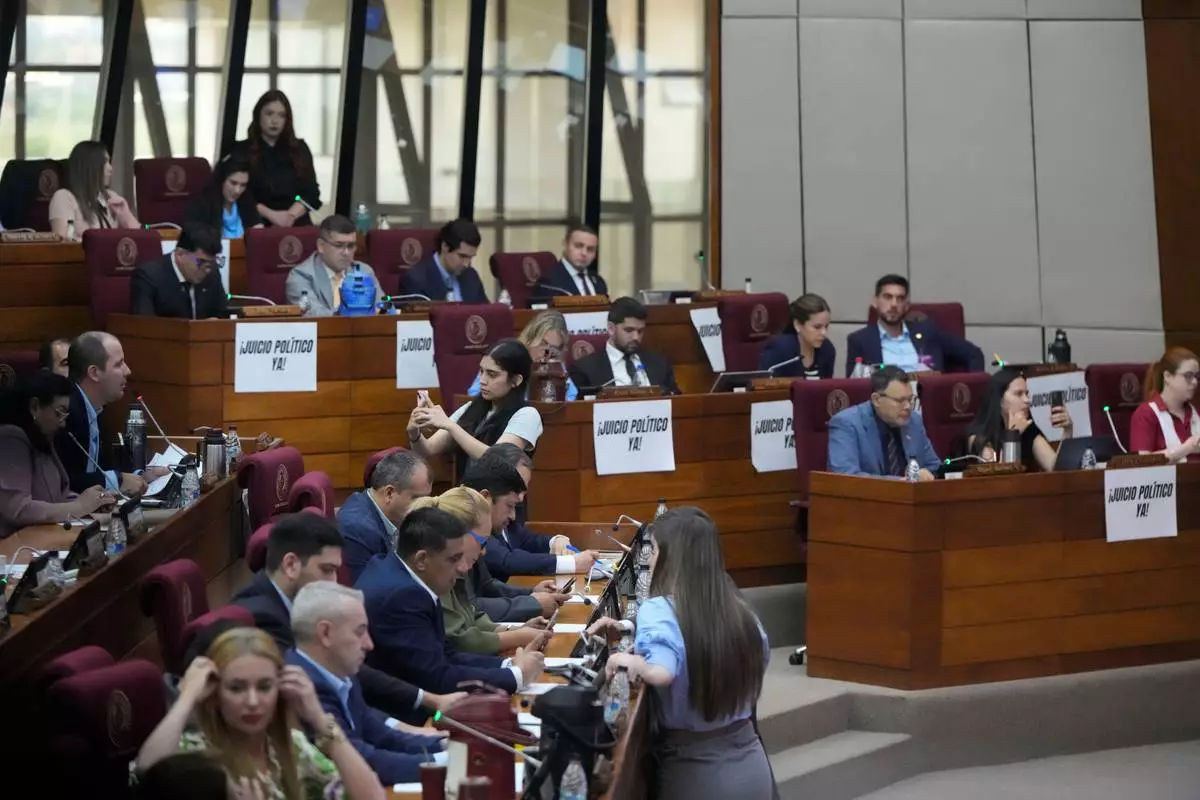
Deputy Carlos Pereira speaks during a discussion on the impeachment of President Santiago Peña in Paraguay's lower house of Congress, as banners reading "Impeachment Now" are displayed on opposition lawmakers' desks in Asuncion, Paraguay, Thursday, Nov. 5, 2026. (AP Photo/Jorge Saenz)
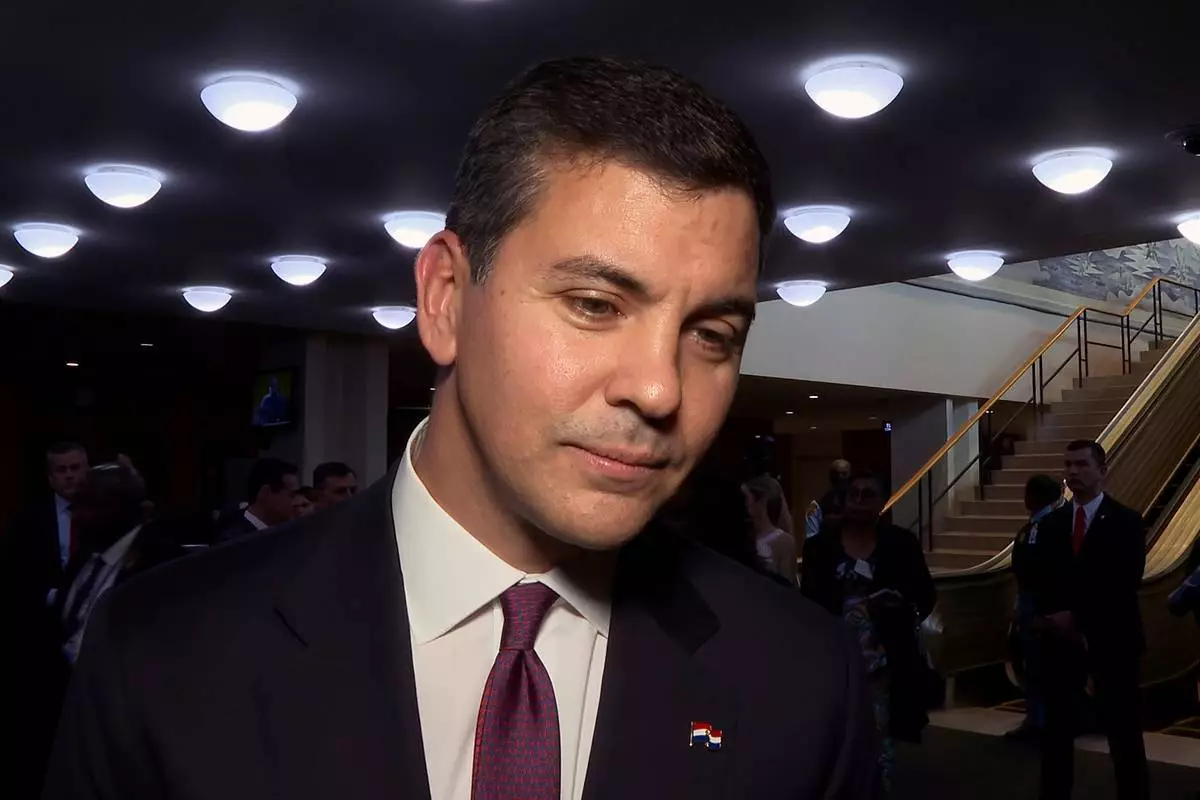
FILE - Paraguay President Santiago Peña speaks to the media at United Nations headquarters, Sept. 19, 2023. (AP Photo/Ted Shaffrey, File)
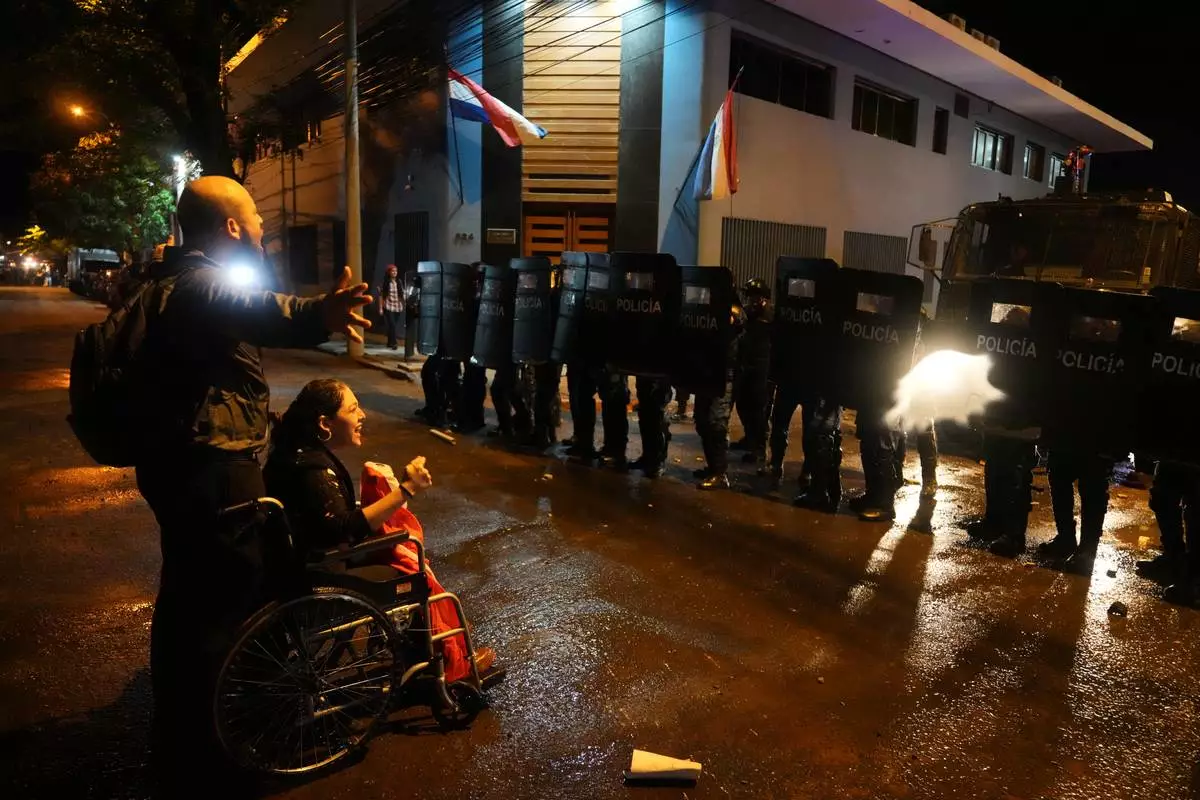
People protest in front of police against the government and Ueno Bank, which Paraguay's central bank seized amid a solvency crisis, in Asuncion, Paraguay, Wednesday, Nov. 4, 2026. (AP Photo/Jorge Saenz)
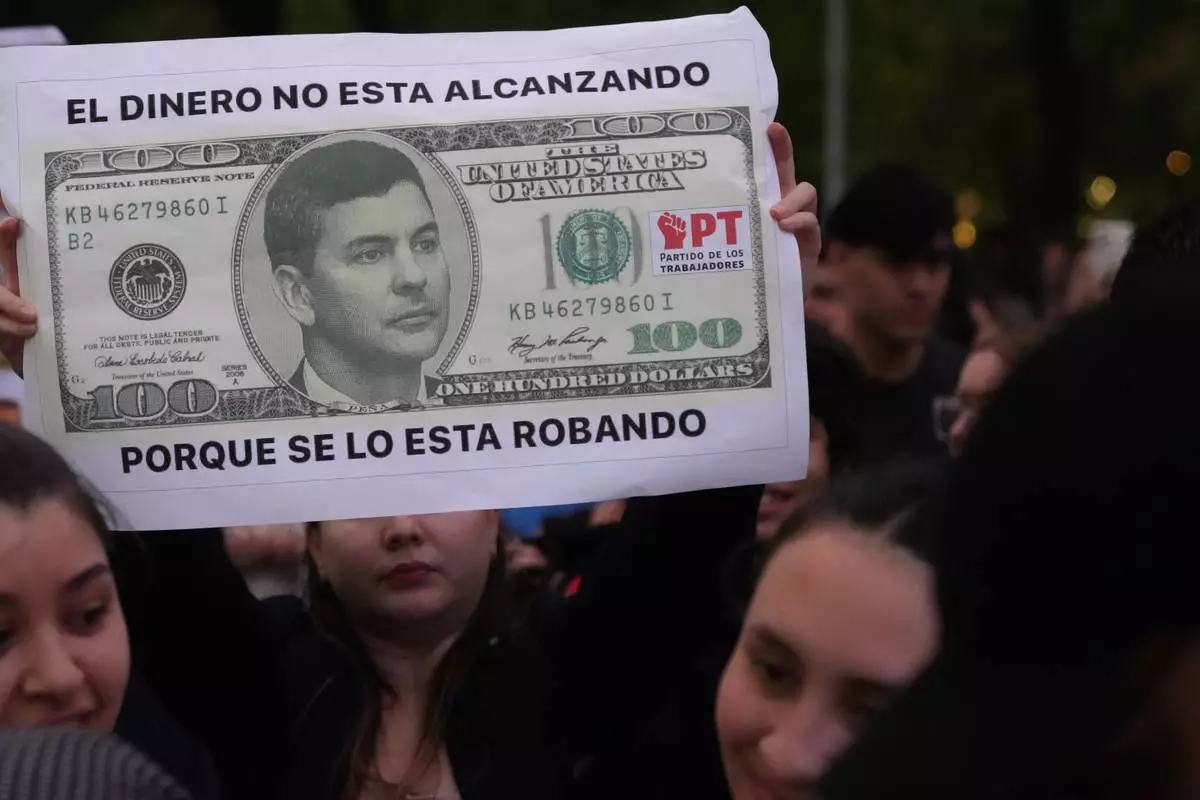
A demonstrator holds a mock U.S. dollar bill depicting Paraguayan President Santiago Peña during a protest against the government and Ueno Bank, which Paraguay's central bank seized amid a solvency crisis, in Asuncion, Paraguay, Wednesday, Nov. 4, 2026. (AP Photo/Jorge Saenz)
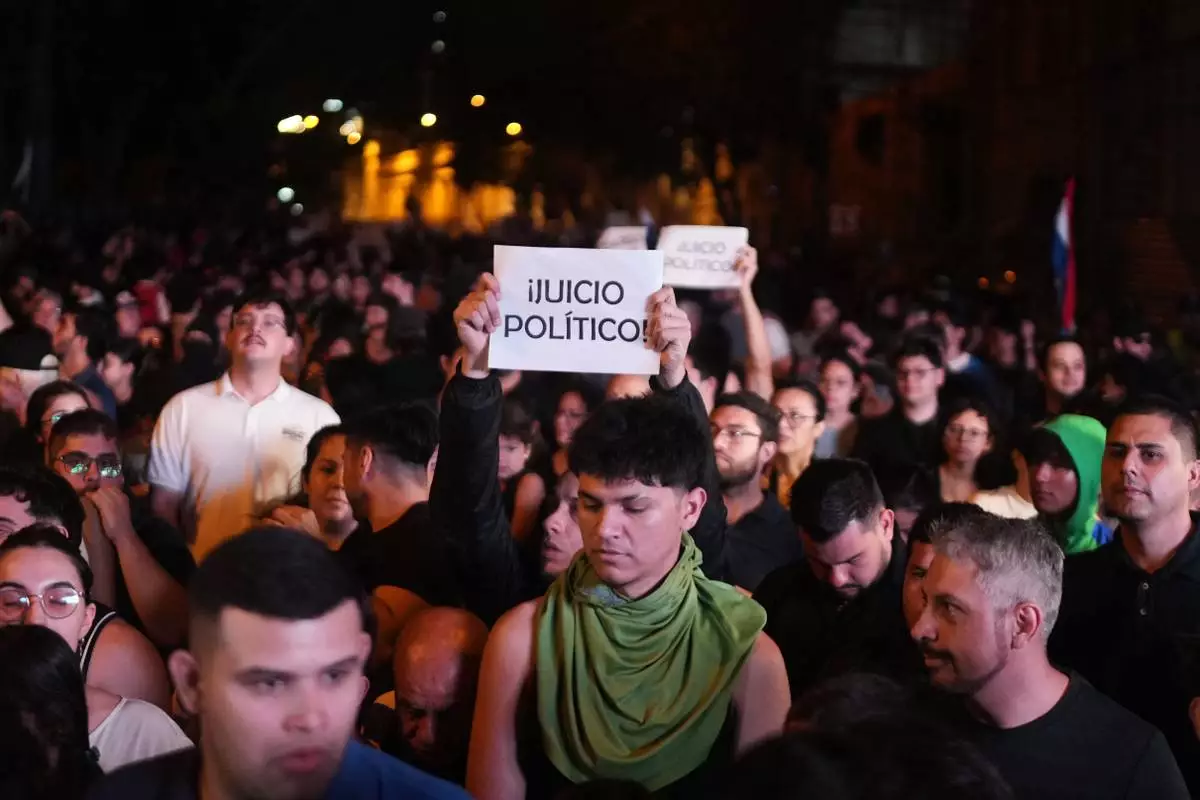
People protest against the government and Ueno bank, which Paraguay's central bank has seized amid a solvency crisis in Asuncion, Paraguay, Wednesday, Nov. 4, 2026. (AP Photo/Jorge Saenz)
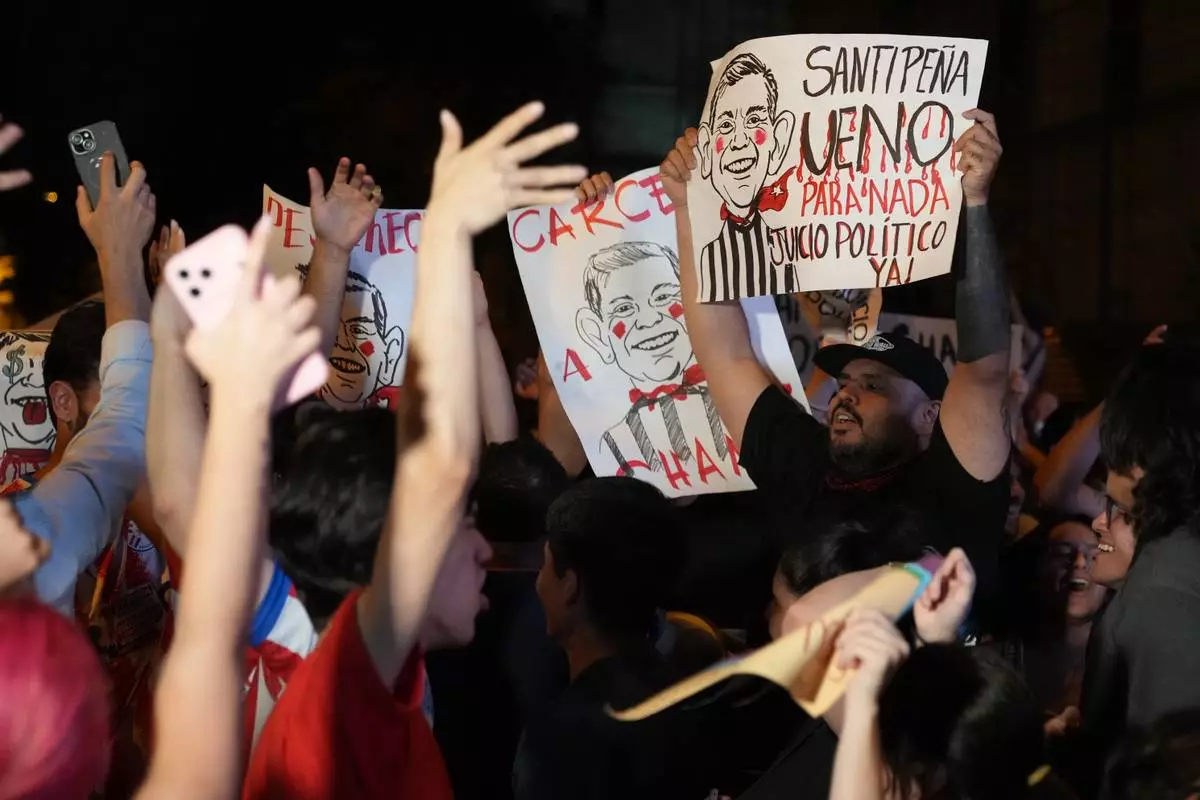
People protest against the government and Ueno bank, which Paraguay's central bank has seized amid a solvency crisis in Asuncion, Paraguay, Wednesday, Nov. 4, 2026. (AP Photo/Jorge Saenz)

Executives of Ueno Bank, taken over by Paraguay's central bank amid a solvency crisis, arrive in custody at the anti-corruption prosecutor's office in Asuncion, Paraguay, Wednesday, Nov. 4, 2026. (AP Photo/Jorge Saenz)

People protest against the government and Ueno bank, which Paraguay's central bank has seized amid a solvency crisis, in Asuncion, Paraguay, Wednesday, Nov. 4, 2026. (AP Photo/Jorge Saenz)

Executives of Ueno Bank, taken over by Paraguay's central bank amid a solvency crisis, arrive in custody at the anti-corruption prosecutor's office in Asuncion, Paraguay, Wednesday, Nov. 4, 2026 (AP Photo/Jorge Saenz)