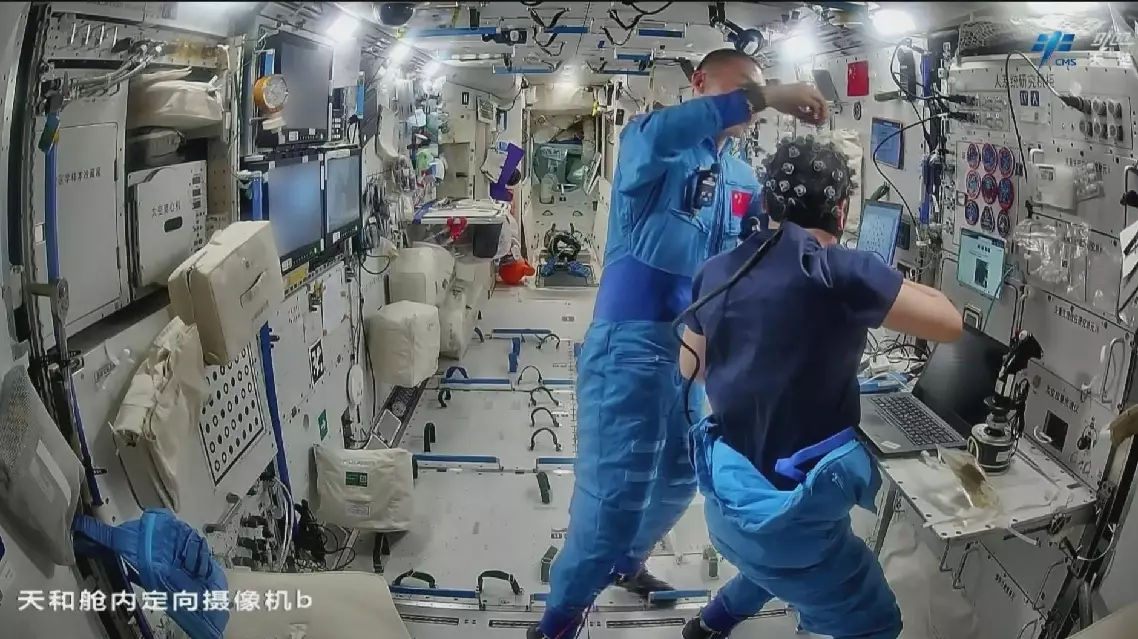
The Shenzhou-23 crew aboard China's Tiangong Space Station has recently carried out in-orbit electroencephalogram (EEG) testing and other scientific experiments, according to the China Manned Space Agency (CMSA).
The three astronauts, Zhu Yangzhu, Zhang Zhiyuan and Lai Ka-ying, used EEG acquisition equipment to conduct a series of experimental tests including space brain monitoring driven by brain network mapping and visual motion processing.
They also carried out experiments on the time-varying characteristics of space brain networks, in-orbit tactile perception and force control tests.
The data obtained will be used to study changes in astronauts' brain functional networks, tactile perception and fine motor control during long-term orbital flight.
In accordance with the experimental arrangements in the field of microgravity physical science, the crew completed the cleaning of samples in the containerless cabinet experiment chamber, replacement of experimental samples and maintenance of the electrode of the axial mechanism. They also inspected and maintained the two-phase system experiment cabinet.
Last week, the Shenzhou-23 crew completed inspections and tests of their in-cabin pressure suits as scheduled, and also carried out in-orbit emergency rescue training.
Meanwhile, the crew has been tending to the space station complex platform, completing work such as measuring the temperature and wind speed inside the cabin.
In-orbit health monitoring also continued. The astronauts conducted overall visual function measurements, intraocular pressure and fundus examinations, and transorbital ultrasound measurements.
They also used a "space scale" to measure their body mass to monitor physiological changes in the microgravity environment.
At present, the crew is in good physical and mental condition, and in-orbit missions are progressing efficiently, the CMSA said.
China's Shenzhou-23 crew conducts in-orbit EEG tests, other space station experiments
China's Shenzhou-23 crew conducts in-orbit EEG tests, other space station experiments
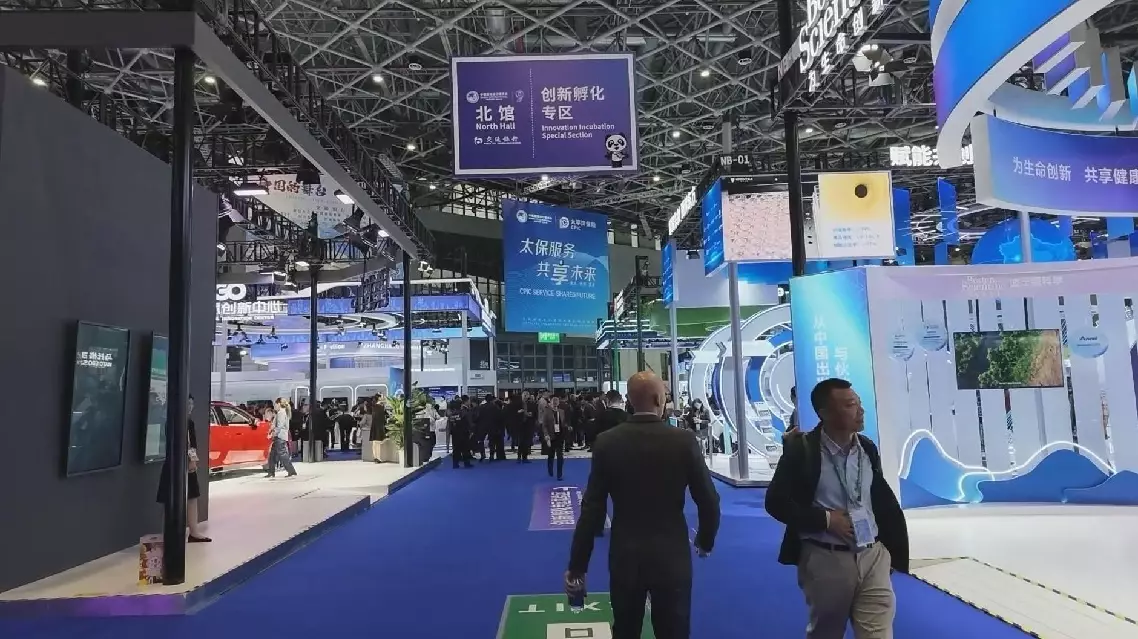
Overseas healthcare and medical firms, from first-time to longtime exhibitors, are using the ongoing 9th China International Import Expo (CIIE) in Shanghai as a platform to tap China's fast-growing market and reach Asian consumers.
The CIIE, running from November 5 to 10 in Shanghai, has attracted 4,142 overseas exhibitors across more than 440,000 square meters, with over 480 exhibits making their global, Asian or China debut, the highest number in the event's history.
In the medical equipment and healthcare zone, both first-time and returning exhibitors are showcasing products and seeking deeper access to the Chinese market.
For Biosan AS, a Norwegian nutrition and health supplement brand, this year marks its CIIE debut. The company is using the Shanghai showcase to roll out seven new products for the Asian market, betting that China's rapidly expanding health sector offers the right entry point.
"This is our first time to attend the CIIE. We are introducing seven new launches to the Asian markets at this exhibition. We think the Chinese market is a really fast-growing health market, it's a great place for us to start to show the products to the Asian consumers," said a representative of Biosan AS.
For returning exhibitors, the expo has delivered tangible market growth and reinforced their confidence in deepening their presence in China.
"So we have been to CIIE many times. It definitely helps a lot as a U.S. brand to enter the Chinese market and we really appreciate the opportunities that China opening-up policies has brought us," said a U.S. exhibitor.
Another exhibitor, back for a second year, described a three- to five-fold revenue increase after its first CIIE appearance.
"We first attended the CIIE last year, and our brand's revenue grew three- to five-fold. We hope the expo will help us further expand our brand influence, win more orders and partnerships. We are also working with universities on the Chinese mainland on joint research to advance industry-academia-research integration," said the exhibitor.
Several foreign companies said that their operations in China are moving beyond simply importing overseas products: they are ramping up production investment, co-building clinical research programs and assembling fuller industrial ecosystems on the ground.
"These technologies are being rolled out from our China factories, based in the Yangtze River Delta. We are very optimistic about the Chinese market and are continuing to invest across various aspects and pursue ongoing technological iteration," said an exhibitor.
Global firms eye China's fast-growing health market at 9th CIIE