ALBUQUERQUE, N.M. (AP) — A third-grade field trip to the Navajo Nation Council sparked Crystalyne Curley’s political ambition when she witnessed a fiery debate erupt between two tribal lawmakers.
“I thought to myself at a very young age, that’s where I want to be,” Curley said.
On Election Day, Curley surpassed that childhood dream and broke a barrier she says she never imagined as a nine-year-old: She was elected the first woman president of the Navajo Nation.
This week's elections brought a wave of milestone victories, from the nation’s first Black female governor to the first openly gay man and first Muslim elected to the U.S. Senate. It also marked a turning point for Native American women, whose leadership in their families and communities has rarely translated to formal political power.
Peggy Flanagan became the first Native American woman elected to the Senate, Deb Haaland the first to win a state governorship, and Curley the first to lead one of the largest tribes.
“This is a win for all Navajo women,” Curley told The Associated Press.
Jordan James Harvill, a Cherokee Nation citizen and strategist with the advocacy group Advance Native Political Leadership, said decades of political organizing are bearing fruit as more Native women run for and win office.
“This is a seismic shift that is happening in our communities,” he said.
Lene Bitsui supported Curley in the Navajo Nation election because she felt she was best positioned to restore order to the tribal government after what she sees as a period of dysfunction. But when Bitsui cast her ballot, she felt pessimistic.
“I thought our people weren't ready for a female president,” Bitsui said. “I was wrong, and I feel so happy to have been wrong.”
The modern, centralized Navajo government has been led by men since its establishment under federal pressure over a century ago. Navajo has the largest land base of any federally recognized tribe, spanning 27,000 square miles (70,000 square kilometers) in Arizona, New Mexico and Utah, and is second in population to the Cherokee Nation in Oklahoma.
Some Navajo people believe traditional teachings prohibit women from holding top government positions. Others say women's absence from the presidency stands in contrast to the matrilineal structure of Diné society.
“You see the language of tradition used to both deride the possibility of a woman being president and to say that women’s leadership is needed now,” said Jennifer Nez Denetdale, a professor of Diné studies at the University of New Mexico.
Curley, who narrowly defeated attorney Justin Jones, according to unofficial results, told the AP she faced sexist rhetoric while campaigning and expects to be held to a higher standard as the first woman president.
“As women, we have to work twice or triple as hard, especially within Navajo politics,” said Curley, who also was the first female to lead the tribe's legislative branch as speaker of the tribal council.
After Curley and her running mate Chris Deschene take office in January, they plan to transition the Navajo Nation away from coal development, historically a major economic engine for the tribe, and reassert its leading role in national discussions around federal Indian policy.
The Seneca Nation of Indians in western New York also elected its first woman president, longtime council member Tina Abrams, on Tuesday.
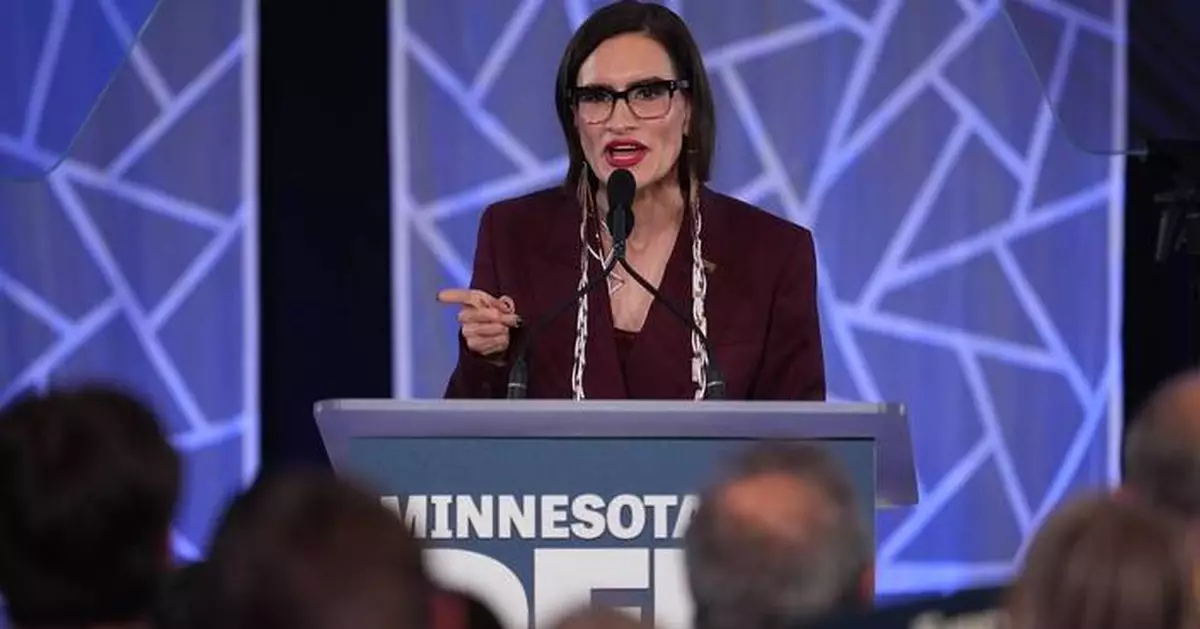
At her Senate victory celebration in St. Paul, Minnesota, Democrat Flanagan, a citizen of the White Earth Nation and the state’s outgoing lieutenant governor, credited supporters from her community.
“I could not run for the U. S. Senate without Native women. I could not exist in the way that I do without Native women,” Flanagan said.
More than 230 years after the U.S. Senate was established, only four Native people have served in the chamber, all men.
“This is a win that shows we can break every single glass ceiling,” Harvill said.
Flanagan will join Oklahoma Republican Sen. Tom Cole, a citizen of the Chickasaw Nation. A victory for Democrat Mary Peltola, a Yup’ik woman, in Alaska's still unsettled Senate race, would mark the first time three Native people have served in the chamber simultaneously.
In the House, Kansas Democrat Sharice Davids, Ho-Chunk, and Oklahoma Republican Josh Brecheen, Choctaw, won reelection. New York Democrat Claire Valdez, a citizen of Ysleta del Sur Pueblo, and Michigan Democrat Sean McCann, a citizen of the Citizen Potawatomi Nation, became the first Native Americans elected to represent their states in Congress.
Haaland’s political career has been defined by historic milestones. She was one of the first two Native women elected to Congress in 2018 before becoming the first Native American to lead a U.S. Cabinet agency, the Interior Department.
Now, in her home state of New Mexico, the Laguna Pueblo citizen, will break ground as the first female Native governor of a U.S. state.
“I think it's a long time coming,” said Haaland, who traces her ancestry in what is now New Mexico back 800 years.
She is tasked with making good on campaign promises to make life more affordable for struggling New Mexicans and addressing persistently poor education outcomes in the state.
Haaland, who is affectionately known as “Auntie Deb” in parts of Indian Country, was tearful reflecting on the support she has received from Native voters and other Native women in politics, including Davids and Flanagan.
“It makes me very happy that we're able to have a presence,” Haaland said. “It’s not just a slogan. It matters that people feel represented.”
This story is published through the Global Indigenous Reporting Network at The Associated Press.
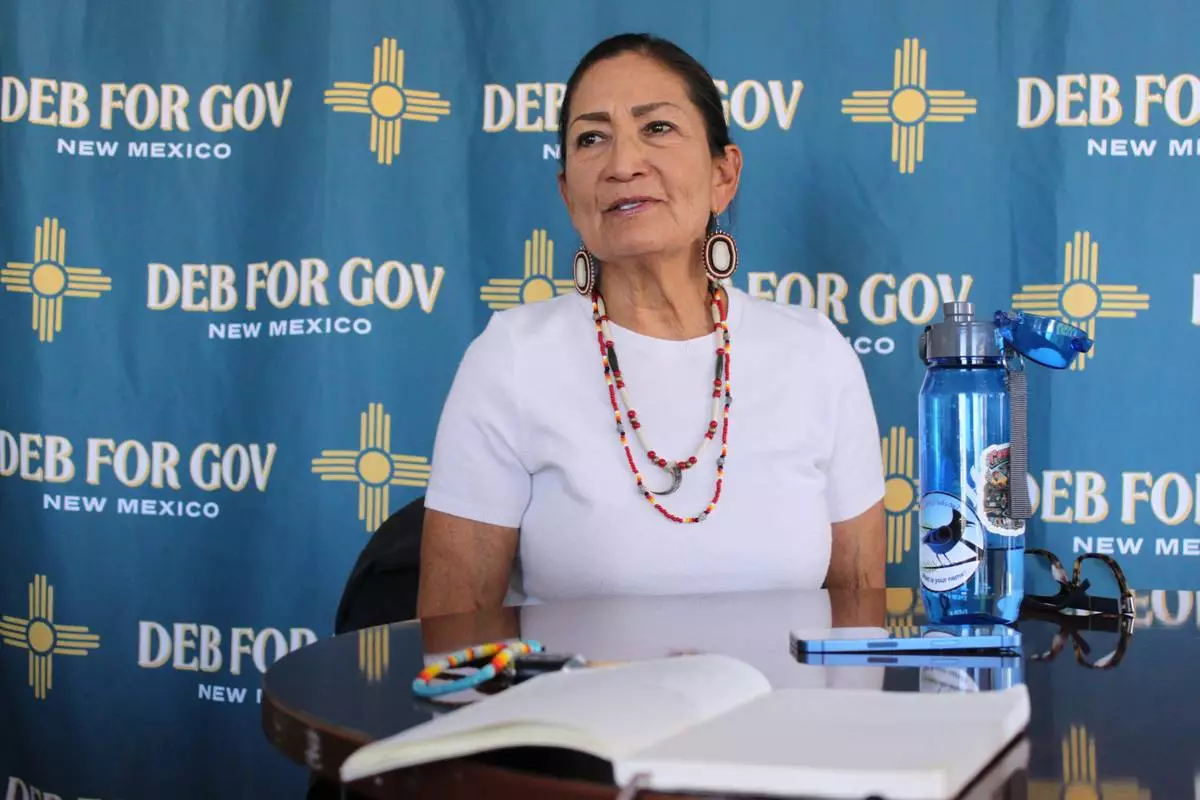
FILE - In this photo taken with a smartphone, Democratic gubernatorial nominee Deb Haaland answers questions during an interview at her campaign headquarters in Albuquerque, N.M., on Friday, Oct. 9, 2026. (AP Photo/Susan Montoya Bryan, file)
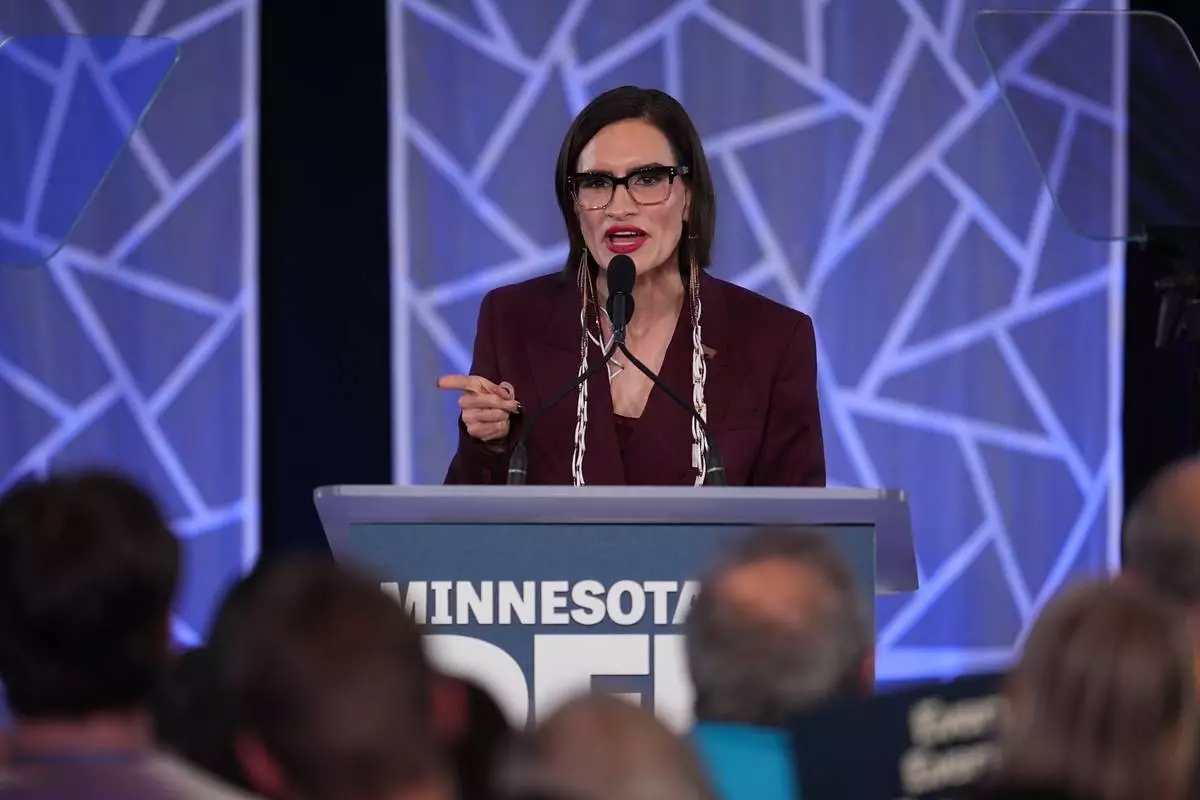
FILE - Democratic Senate candidate Minnesota Lt. Gov. Peggy Flanagan, speaks at an election night event, Tuesday, Nov. 3, 2026, in St. Paul, Minn. (AP Photo/Abbie Parr, file)
ZAPORIZHZHIA, Ukraine (AP) — A Russian drone struck emergency workers on rescue missions in southern Ukraine on Sunday, hitting a former school and nearby shelter that had been earlier blasted by multiple Russian guided bombs as residents waited for humanitarian aid, authorities said.
No one was injured in Sunday’s strike on the village of Komyshuvakha, but specialized rescue equipment was damaged, according to Ukraine’s State Emergency Service.
Ukraine said Monday's attack on the same location killed at least 55 people, near the front line in the Zaporizhzhia region.
As of Sunday afternoon, 45 people were listed as missing, according to the acting head of the regional military administration, Mykhailo Semikin. Many of the bodies recovered have not been identified and DNA analysis is ongoing.
Village resident Mykola Krasnov, 72, told The Associated Press on Saturday that he was still looking for his wife, but had heard no word from rescuers.
“She went to get humanitarian aid, and a 3-ton bomb was dropped there. Where is she?” he said. “She didn’t come home, and they didn’t find her body there. She isn’t in the morgue, and she isn’t here alive.”
Ukraine has routinely accused Russia of conducting multiple strikes at the same site in quick succession to target emergency crews responding to the initial attack.
On Saturday, police officers and relatives gathered in Zaporizhzhia for a farewell ceremony for six officers killed in Russian strikes on Komyshuvakha, including four who died near the former school.
Rain fell as families wept beside the coffins, and officers held portraits of their fallen colleagues.
“They used every skill at their disposal to protect themselves. But when the enemy deliberately gathered civilians in one place and then launched strikes against them, no skills could have helped,” said Andrii Khomenko, a police lieutenant colonel who had worked alongside the victims.
The community also said goodbye to three residents among the dead. Among those mourning was Yurii Karapetian, whose wife Natalia was killed. He said she was distributing bread to those in the shelter when the Russian bombs struck.
“This pain, I would say, is unbearable,” he said, and urged the international community to act.
“The whole world must understand that if (the Russians) are not stopped, they will not stop. They will not stop at Ukraine. They will not stop anywhere,” he said.
President Volodymyr Zelenskyy on Sunday called the attack on emergency crews in Komyshuvakha “absolute cynicism and brutality" in a post on X.
French Foreign Minister Jean-Noël Barrot said Sunday that France and other European representatives would participate in the U.S.-mediated talks between Russia and Ukraine in Abu Dhabi on Nov. 10-11.
“France will be there and will ensure that Europe’s voice is heard,” Barrot told RTL radio. He did not specify who would represent France, or whether European officials would participate directly in negotiations.
The talks were previously presented as a trilateral meeting between Washington, Moscow and Kyiv, with U.S. President Donald Trump predicting a “very big” deal with Russia extending beyond Ukraine to “all of Europe". This raised concerns that European countries might be sidelined in negotiations over their own security.
Russian strikes in Ukraine's Dnipropetrovsk region have left more than 600,000 people without power, Zelenskyy wrote on X on Sunday. Russia's defense ministry claimed its forces had struck an electrical substation that powered Ukrainian “military-industrial enterprises”. Other regions in Ukraine also faced outages.
Russia launched 115 missiles, 1,900 guided aerial bombs and more than 3,000 drones against Ukraine in the past week, Zelenskyy said on X. Many of the missiles had been produced this year, he added, calling on Ukraine's partners to sanction entities involved in their production.
“If the world does not have enough anti-ballistic capabilities to protect Ukrainian skies, then the missiles must be stopped on the production lines," he said.
The Russian-controlled Zaporizhzhia Nuclear Power Plant, the largest in Europe, has lost its external power supply after a damaged power line was disconnected for safety, the plant’s management reported Sunday.
It said the plant was powered by backup diesel generators since an automatic protection system shut down the damaged Ferosplavna line. Ukraine's state nuclear operator, Energoatom, also reported on Sunday that the plant was relying on generators.
The plant went offline soon after being captured by Russia early in the war, but needs power to keep essential cooling systems running. Its external power supply has been periodically severed, raising fears of a nuclear accident in case of protracted outages, as Moscow and Kyiv blamed each other for strikes that damaged nearby power lines.
This story corrects the number of police officers killed in the strike on the former school.
AP writer Thomas Adamson contributed from Paris.
Follow the AP’s coverage of the war in Ukraine at https://apnews.com/hub/russia-ukraine
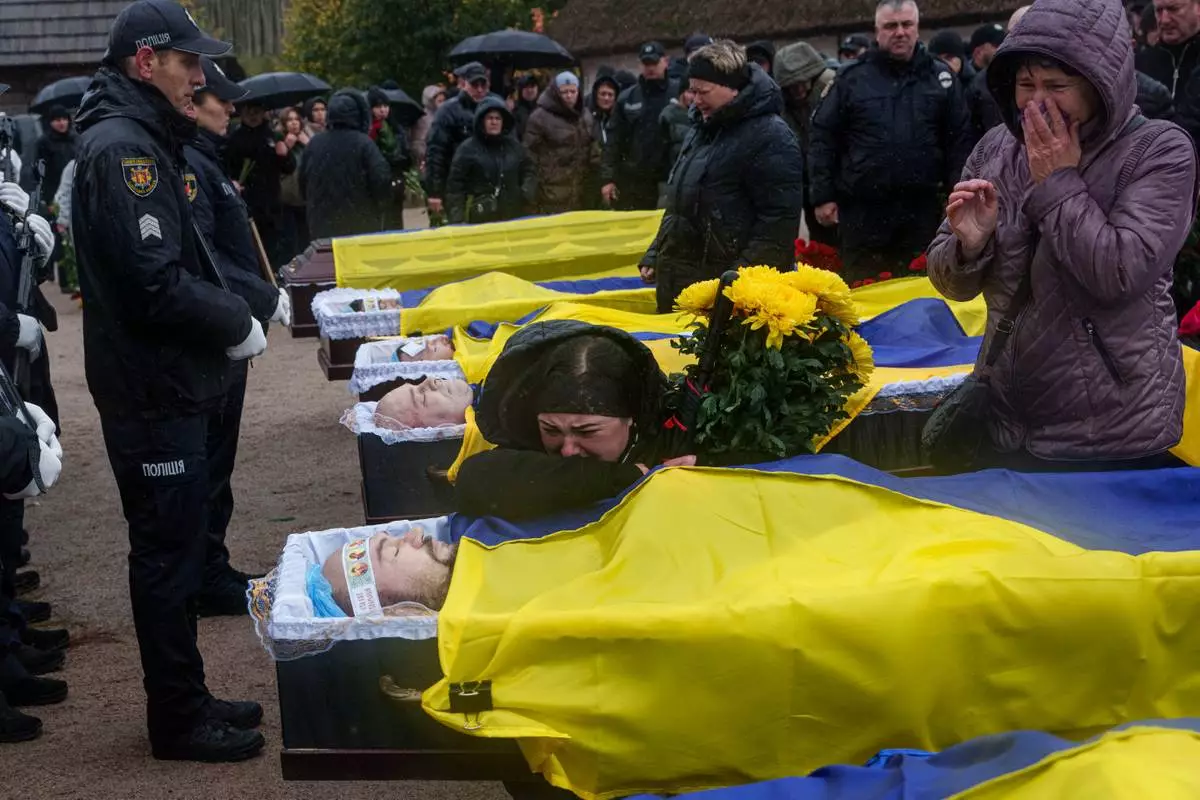
Family members cry beside the coffins of police officers Dmytro Besedin, Mykhailo Buzhenko, Mykola Balanda and Mykhailo Romanov, killed in a Russian airstrike that destroyed an underground school, and Serhii Berezhko and Oleg Dubetskyi, killed in an FPV drone attack in Komyshuvakha, during a farewell ceremony on Khortytsia Island in Zaporizhzhia, Ukraine, Saturday, Nov. 7, 2026. (AP Photo/Evgeniy Maloletka)
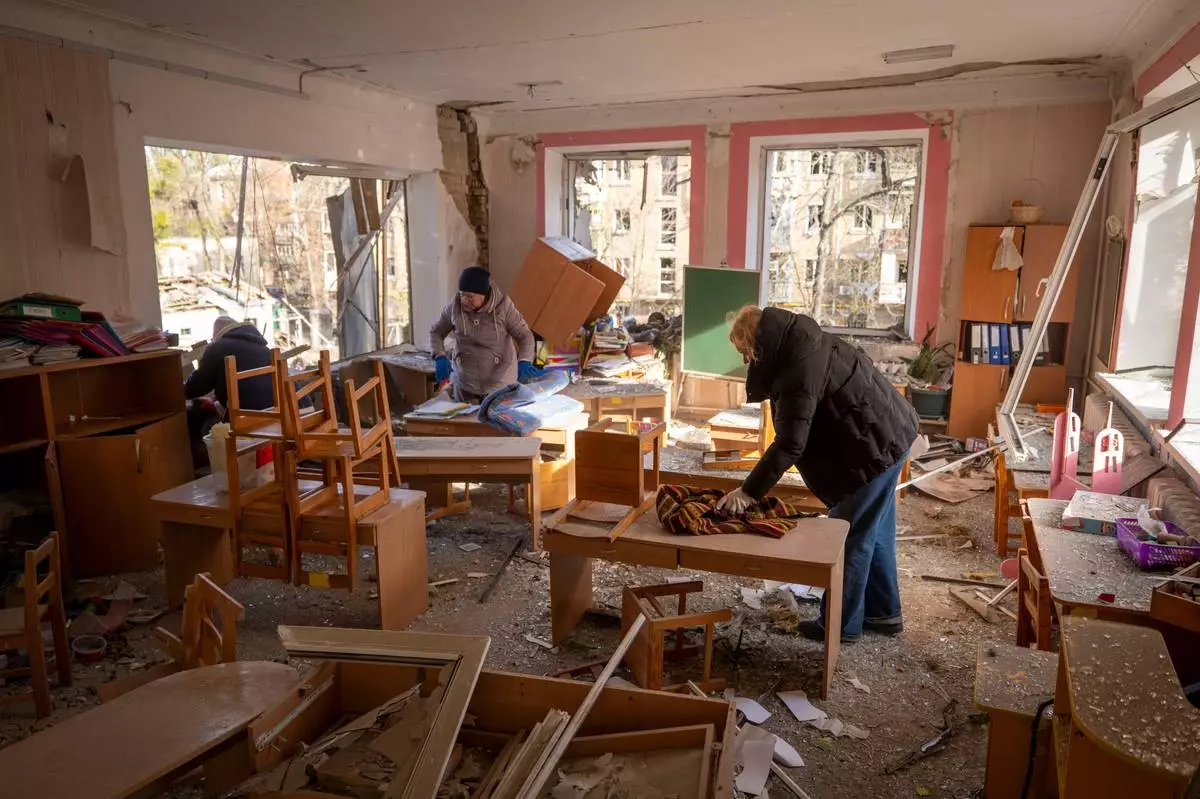
Kindergarten personnel cleaning debris inside a heavily damaged class following a missile attack on a residential area in Kyiv, Saturday, Nov. 7, 2026. (AP Photo/Dan Bashakov)
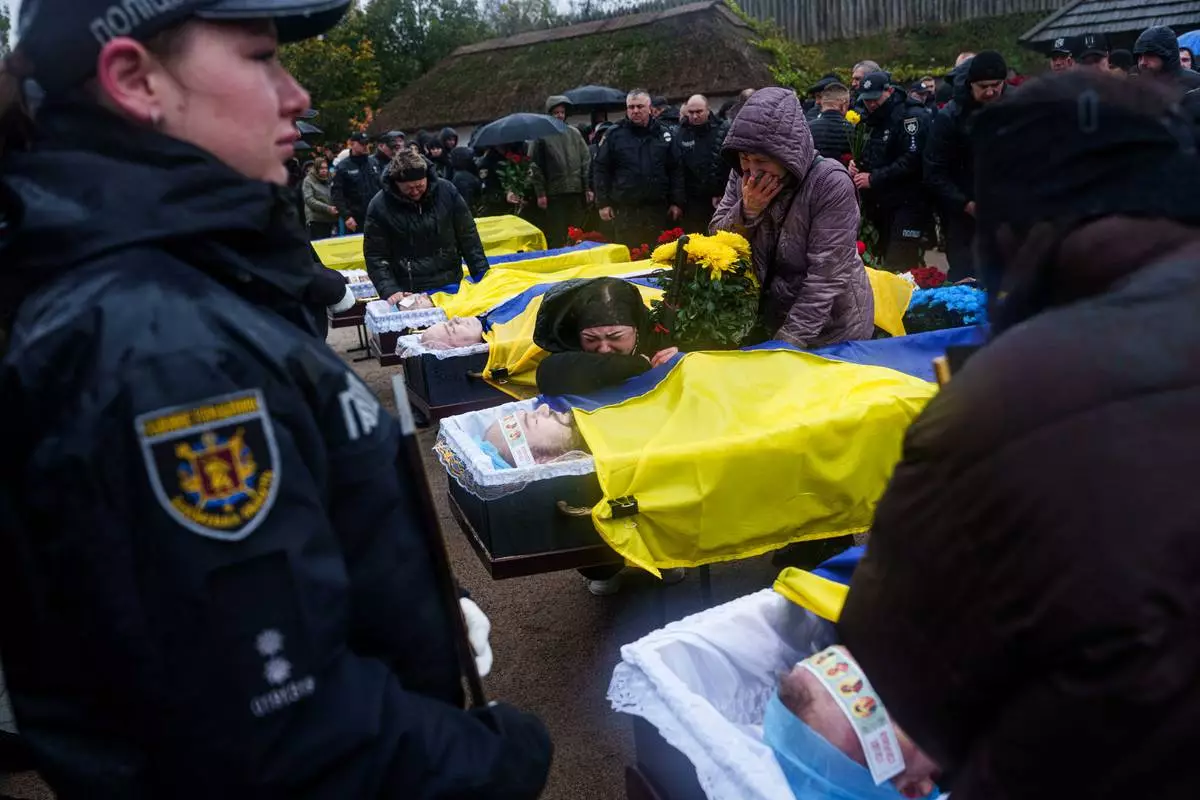
Family members cry beside the coffins of police officers Dmytro Besedin, Mykhailo Buzhenko, Mykola Balanda and Mykhailo Romanov, killed in a Russian airstrike that destroyed an underground school, and Serhii Berezhko and Oleg Dubetskyi, killed in an FPV drone attack in Komyshuvakha, during a farewell ceremony on Khortytsia Island in Zaporizhzhia, Ukraine, Saturday, Nov. 7, 2026. (AP Photo/Evgeniy Maloletka)
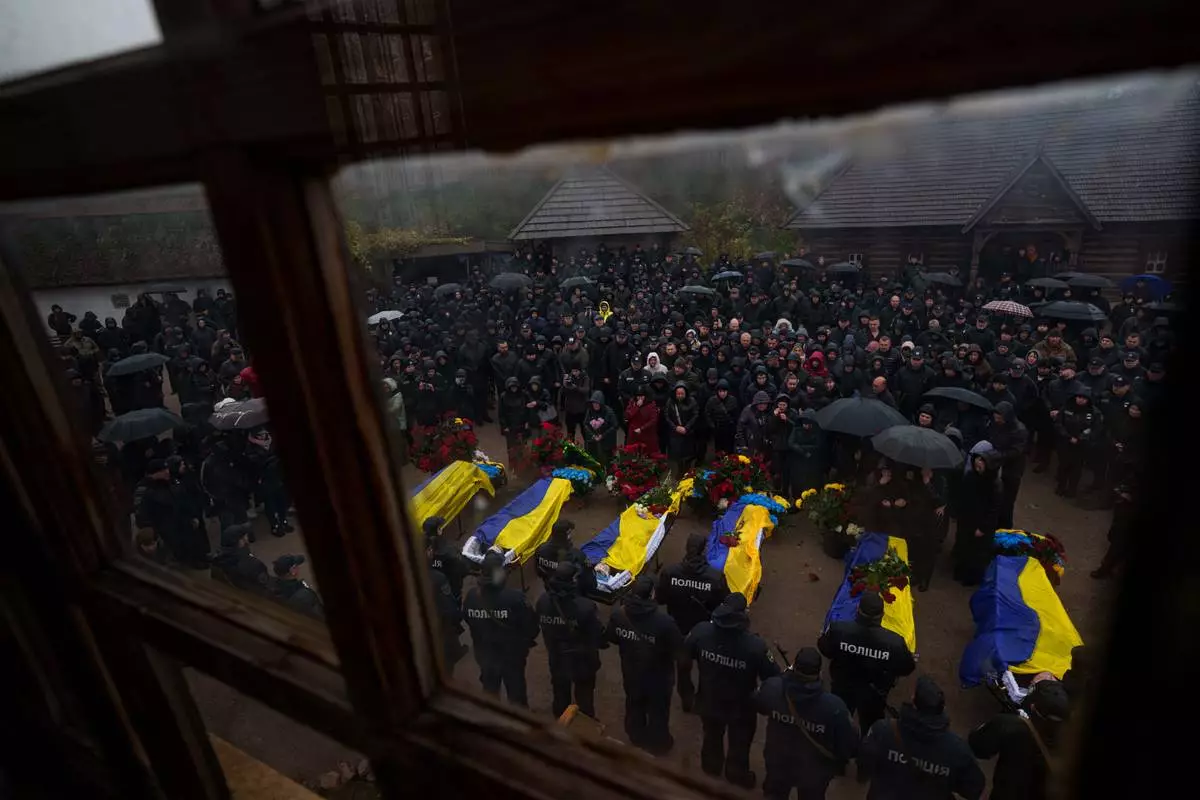
Colleagues, friends and family members pay their last respects to police officers Dmytro Besedin, Mykhailo Buzhenko, Mykola Balanda and Mykhailo Romanov, killed in a Russian airstrike that destroyed an underground school, and Serhii Berezhko and Oleg Dubetskyi, killed in an FPV drone attack in Komyshuvakha, during a farewell ceremony on Khortytsia Island in Zaporizhzhia, Ukraine, Saturday, Nov. 7, 2026. (AP Photo/Evgeniy Maloletka)
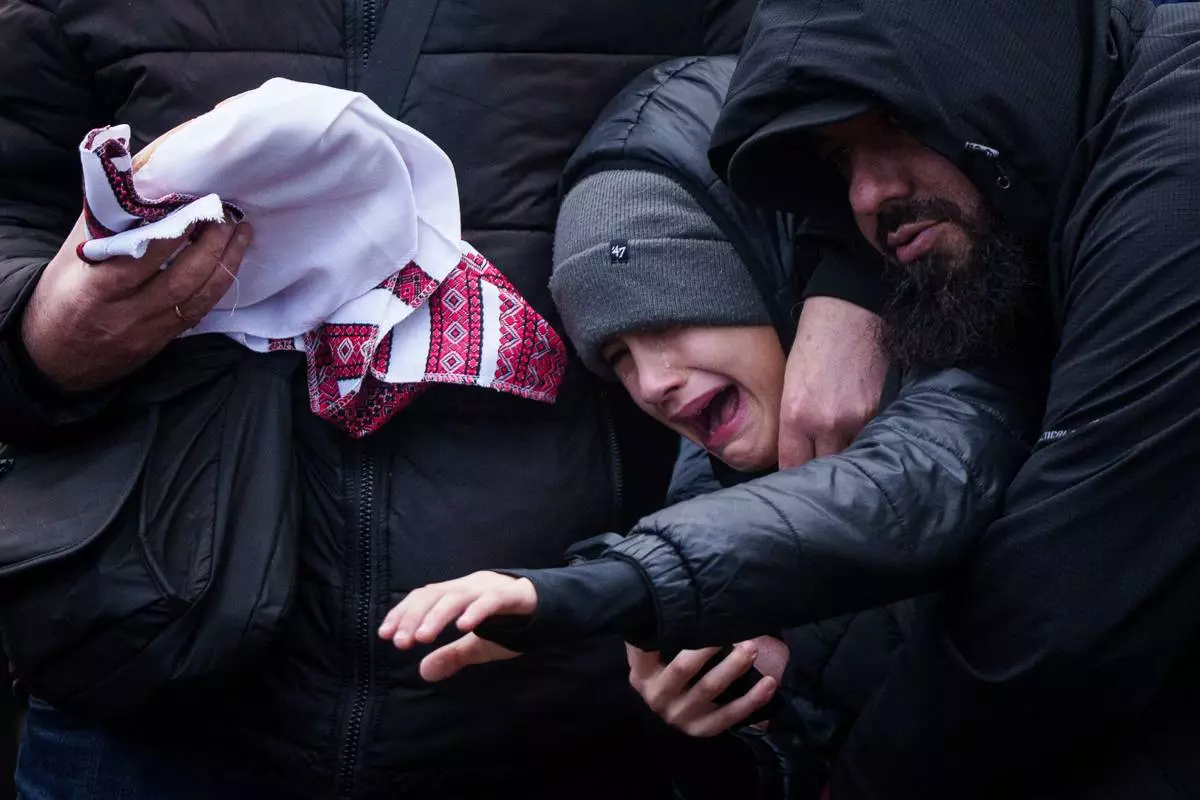
A family member cries beside the coffins of Viktor Fomenko, Natalia Karapetian and Andrii Anikin, killed in a Russian airstrike that destroyed an underground school in Komyshuvakha, during a farewell ceremony in Zaporizhzhia, Ukraine, Saturday, Nov. 7, 2026. (AP Photo/Evgeniy Maloletka)