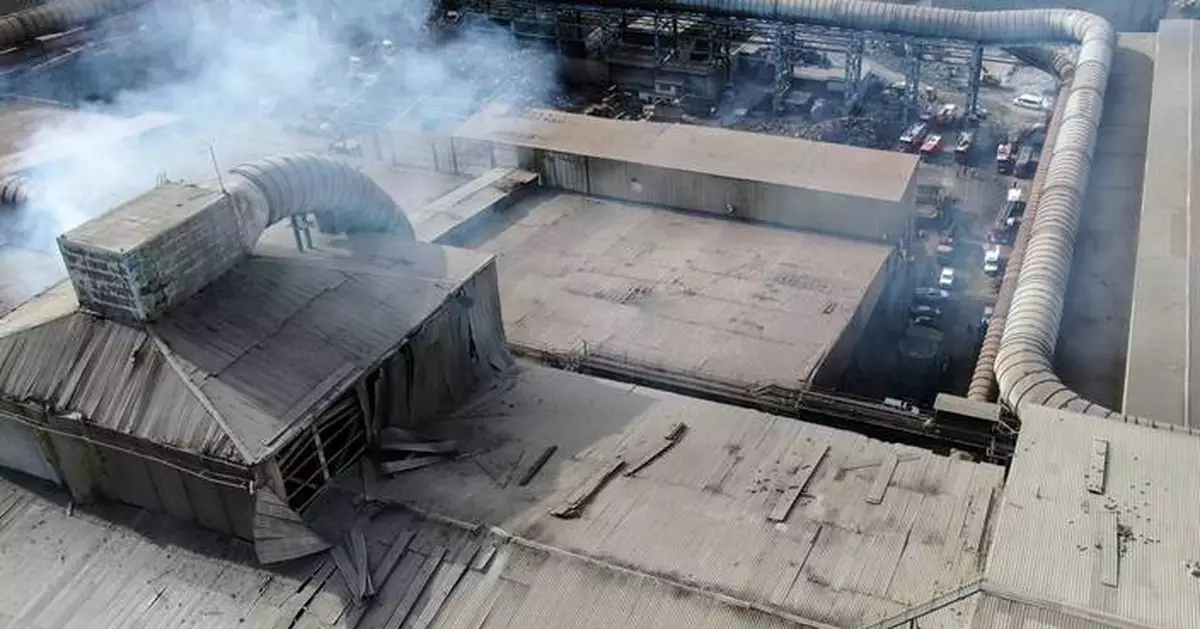
ISTANBUL (AP) — A huge explosion and fire at an iron and steelworks in western Turkey left 10 people dead Monday as rescuers searched for four missing workers, officials said.
The fire at the HABAS plant in Aliaga, Izmir province, also injured 15 people, two of them critically, Provincial Gov. Suleyman Elban said in a televised update of the latest casualties. Search teams were looking for four people still believed to be under the wreckage, he added.
An earlier statement from his office had put the death toll at three, with 14 wounded and 10 missing.
Izmir Mayor Cemil Tugay said that the exact number of casualties would only be known once the debris is cleared.
Broadcaster NTV showed images of a large fire inside the facility and a tall column of smoke rising.
“The ground shook. It was very intense,” witness Nuri Ali Ulker was quoted as saying by the state-run Anadolu news agency.
Another witness, Deniz Ulker, said that the explosion “felt like the earth’s crust was shifting beneath us. I thought it was an earthquake,” according to Anadolu.
Interior Minister Mustafa Ciftci said that emergency teams fought the blaze while searching for casualties.
“Our injured compatriots have been taken to hospitals and their health is being closely monitored,” he posted on social media.
The governor’s office said that the blast happened around noon (0900 GMT) when an overhead crane toppled into a furnace during the casting of liquid steel. It said that an investigation had been launched and Justice Minister Akin Gurlek said four public prosecutors had been assigned to the case.
Aliaga has a large port and is known for shipbreaking, which critics say has caused significant environmental damage and has led to calls to remove its shipbreaking yard from the European Union’s list of ship recycling facilities.
The disaster came as world leaders and environmental activists gathered in Antalya, on Turkey’s Mediterranean coast, for talks on curbing climate change.
The HABAS plant was established in 1987 and can produce 4.5 million tons of steel annually, according to the company’s website.
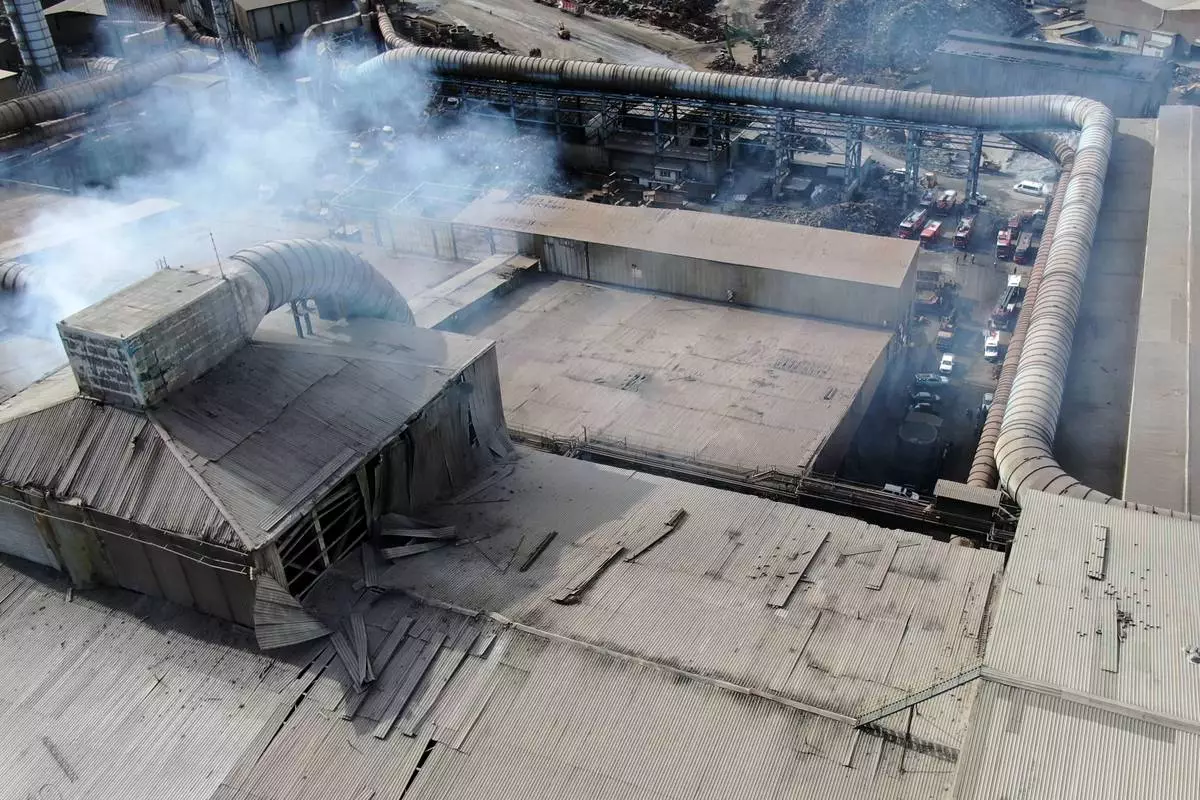
Smoke rises aftermath of an explosion at the Habas iron and steel plant in Izmir, Turkey, Monday, Nov. 9, 2026. (Ali Ihsan Ciftci/IHA via AP)
For the first time since February, Russian, Ukrainian and U.S. negotiators are scheduled to hold talks on ending the full-scale war that is nearing the five-year mark, with security guarantees topping the agenda.
The two-day session starting Tuesday in Abu Dhabi, United Arab Emirates, follows previous negotiations early this year that failed to produce any visible progress toward ending Europe’s most devastating conflict since World War II.
The talks follow last month's localized truce around the Russian-occupied city of Oleshky in southern Ukraine that was brokered with the help of U.S. first lady Melania Trump and allowed the evacuation of some of its residents and the delivery of desperately needed humanitarian supplies.
But even as Moscow and Kyiv touted the weeklong ceasefire as a positive model, fierce fighting has continued along the 1,200-kilometer (750-mile) front line. Both sides also have escalated their long-range attacks on each other with drones and missiles.
Russia has intensified its strikes on Ukraine’s power system, seeking to undermine the country’s resolve as winter sets in. Moscow has relied on ballistic missiles and new, faster jet-powered drones, taking advantage of Ukraine’s shortage of U.S.-made Patriot interceptors.
A look at the talks and what's on the agenda:
Russia and Ukraine remain far apart on key elements of any prospective peace deal.
Russian President Vladimir Putin wants Ukraine to pull its troops back from the four regions that Moscow illegally annexed in September 2022 but never fully captured. He also demands that Ukraine abandon its bid to join NATO, accept strict limits on its military and drop restrictions on the Russian language and the Moscow-affiliated Orthodox Church in Ukraine.
Putin wants a comprehensive peace deal on those conditions and won't agree to a general halt in hostilities, arguing such a pause would only allow Ukrainian troops to rest and replenish their weapons stockpiles.
Ukrainian President Volodymyr Zelenskyy rejects Putin’s demands to voluntarily cede territory Russia has not been able to take on the battlefield and agree to limits on the military and arrangements with Western partners, which it sees as essential security guarantees to stop Moscow from invading again.
Ukraine argues that an immediate ceasefire is the first step toward negotiating a wider settlement and says a direct meeting between Putin and Zelenskyy is the only way territorial issues can be settled.
Russia and Ukraine said the talks will focus on security guarantees.
Zelenskyy noted that Ukraine and its allies have discussed security guarantees similar to NATO’s Article 5, which states the alliance sees an attack on one of its members as an attack against all.
In a Nov. 5 interview, he said Ukraine's security guarantees boil down to what Western allies would do if Russia launches a new invasion of his country. “If Russia starts again, what will happen?” Zelenskyy asked. “Who will do what, with what means, and when?”
Some European nations have mulled a possible deployment of their troops to Ukraine after a prospective peace deal. Russia rejects that as a nonstarter, warning it would view any European troops on Ukrainian soil as legitimate targets.
The Kremlin insists any prospective deal should also offer security guarantees for Russia. Just before Moscow launched the all-out invasion in 2022, it demanded that NATO roll back its deployments in the alliance's member countries in Central and Eastern Europe, seeing their presence as a security threat. Similar demands will likely be part of any comprehensive peace deal proposed by Russia.
U.S. President Donald Trump said in a “60 Minutes” interview broadcast Sunday that Moscow and Kyiv are “very close” to a deal but added that “they’re going to end up with a little bit different shape Ukraine.”
He also declared after meeting Putin's envoy Kirill Dmitriev Nov. 4 at the White House that some kind of grand deal about European security was in the works, although he did not elaborate.
“It’s going to be a big agreement and it’s going to involve more than Ukraine,” Trump said, adding that it might include all of Europe.
Ukraine insists its European allies must have a seat at the negotiating table, while Russia opposes any such involvement at this stage.
“No one is going to invite them to the negotiating table,” Kremlin foreign affairs adviser Yuri Ushakov snapped.
Ukraine's chief negotiator Rustem Umerov said his delegation will meet separately with European envoys in Abu Dhabi.
Kremlin spokesman Dmitry Peskov said the Europeans would need to be involved in broader negotiations but only later.
“Since the discussion will touch upon the future security architecture in Europe while addressing the mutual security of Russia and Ukraine, at some stage it would be impossible to do it without the Europeans,” he said.
On Oct. 27, Finland’s President Alexander Stubb and Norway’s Prime Minister Jonas Gahr Støre spoke by phone with Putin in their first known direct conversation since shortly after the 2022 invasion. They said they spoke in their capacity as the heads of Russia's Nordic neighbors and not on behalf of the European Union, which has struggled to pick a negotiator with Moscow.
Peskov mocked the EU's “protracted indecisiveness,” saying that its members “can’t even decide yet who is authorized to speak on their behalf."
On Nov. 4, Zelenskyy said on X that he spoke to U.S. negotiators Steve Witkoff and Trump's son-in-law Jared Kushner, saying the talks “must move forward at full throttle to bring this war to an end as quickly as possible.”
Kushner said on X that “our objective is to develop practical arrangements that address the security concerns of all sides, reduce the risk of future conflict, and create a more stable and predictable security environment.”
For over 30 years, “Europe and Russia have struggled to establish a sustainable security framework,” Kushner wrote. “Decades of mistrust, competing security concerns, and the devastating consequences of this war make this an extraordinarily difficult challenge, but one that is essential to lasting peace.”
He noted the main goals of the talks were “permanent security consultations, reliable crisis communications, greater military transparency, reciprocal measures to reduce escalation risks, and an enduring framework for long-term European security and stability.”
Kushner also said Monday that he and Witkoff will meet with envoys from Ukraine, the EU, NATO, Germany, France, the United Kingdom and Italy before the talks.
Putin aide Vladimir Medinsky, who led Russia’s delegation in the first direct peace talks with Ukraine in Istanbul in March 2022 and in subsequent sessions, remains Moscow’s chief negotiator.
A former culture minister who wrote books about purported Western plots against Russia over the centuries, Medinsky is known for his hard-line views and blustery statements. At the 2025 talks, also in Istanbul, he reportedly said it took Peter the Great 21 years to defeat Sweden in the 18th century and Moscow was now ready to fight as long as it takes.
The Russian team also includes deputy foreign ministers Sergei Ryabkov and Mikhail Galuzin, military intelligence chief Igor Kostyukov and deputy chief of the General Staff's operational department Yuri Zhigarlovsky.
Ukraine’s delegation is led by Umerov, head of the country’s Foreign Intelligence Service, who attended earlier talks. It also reportedly includes Zelenskyy’s chief of staff Kyrylo Budanov, his deputy Sergiy Kyslytsya, chief of the general staff Andrii Hnatov and Davyd Arakhamia, parliamentary faction leader of Zelenskyy's Servant of the People party.
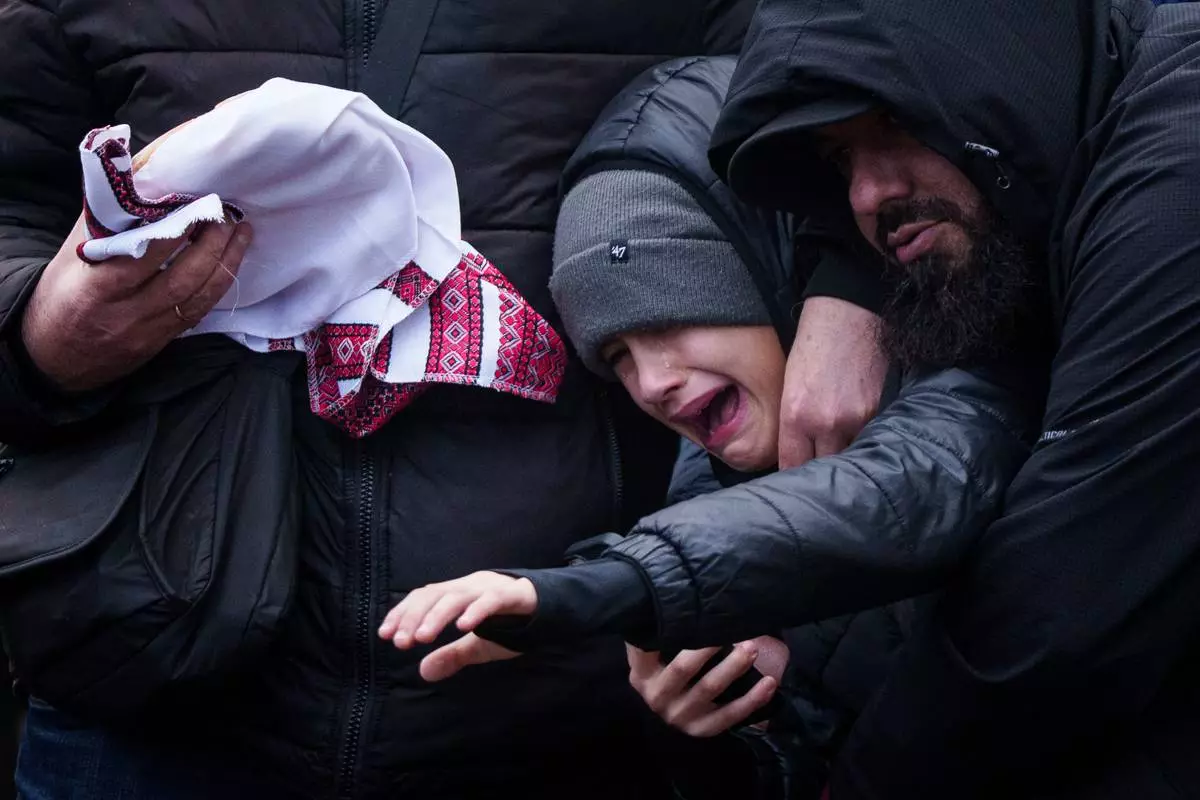
A family member cries beside the coffins of Viktor Fomenko, Natalia Karapetian and Andrii Anikin, killed in a Russian airstrike that destroyed an underground school in Komyshuvakha, during a farewell ceremony in Zaporizhzhia, Ukraine, Saturday, Nov. 7, 2026. (AP Photo/Evgeniy Maloletka)
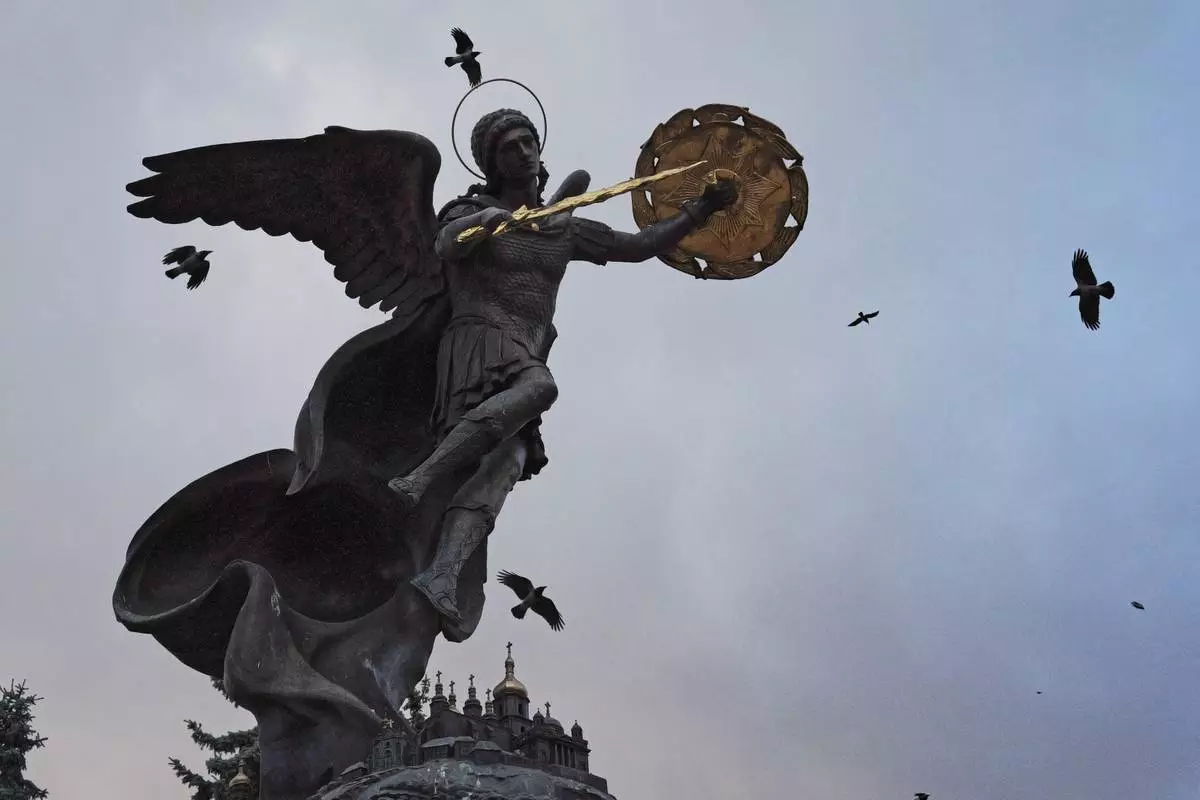
Black crows circle above the statue of Archangel Michael, Kyiv's patron saint, during blackouts caused by Russian air attacks on Ukraine's energy system in central Kyiv, Ukraine, Wednesday, Nov. 4, 2026. (AP Photo/Efrem Lukatsky)
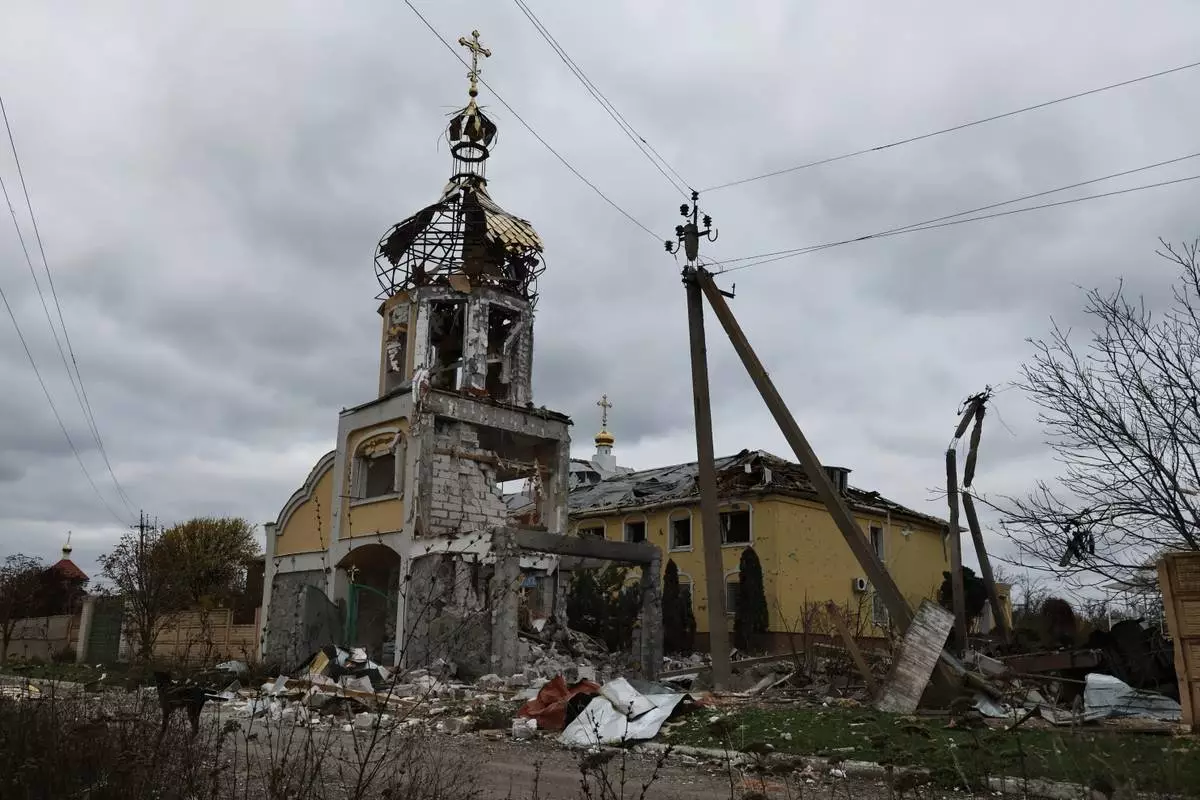
In this photo provided by Ukraine's 65th Mechanized Brigade press service, an Orthodox Christian monastery is damaged following Russian aerial guided bomb strikes that killed at least 43 in Komyshuvakha, Zaporizhzhia region, Ukraine, Thursday, Nov. 5, 2026. (Andriy Andriyenko/Ukraine's 65th Mechanized Brigade via AP)
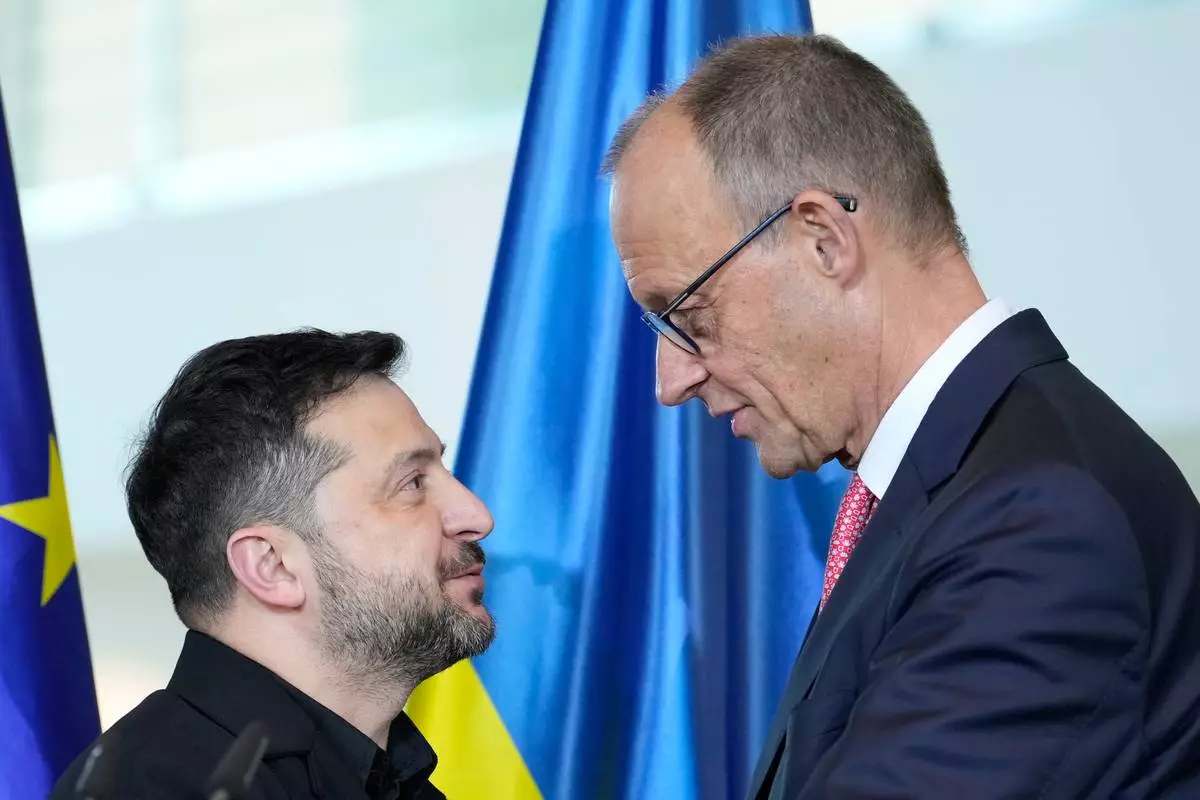
German Chancellor Friedrich Merz, right, and Ukrainian President Volodymyr Zelenskyy attend a press conference in Berlin, Germany, Tuesday, Nov. 3, 2026. (AP Photo/Ebrahim Noroozi)
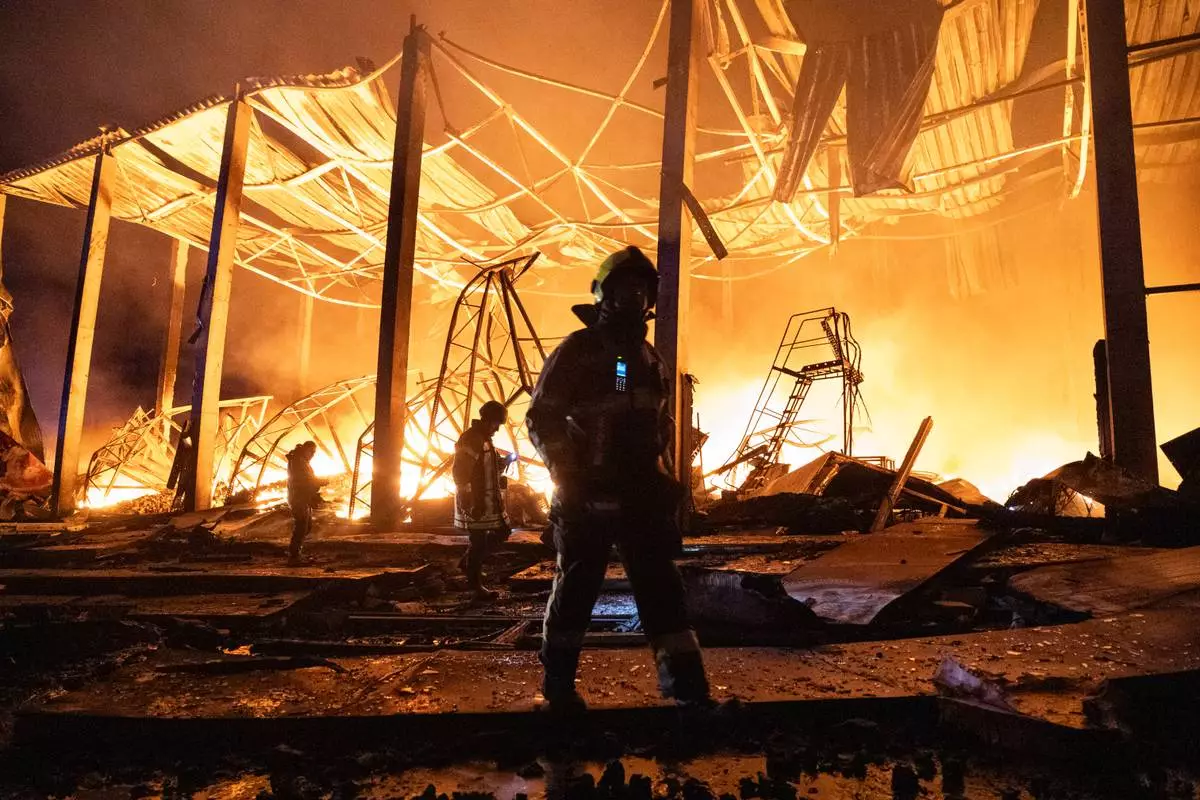
Firefighters walk at the site of a destroyed warehouse after a Russian drone attack in Sofiivska Borshchahivka, on the outskirts of Kyiv, Ukraine, Thursday, Nov. 5, 2026. (AP Photo/Danylo Antoniuk)