NEW YORK--(BUSINESS WIRE)--Nov 9, 2026--
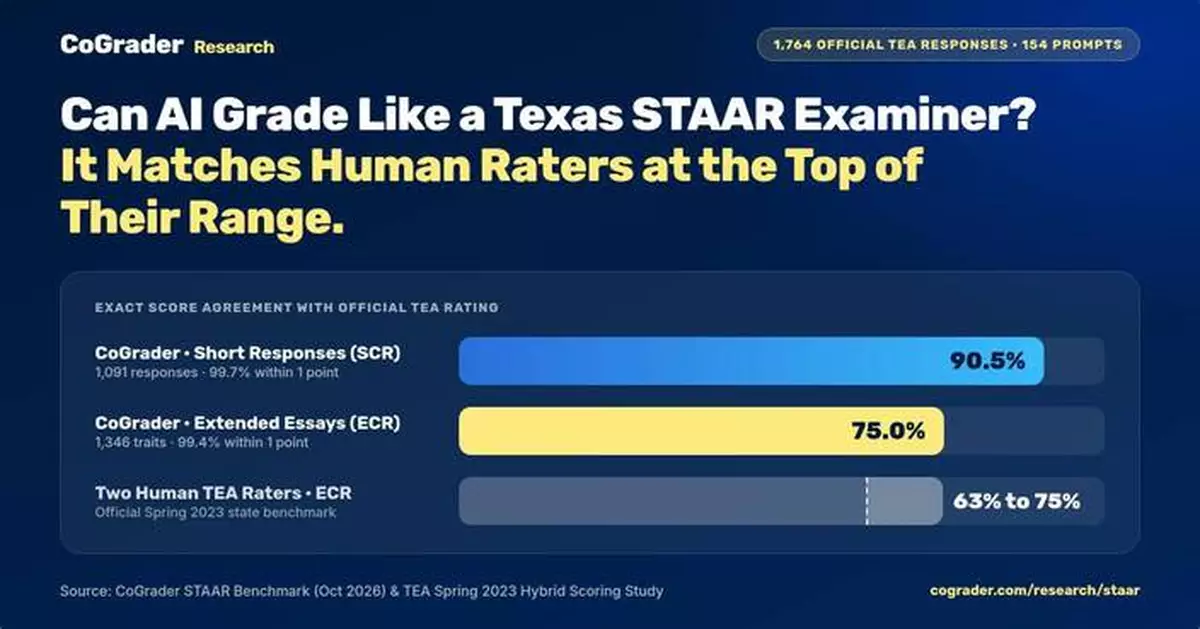
CoGrader, the AI essay grader trusted by more than 100,000 teachers, today released a study that shows its Texas STAAR AI Grader scored essays within one point of the official Texas Education Agency (TEA) score on 98.3% of 1,764 STAAR constructed responses.
This press release features multimedia. View the full release here: https://www.businesswire.com/news/home/20261109150003/en/
“The within-one-point threshold is TEA’s standard for two human raters, and a fair test for an automated scorer is whether it agrees with a trained rater about as often as a second trained rater would,” said Gil Flores, founder and CEO of CoGrader. “This data shows that the Texas STAAR AI Grader earned an A on that test.”
CoGrader’s grading engine was also able to exactly match the TEA-assigned rating on 80.4% of the responses. For reference, the CoGrader study found that two trained TEA raters had exactly matching scores 63% to 75% of the time.
The student responses were drawn from released TEA scoring guides and rater-training materials covering grades 3 to 8, English I, English II, Biology, and U.S. History. The redesigned STAAR includes both Short Constructed Responses (SCRs) and Extended Constructed Responses (ECRs). When scoring SCRs, the Texas STAAR AI Grader was within one point of the TEA rating 99.7% of the time. For ECRs, the grader’s score was within one point of the TEA rating 96.0% of the time.
The Texas STAAR AI Grader uses the publicly released TEA STAAR scoring guides as in-context calibration material. The grader evaluates student practice writing against the state’s published rubrics and returns a score with rubric-aligned feedback in approximately three seconds. The teacher then reviews each score, adjusts the feedback where needed, and decides exactly what each student sees.
Although the spring operational exam is assessed by machines, students’ classroom and benchmark writing throughout the school year is not. This leaves teachers to manually score every practice essay, benchmark, and short answer. Without CoGrader, a teacher might take 5 minutes to grade one essay. For 130 students, that adds up to 10 hours. With CoGrader, teachers can grade an essay in 2 or 3 minutes, saving them as much as 6 hours per assignment.
“These results demonstrate that the CoGrader AI Grader not only saves teachers time, but matches the reliability of the state’s own human rater pool,” concluded Flores.
About CoGrader
CoGrader is the AI essay grader trusted by more than 100,000 teachers and impacting more than 1,000,000 students in US schools. Research on CoGrader was funded by an IES grant from the U.S. Department of Education (Award R305J250071). Built on decades of research on writing feedback and revision, the grader evaluates students’ practice writing against state, AP, or custom rubrics and returns a score, along with consistently objective feedback, in approximately three seconds. Teachers review each score, personalize the feedback, and decide exactly what each student sees. Learn more at CoGrader.com.
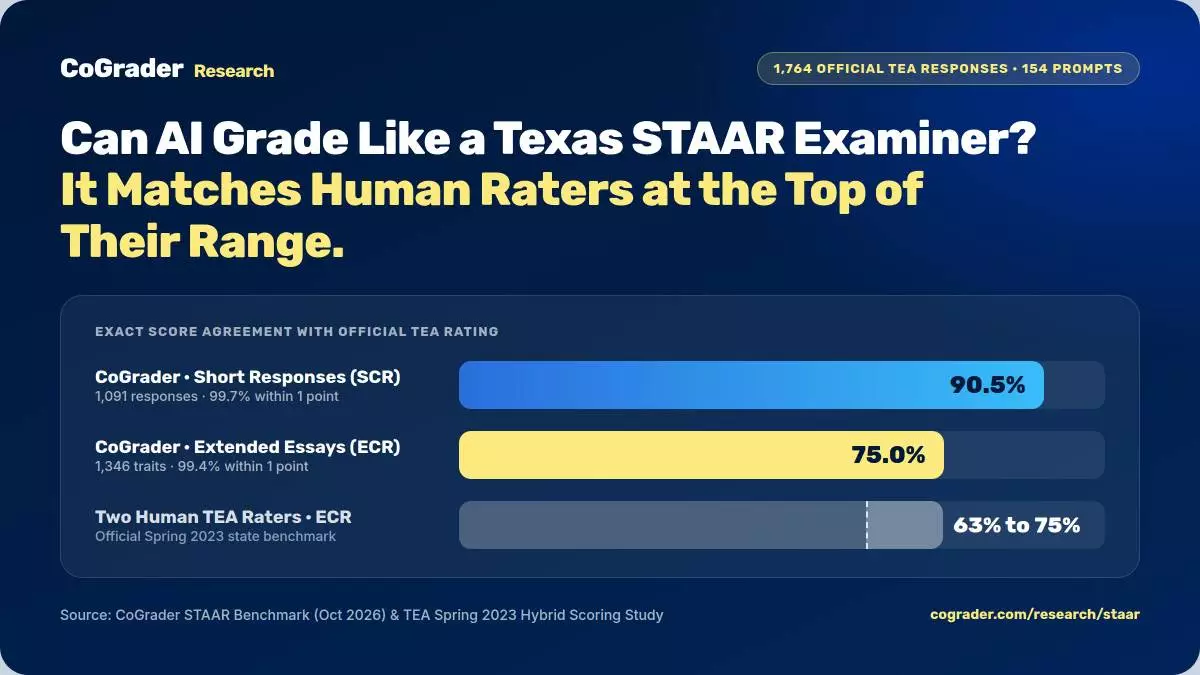
Data from a new study shows that CoGrader’s Texas STAAR AI Grader exactly matches a human grader’s score as much as 90.5% of the time.
KYIV, Ukraine (AP) — Russia battered Ukraine’s power grid again and Ukrainian forces hit another of Russia’s biggest oil refineries, officials said Monday, hours before delegations from Moscow and Kyiv were due to meet for new U.S.-brokered talks on how to end the fighting.
Nearly five years after Russia invaded its neighbor, the two countries remain locked in battle with no sign that either side is ready to budge from their demands. The war has already killed hundreds of thousands of soldiers and thousands of civilians, analysts and humanitarian organizations say.
The three-way talks between envoys from the U.S., Russia and Ukraine are due to start in Abu Dhabi, United Arab Emirates, on Tuesday and last for two days. The previous round of talks was in February.
U.S. President Donald Trump said in a “60 Minutes” interview that aired Sunday that Moscow and Kyiv are “very close” to a deal, despite the “tremendous hatred” between Russian President Vladimir Putin and Ukrainian President Volodymyr Zelenskyy.
He said that Ukraine would have “a little bit different shape” under the settlement, but he didn’t elaborate.
Trump has previously made statements about developments in the war which haven't materialized.
Trump's son-in-law, Jared Kushner, who will mediate in the talks with U.S. envoy Steve Witkoff, said that the priorities will be ending the conflict, finding ways to stop the war reigniting, reviving Ukraine’s postwar economy and preparing humanitarian aid.
“We hope these discussions will identify areas of common ground, advance practical solutions, and build momentum toward the next phase of negotiations,” Kushner said on X Monday.
Russian Foreign Minister Sergey Lavrov said Monday that Trump’s team has placed “collective security,” covering not just Russia and Ukraine but also a wider area, at the top of the agenda.
The last three-way talks, in Geneva nine months ago, also took place amid continuing attacks. They delivered no significant progress in ending the war, but some circumstances have changed.
Trump, whose stance on the war has varied, has to reckon with Democrats taking over the U.S. Congress in January following the U.S. midterm elections. They could demand more support for Ukraine.
Russian state finances are under heavy strain because of the war, and Ukraine’s economy is being choked by the relentless attacks.
In Abu Dhabi, the talks will look at what security guarantees would satisfy Russia, which sees NATO as a threat, and Ukraine, which wants to prevent future Russian invasions.
Putin has sought to sideline European countries and negotiate Ukraine’s future directly with Trump. However, European leaders and Ukraine have insisted that they be included.
Moscow says that European representatives won’t be directly involved in the Abu Dhabi discussions, but European officials said that representatives will be in the United Arab Emirates.
Ukraine’s lead negotiator, Rustem Umerov, said that European officials will hold “separate coordination” with the delegation from Kyiv.
Kushner said that before the talks in Abu Dhabi begin, he and Witkoff will consult with officials from Ukraine, the European Union, NATO, Germany, France, the United Kingdom and Italy.
Kremlin spokesperson Dmitry Peskov said Monday that the meeting would focus on trilateral negotiations, with the United States mediating between Russia and Ukraine.
“You are aware that the Americans have their own channels of communication with the Europeans, as do the Ukrainians, and it appears they are already establishing their own methods of coordination,” Peskov said. “But, to reiterate, this is a matter of trilateral negotiations.”
Russian forces targeted four electrical substations in Ukraine’s Kyiv, Dnipropetrovsk, Cherkasy and Vinnytsia regions, Russia’s Defense Ministry said Monday. The attacks are part of Russia’s campaign to deny Ukrainian civilians heating, light and running water during the approaching winter.
Zelenskyy said Monday that the European Union had agreed to activate a special emergency mechanism that speeds up funding for power grid repairs.
Russia launched 317 drones of various types including 105 jet-powered drones at Ukraine overnight, Ukraine’s air force said.
Russian aerial attacks have pummeled Ukraine throughout the war, with gruesome consequences. A Russian glide bomb attack last week near the front line in the southern Zaporizhzhia region killed at least 55 people at an aid distribution center.
On Monday, Russian forces hit a warehouse in Odesa in southwestern Ukraine containing food supplies for kindergartens and schools, killing three people, local officials said.
Meanwhile, an attack by long-range drones developed by Ukraine during the war started a fire at the KINEF oil refinery, one of Russia’s largest, close to St. Petersburg and more than 1,200 kilometers (745 miles) from the Ukrainian border, Leningrad Gov. Alexander Drozdenko said Monday.
Ukraine said in early October that its long-range strikes had neutralized more than half of Russia’s oil refining capacity, hampering Moscow’s ability to supply its forces.
Ukrainian forces also struck a plant near St. Petersburg, Russia’s second-largest city, that produces solid rocket propellant for Russia’s Iskander-M ballistic missiles, Ukraine’s General Staff said.
Ukraine is trying to prevent Russia from firing ballistic missiles, which Kyiv’s forces can’t stop once they are in the air without more U.S.-made Patriot air defense systems. Patriot missiles, however, are in short supply.
Katie Marie Davies contributed to this report from Manchester, England.
Follow the AP’s coverage of the war in Ukraine at https://apnews.com/hub/russia-ukraine

Police officers carry a man with a disability to a vehicle during an evacuation of civilians from Komyshuvakha, in the Ukraine's Zaporizhzhia region, Friday, Nov. 6, 2026. (AP Photo/Evgeniy Maloletka)

A family member cries beside the coffins of Viktor Fomenko, Natalia Karapetian and Andrii Anikin, killed in a Russian airstrike that destroyed an underground school in Komyshuvakha, during a farewell ceremony in Zaporizhzhia, Ukraine, Saturday, Nov. 7, 2026. (AP Photo/Evgeniy Maloletka)