LOS ANGELES (AP) — “Grand Theft Auto” has never been much for following the rules.
Nearly three decades after a video game built around stealing cars, outrunning police and embracing criminal mayhem first arrived, the franchise has survived controversy, transformed open-world gaming and become one of the biggest sellers in entertainment.
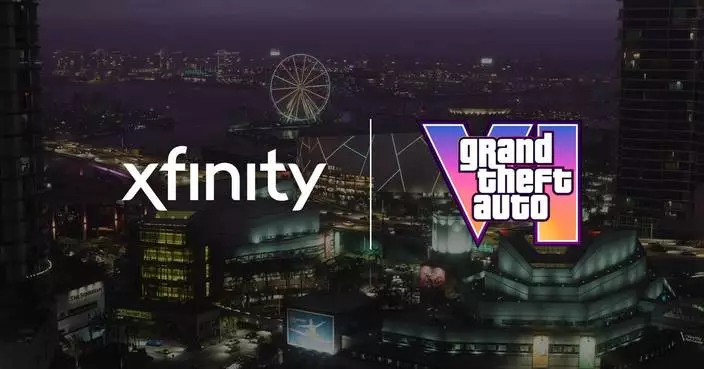
Now, after a 13-year wait since its last main installment, “Grand Theft Auto VI” is preparing for another big score. The latest chapter arrives Nov. 19 with a return to the neon-soaked streets of Vice City with two protagonists.
For longtime fans, “GTA VI” is a highly anticipated return. For everyone else, here’s what to know about the blockbuster video game, its characters and the enormous business riding on its release.
The franchise began in 1997 as a relatively simple, top-down game that allowed players to roam fictional cities, steal vehicles, evade police and commit crimes.
The release of “Grand Theft Auto III” in 2001 helped redefine open-world gaming. It gave players greater freedom to explore a sprawling three-dimensional city, pursue missions and interact with their surroundings.
Later installments expanded that freedom with larger environments, cinematic storytelling, social satire and detailed worlds. The influence reached far beyond games about stealing cars.
Ubisoft’s Assassin’s Creed series brought open-world exploration to historical settings, while Bethesda’s The Elder Scrolls games expanded their own longstanding tradition of open-ended fantasy role-playing. Nintendo’s “The Legend of Zelda: Breath of the Wild” later emphasized experimentation and discovery, allowing players to use the environment itself to solve problems.
For “Grand Theft Auto: San Andreas” and “Grand Theft Auto V,” Rockstar Games recruited real-life gang members to help bring authenticity to background characters and dialogue. Former writer and audio director Lazlow Jones has said some performers challenged scripted lines, prompting developers to let them use language drawn from their own experiences.
That attention to detail helped create the sense of a living world that became a hallmark of the franchise, even as the series drew criticism for its depictions of violence, crime and women.
But controversy did not stop the franchise’s commercial rise.
According to publisher Take-Two Interactive, the franchise has sold more than 470 million units worldwide. “Grand Theft Auto V,” released in 2013, accounts for more than 230 million of those units and reached $1 billion in retail sales in just three days.
Its online multiplayer component, “Grand Theft Auto Online,” has helped keep players engaged through years of updates, new activities and in-game purchases.
This time, the action returns to Vice City, Rockstar’s fictional version of Miami, and expands across the surrounding state of Leonida, a Florida-inspired setting filled with beaches, highways, nightlife and criminal enterprises.
At the center are Lucia Caminos and Jason Duval, a couple trying to improve their circumstances through a life of crime. Lucia has recently been released from prison while Jason, a former soldier who became involved with drug runners in the Leonida Keys, is looking for a different path.
Their plans become more complicated when a seemingly straightforward criminal job goes wrong, drawing them into a conspiracy that stretches across Leonida.
The trailers suggest a story mixing romance, robberies, betrayals and the series’ familiar satirical take on American culture.
Rockstar has revealed several supporting characters, including bank robber Raul Bautista, aspiring music executive Dre’Quan Priest and nightclub owner Boobie Ike.
Rockstar has kept much of the voice cast under wraps, including the performers behind Lucia and Jason.
One familiar actor has confirmed his involvement: Stephen Root, known for his work in “Office Space,” “King of the Hill” and “Barry." He told The Associated Press in September that he appears in the game, adding that fans had already recognized his distinctive voice in promotional footage.
Root has been identified in reports as the voice of Brian Heder, an aging drug runner operating out of the Leonida Keys. Rockstar has introduced the character but has not publicly confirmed Root’s casting in that specific role.
Beyond the return to Vice City, one of the biggest changes is the focus on two protagonists whose relationship drives the story.
“Grand Theft Auto V” featured three playable main characters. The new installment centers on Lucia and Jason as partners navigating the criminal underworld together.
Rockstar has promoted a larger, more detailed setting that stretches beyond the city into the wider state of Leonida. The game also arrives in a vastly different technological landscape from its predecessor, with newer consoles capable of supporting more elaborate environments and character interactions.
But not every detail is known. Rockstar has offered trailers and promotional previews, while questions remain about the full range of activities, how the game’s systems will work and the future of its online multiplayer experience.
Music has long been part of Grand Theft Auto’s identity. It has included everything from fictional radio stations to the songs accompanying players as they cruise through the game’s cities.
“Grand Theft Auto VI” is expanding that tradition with an original score by Justice, the Grammy-winning French electronic duo of Gaspard Augé and Xavier de Rosnay.
Rockstar says the score adapts to players’ actions and experiences throughout the game, shifting with the environments and situations they encounter.
A 30-track score album is scheduled for Dec. 11, featuring collaborations with artists including Tame Impala, SZA, King Gizzard & The Lizard Wizard and Gesaffelstein.
The game also features in-game radio stations and a separate collection of original songs, continuing the franchise’s connection to popular music.
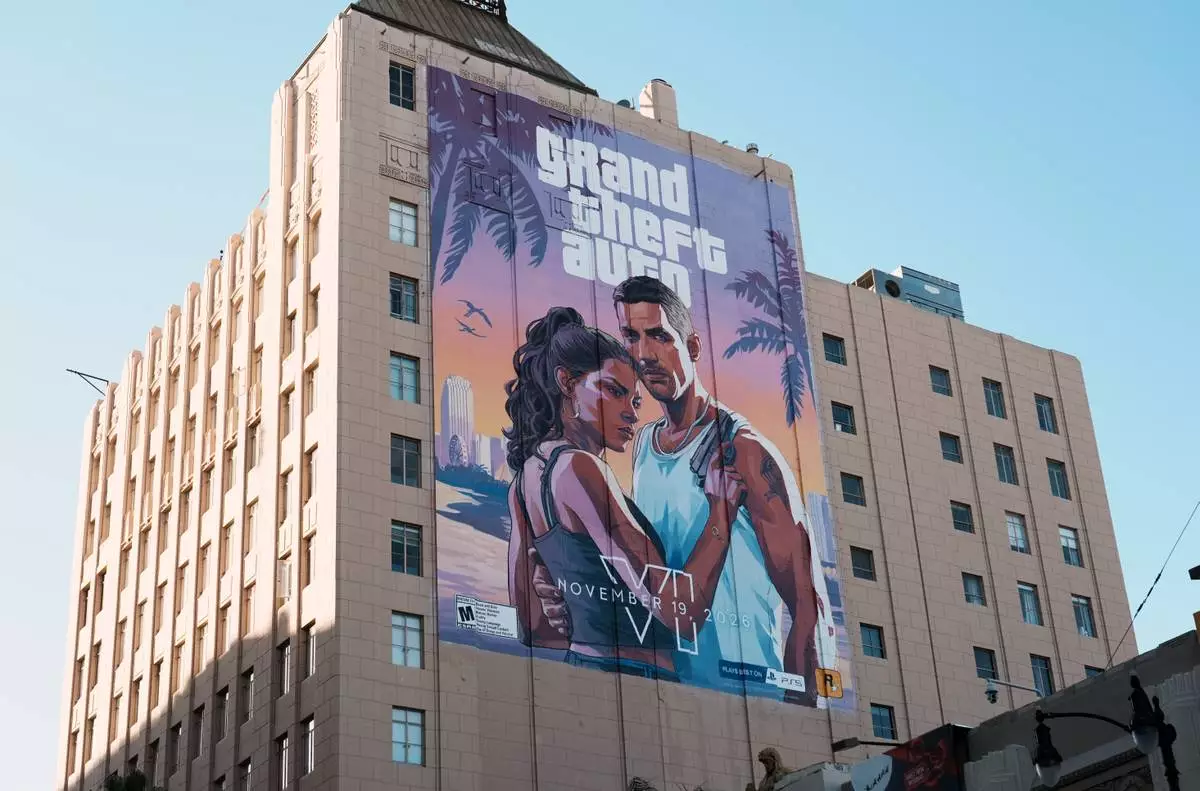
A billboard for the video game "Grand Theft Auto VI" is pictured above Hollywood Blvd. on Wednesday, Nov. 4, 2026, in Los Angeles. (AP Photo/Chris Pizzello)

A billboard for the video game "Grand Theft Auto VI" is pictured above Hollywood Blvd. on Wednesday, Nov. 4, 2026, in Los Angeles. (AP Photo/Chris Pizzello)
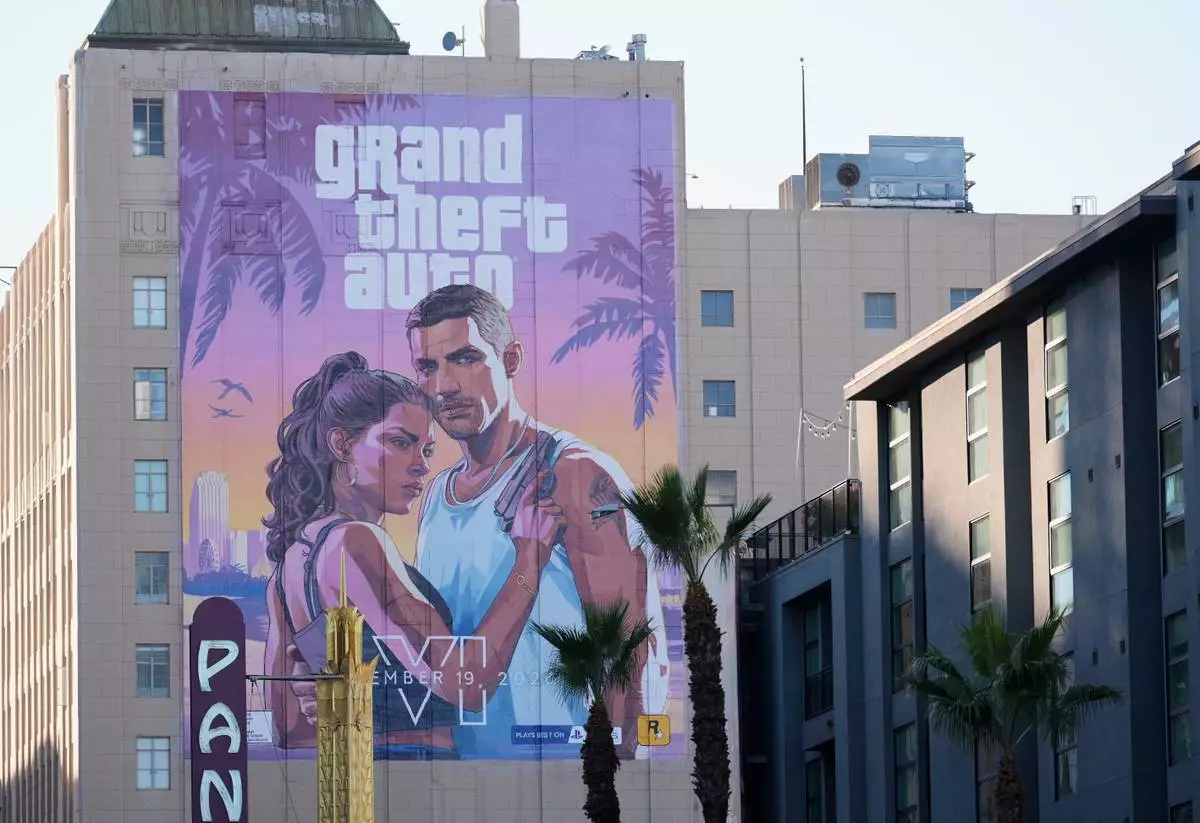
A billboard for the video game "Grand Theft Auto VI" is pictured above Hollywood Blvd. on Wednesday, Nov. 4, 2026, in Los Angeles. (AP Photo/Chris Pizzello)
College football will expand its playoff to 24 teams beginning next year, a move that lends an NFL flavor to its postseason while resetting decades of tradition surrounding a once all-important regular season and dumping conference championship showdowns that used to be among the sport's marquee events.
The announcement from the College Football Playoff and ESPN on Monday made official a deal that's been in the works for months. The network reported it would pay an additional $1.7 billion over five years on top of the original $7.8 billion contract that runs through the 2031 season.
The new format will grant the Power Four conference champions automatic spots and give one more to the best team from the Group of Six. But that slot and the other 19 will be decided by a selection committee that will serve as the latest edition in college football's long history of polls and opinions having lasting impacts on teams' fates.
The move marks a seismic shift in college football that even ESPN conceded comes with some question marks. The network pays billions to televise regular-season games that might — or might not — have more meaning.
“In all honesty, it's impossible to know for sure,” ESPN senior vice president Nick Dawson said in a conference call.
The revenue generated from the playoff expansion will presumably make up for the estimated $345 million the Power Four conferences generated in TV money for their title games. ESPN would then not be on the hook for $140 million of the extra money due to cancellation of the title games, the network reported.
The top eight seeds will receive first-round byes in the new format and the playoff will start on the second weekend in December, with the first two rounds of games on campus. The traditional Army-Navy game will be played on the first weekend in December, which used to be reserved for conference title games.
Both the Southeastern and Big Ten conferences, whose approval was needed to adopt this change, and their Power Four brethren — the Big 12 and Atlantic Coast Conference — are banking that most of the additional spots will go to their members so their second-tier teams will have new motivation to keep spending big in an era of NIL payments and $50 million football rosters.
“I think it will be healthy for teams like our current situation, building to try to get to that point,” said coach Barry Odom, who is trying to rebuild at Purdue.
The first final for the 24-team playoff remains set for Jan. 24, 2028, in New Orleans. Traditional bowl games will still host the quarterfinal and semifinal rounds.
As for the rest of the bowls, most of them operated or televised by ESPN: “No decisions have been made at this time,” Dawson said.
As part of the expansion, the CFP is requiring Power Four teams to play at least 10 regular-season games against conference foes, other Power Four opponents and Notre Dame. Group of Six teams will have to play 10 games against conference opponents.
In theory, these requirements will keep everyone in the same ballpark when it comes to strength of schedule, which figures to play a huge role in the selection committee's considerations.
Notre Dame didn't receive any guarantees, the way it did this year when, if it’s ranked in the top 12 by the CFP for what will be the last year of the 12-team postseason, it will get a spot.
Coach Marcus Freeman said he looks at the change as a net positive, in part because a team like his can now presumably afford more than one loss, and in part because of the new scheduling requirements. Notre Dame is one of only two independents left in major college football.
“I don’t want this to be like March Madness and have 60-something teams making the playoff,” he said. “But the more opportunities we have to make the playoff, it helps us.”
The new schedule also guarantees two off weeks during a regular season that will begin the week before Labor Day.
The move to 24 teams marks the second expansion of the playoff since it began in 2014 as a four-team affair. Right after it moved to 12 in 2024, most thought it would eventually max out at 16, which was the SEC’s preference.
But the Big Ten wanted to go bigger, while the SEC balked at that, concerned about the league title game — a property it invented in 1992 and made billions from over the decades — along with the marketability of CFP games featuring third- and fourth-place finishers in power conferences.
ESPN took care of the money problem. Now, the question is whether fans will embrace an NFL-style free-for-all that could include about one-third of the Power Four’s 68 teams, depending on what happens with Group of Six schools whose role in these big-money power grabs seems to diminish with every move.
It's the latest change for a sport that, for decades, built its distinct character and generated controversy by leaning on media and coaching polls to hand out national titles.
Like then, critics see a risk in giving more power to a selection committee that hasn’t really mastered four- or 12-team brackets. The exclusion of Florida State in 2023 and Notre Dame last season stand out as the best examples, and the first rankings this season left people scratching their heads again.
Skeptics also view the expanded playoff as another dilution of what is largely seen as one of the most important regular seasons in sports, replacing potential matchups between, say, Alabama and Georgia in an SEC title game with a 13 seed vs. 20 seed game that would pit, say, Kentucky and South Carolina.
Fan reaction “certainly weighed into the decision,” Dawson said.
“Ultimately, we just need to make a spectacular playoff,” he said. “The CFP has a responsibility to our fans, they're the lifeblood of college football. We owe them to make this great. That really is our intent.”
As Big Ten commissioner Tony Petitti argued from the beginning, a postseason that gives bubble teams hope and keeps others vying for home-field advantage or byes will bring more eyes — not fewer — to the end of a regular season that sometimes boils down to only three or four traditional rivalry games with meaning.
Of course, nobody can be certain how things will play out. The only sure thing is that college football will never look quite the same.
“If they think it’s a good thing for college football, then I’ve got to believe that this is the route we’re headed," Wisconsin coach Luke Fickell said, “and we’re going to make it a great thing for college football.”
This story has been corrected to show the Purdue coach's name is Barry Odom.
AP Sports Writers Mike Marot, Steve Megargee, Will Graves, Aaron Beard, Brett Martel and Jim Vertuno contributed.
Sign up for Top 25 poll alerts here, visit the Top 25 here and see AP’s full college football coverage here
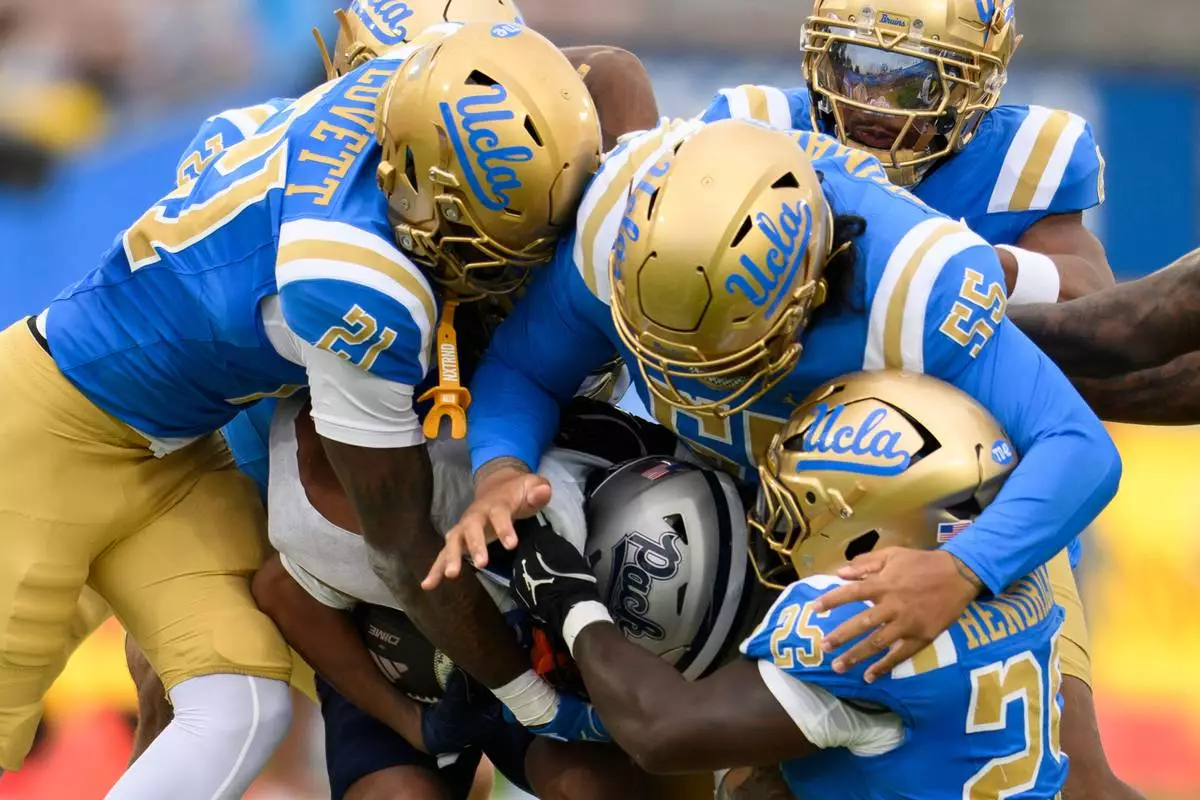
UCLA defenders tackle Nevada wide receiver Perrion Williams, center bottom, during the second half of an NCAA college football game Saturday, Oct. 31, 2026, in Pasadena, Calif. (AP Photo/Kyusung Gong)
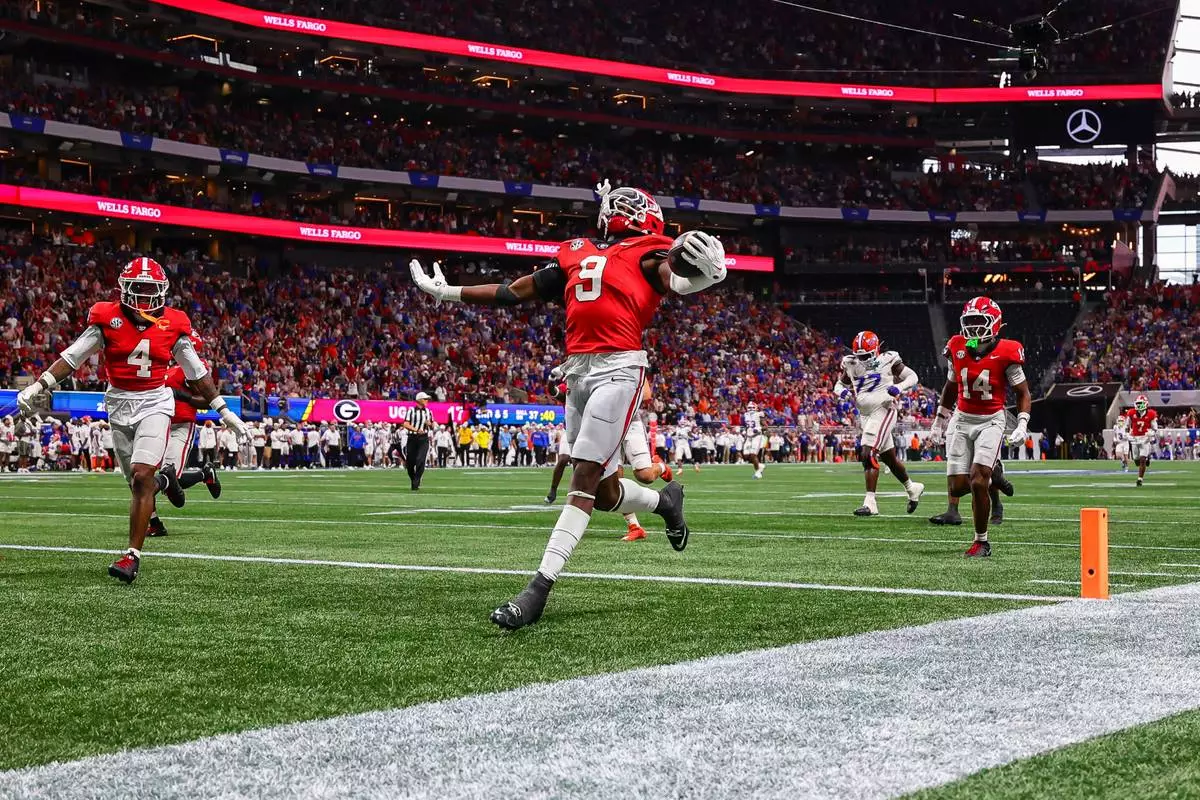
Georgia linebacker Chris Cole (9) scores a touchdown during the first half of an NCAA college football game against Florida, Saturday, Oct. 31, 2026, in Atlanta. (AP Photo/Colin Hubbard)
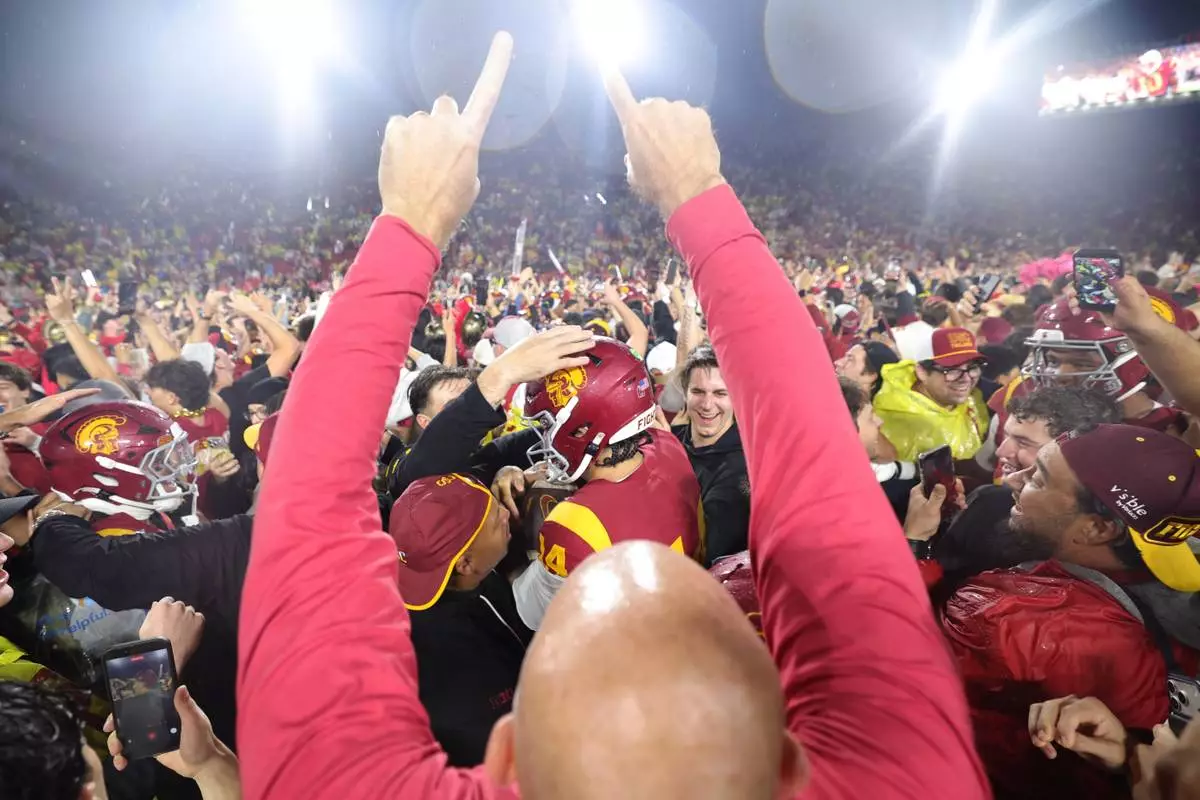
Fans storm the field after an NCAA college football game between Southern California and Ohio State, Saturday, Oct. 31, 2026, in Los Angeles. (AP Photo/Ryan Sun)